


The Zhitong Finance App learned that Yushu Technology (688836.SH) will land on the Science and Technology Innovation Board on August 19, and the humanoid robot industry will welcome an iconic capital market sample.
According to public offering materials, Yushu Technology's issuance price was 150.8 yuan/share, corresponding to a total market value of about 61 billion yuan after issuance, and the initial capital raised was about 6.1 billion yuan. In 2025, the company's humanoid robot revenue share has risen to 51.78%, and the annual delivery volume exceeds 5,500 units. The accelerated convergence of capital, technology and production capacity means that humanoid robots are gradually moving from prototype display and scenario verification to mass delivery and commercial competition.
The impact of Yuuki's listing is not limited to the whole machine itself. Equity investment, robot brains, control systems, actuators, speed reducers, sensors, and scene applications may all attract new industry attention and valuation references.
Let's take a look at these 18 beneficiary stocks first!
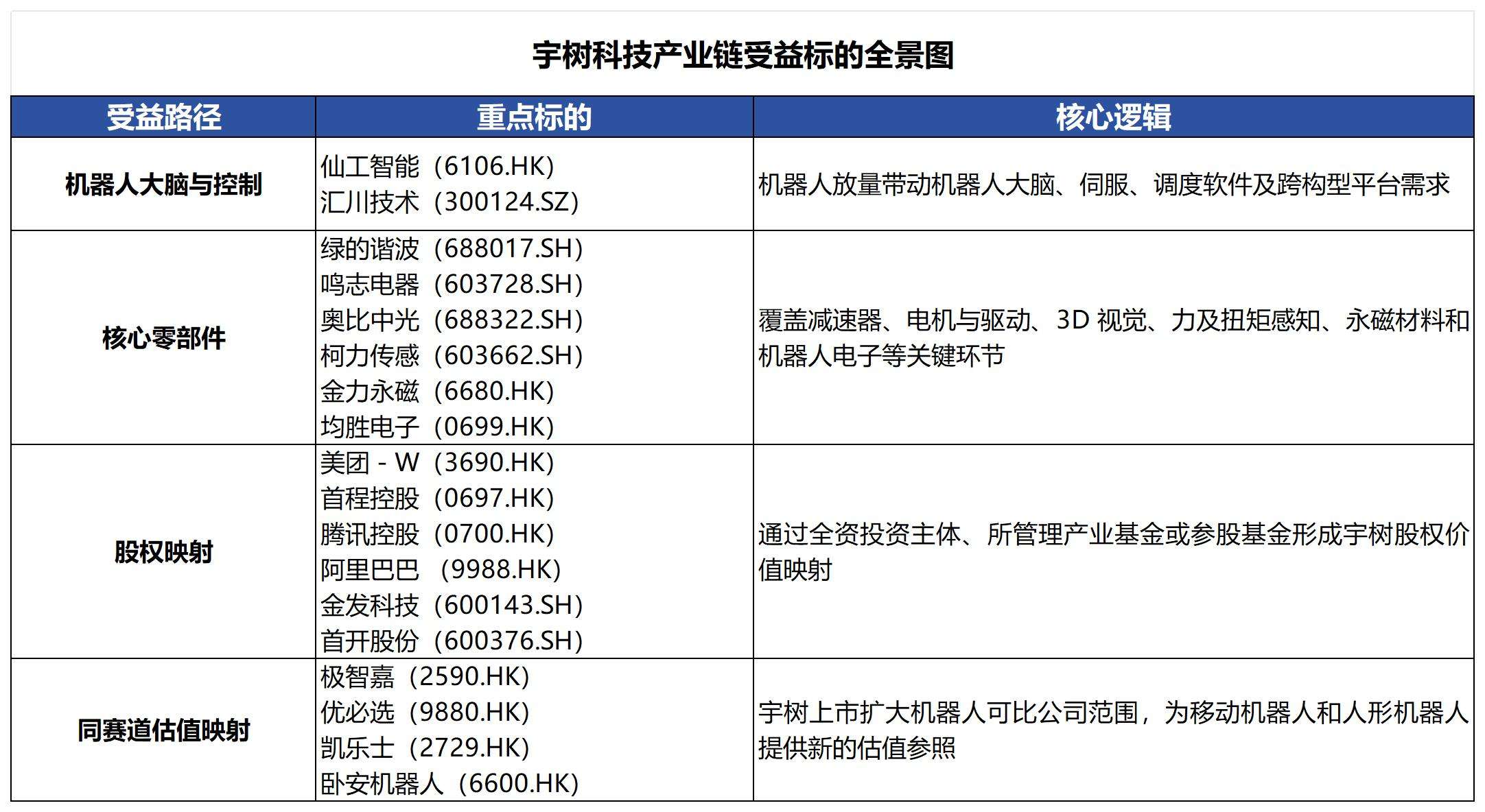
(Note: The above list also includes equity mapping and industry trend benefits. (Other than relationships clearly disclosed in listed company announcements, this does not mean that related companies have already entered Yushu's supply chain)
Equity mapping: The logic is most straightforward, but the equity ratio may be limited
Judging from the shareholder structure disclosed in Yushu Technology's prospectus, Meituan is one of the targets with the clearest equity mapping in the Hong Kong stock market. Hanhai Information, a wholly-owned subsidiary of Meituan, directly holds 7.6114% of Yushu's shares; Hanhai Information forms a concerted action relationship with Galaxy Z and Chengdu Dragon Ball. The three hold a total of 9.6488% of shares, making it the largest group of shareholders of Yushu's external institutions. However, the total shareholding of the same actors does not mean that all economic interests directly belong to Meituan's listed companies, and the final income still needs to be judged based on the investment structure of the relevant funds.
Shoucheng Holdings, on the other hand, forms an investment map through the Beijing Robotics Industry Development Investment Fund it manages. According to Yushu's prospectus, the fund holds 3.8262% of the shares; the Hong Kong Stock Exchange announcement of Shoucheng Holdings confirmed that the fund is managed by its wholly-owned subsidiary and has made additional investments in Yushu. Therefore, its logic is more reflected in fund management and the ecological layout of the robotics industry, which cannot simply be equated with Shoucheng Holdings directly holding 3.8262% of Yushu's shares.
Tencent Technology (Shanghai) holds 0.5986% of Yushu's shares; the actual controller is Tencent Holdings; Hangzhou Haoyue holds 0.4490% of the shares, and the actual controller is Alibaba Group. Both are small financial investments. Currently, public documents have not confirmed that Meituan and Yushu have deep collaboration on delivery robots, nor has it been confirmed that Tencent and Ali cooperate with Yushu in AI algorithms or warehousing and logistics scenarios, so the relevant benefit logic should still be based on equity value mapping.
In addition, Jinjin Technology forms an indirect interest in Yushu Technology through participation in industrial funds; the wholly-owned investment platform for the first shares forms a more indirect capital relationship as a limited partner of the relevant fund.
YuShu's listing may increase the valuation and exit expectations of assets held by relevant investors or funds, but there is a difference between the penetration level and final economic equity of such investments. The actual impact on the profits of listed companies still depends on investment ratios, accounting processing, lockdown period, and subsequent exit arrangements, and cannot simply be equated with the main business receiving orders from Yushu.
As for Astrend IV holding 4.4245% of Yushu's shares, although public information shows that it is related to Lei Jun's Shunwei Capital, Shunwei Capital is not a wholly-owned or holding subsidiary of the Xiaomi Group, so the Xiaomi Group will not be included as a direct equity beneficiary for the time being.
Component expansion: the faster mass production, the more important is cost reduction and supply chain capacity
From “being able to move” to “stable operation,” humanoid robots need to solve a series of problems such as joint life, movement accuracy, force control safety, environmental perception, and overall machine cost.
Among them, the harmonic reducer with a green harmonic layout is an important component of the rotating joint; Narushi electric appliances cover frameless torque motors, hollow cup motors, drives, and encoders; Obi Zhongguang has 3D vision products and spatial sensing solutions covering multiple technical routes; and the force and torque sensing links in which Ke Li Sensor is located are related to robot joint force control and safe interaction.
Huichuan technology also covers servo systems, motors, controllers and joint modules. It not only has the industrial automation business foundation, but also has the product capability to meet the needs of robot control layers.
Jinli Permanent Magnet has achieved business growth in the field of robots and industrial servo motors. According to the company's investor relations records for July 2026, revenue in this field is expected to increase by about 90% year-on-year in the first half of the year, and motor rotors for embedded robots have already been delivered in small quantities. High-performance NdFeB permanent magnet materials are important materials for robot joint motors, so the company is expected to benefit from increased robot shipments.
Joyson Electronics, on the other hand, is extending the control, sensing, and large-scale manufacturing capabilities accumulated in the field of automotive electronics to the robotics industry. According to the company's public information, it has cooperated with leading customers such as Zhiyuan Robotics and Galaxy GM to achieve batch supply of customized main control boards, and to lay out products such as IMU, cameras, dexterous hands, electronic skins, and physical intelligent brains.
Using Optimus as an example, CMB International estimates that as mechanical components continue to reduce costs, although the absolute value of domain controls and chips may decrease, their share of the total machine cost is expected to rise from about 9.4% to 15.6%. This calculation is not Yushu Technology's material list, but it reveals an industry trend worth watching: the more standardized and low-cost machinery and hardware, the relative value of control, perception, and intelligence layers is likely to rise.
Xiangong Intelligence: In addition to the launch of the main body, the “robot brain” ushered in a window of attention
In the above list, Xiangong Intelligence deserves separate attention.
Its beneficial logic does not come from a Yushu order; rather, YuShu's listing is expected to accelerate research and development, financing, and scenario implementation of humanoid robots, thereby expanding the entire industry's demand for control systems and “robot brains.”
Xiangong Intelligence is essentially a platform-type embedded intelligence company with a “robot brain” as the core and the underlying software, algorithms, and control. The robot brain of Xiangong Intelligence is not a single control hardware, nor is it an independent model ability. It is a “model+cerebelline+nerve” three-in-one architecture: the model layer is responsible for environmental understanding, task reasoning and decision planning, and is the core of robot cognitive ability; the cerebellar layer undertakes motion control and execution scheduling to transform decisions into accurate and stable robot actions; the neural layer connects multi-modal perception with the whole machine hardware to achieve real-time collection of sensor data and efficient distribution of instructions. The three work together in a closed loop to form a complete intelligent link for robots from perception to action. Its unified control architecture, standardized software interface, and open development tools can be adapted to cross-configuration bodies such as humanoid robots, robot dogs, self-contained forklifts, composite robots, and cleaning robots. This means that the company does not need to bet on a certain robot form or a certain machine manufacturer, but can meet platform requirements along with the overall expansion of the industry.
According to insight consulting data quoted in the company's mid-term announcement, Xiangong's intelligent robot brain sales ranked first in the world for three consecutive years from 2023 to 2025, with a global market share of about 25% in 2025.
The latest results have also provided realistic support for this business model. In the first half of 2026, the company achieved revenue of 264 million yuan, an increase of 67.5%; the “robot brain” revenue was 59.02 million yuan, an increase of 56.1% year on year, and the shipment volume exceeded 8,000 units, up more than 80% year on year, and gross margin reached 80%. The company obtained more than 467 million yuan in new orders, an increase of more than 60% over the previous year; the adjusted net loss narrowed by 50.1% to about 11 million yuan.
In the same period, revenue from intelligent robots reached 185 million yuan, a year-on-year increase of 70%. This portion of growth should not simply be understood as hardware deployment. Xiangong's “brain” ability will be embedded in dozens of cross-configuration machine products to achieve commercial delivery. Therefore, the growth of the whole machine is also an external result of commercialization and scenario-based “brain” capabilities.
The company revealed that tens of thousands of robots equipped with its “brain” have been deployed, reaching more than 2,100 customers and covering more than 20 industries. The company is applying E2E and VLA models to composite robots, humanoid robots, self-contained forklifts and AI delivery robots through data governance, model training, simulation verification, end-side deployment and operation feedback. Under customer authorization, data security and compliance requirements, more real-world scenario deployments are expected to provide a foundation for product and model iteration.
This is the difference between Xiangong and traditional parts companies: parts usually increase in stand-alone value and shipment volume, and platform-based “brains” can also be reused across products and scenarios. Whether it can ultimately be realized as a continuous growth depends on customer expansion, product adaptation efficiency, and model commercialization progress.
The robotics sector of Hong Kong stocks will also receive new valuation references
Yuuki's listing may also expand the scope of comparison of robotics companies in the capital market.
Preferably, it is a complete model of humanoid robots that are scarce in the Hong Kong stock market. Yushu's listing will provide new observation coordinates for the two companies' shipping scale, application scenarios, and commercialization progress; Gizhijia will focus on mobile warehousing robots, representing large-scale applications of robots in real production and logistics scenarios.
Both companies are not the target of Yushu's supply chain, but Yushu's listing is expected to increase the market's attention to the entire robotics sector. It is important to note that the product form, customer structure, gross margin, and profit stage of different companies vary greatly, and it is not possible to simply benchmark one by one according to market value or market sales ratio.
Overall, stocks benefiting from Yushu's listing can still be found along three main lines: the first is equity mapping such as Meituan, Shoucheng Holdings, Tencent, Alibaba, Fintech, and First Equity; the second is the target for expanding industrial chains such as Green Harmonics, Mingzhi Electric, Obi Zhongguang, Coli Sensing, Huichuan Technology, Jinli Permanent Magnet, and Junsheng Electronics; and the third is the robot brain and control platform represented by Xiangong Intelligence.
The listing of the main body companies has shown the scale of delivery of humanoid robots; in the next stage, what is really worth continuing to track is which companies can turn the popularity of the industry into orders, revenue, gross margin, and replicable platform capabilities.