


The Zhitong Finance App learned that Mizuho Financial Group expects that in the context of weakening yen and increased inflation prompting the Bank of Japan to accelerate action, the Bank of Japan will speed up the pace of interest rate hikes, and the next rate hike may arrive as early as next month.
Kenya Koshimizu, co-head of the global markets division responsible for managing the bank's 41 trillion yen ($257 billion) securities portfolio, also expects long-term interest rates to continue to rise after 10-year Japanese Treasury yields hit a 30-year high this week.
Koshimizu said that for Japan's third-largest bank, the result is that apart from inflation-closely linked treasury bonds (treasury bonds) and bonds due within one year, the bank will still avoid buying Japanese treasury bonds. In an interview in Tokyo, he said, “We have limited the interest rate risk we bear, so the life (long-term) of our investment portfolio is very short.”
His remarks highlighted that as interest rates rise and inflation continues, many (though not all) Japanese financial institutions are still wary of reentering the Japanese treasury bond market.
Koshimizu pointed out that the possibility of interest rate hikes in September is “quite high,” and the Bank of Japan may shorten the policy action period from the current period of about once every six months to once every three months.
He said, “Once the Bank of Japan switches to a three-month rhythm, it will be difficult to slow down any longer.” He added that after excluding the impact of current inflation of about 1.6%, the current 1% policy interest rate is still “in a deep negative range.”
As pressure on the yen and consumer prices continues, traders and economists are watching whether the Bank of Japan will step up its interest rate hikes. A former government official even recommended a rate hike at every policy meeting. Despite the joint intervention of the US and Japan last month (this is the first time the two countries have coordinated to boost the yen since 1998), the yen has resumed its downward trend.
“Joint intervention is significant,” Koshimizu said, reflecting the agreement between the two sides that further depreciation of the yen is not desirable. “Furthermore, the weakening of the yen was partly due to Japan's loose monetary policy.”
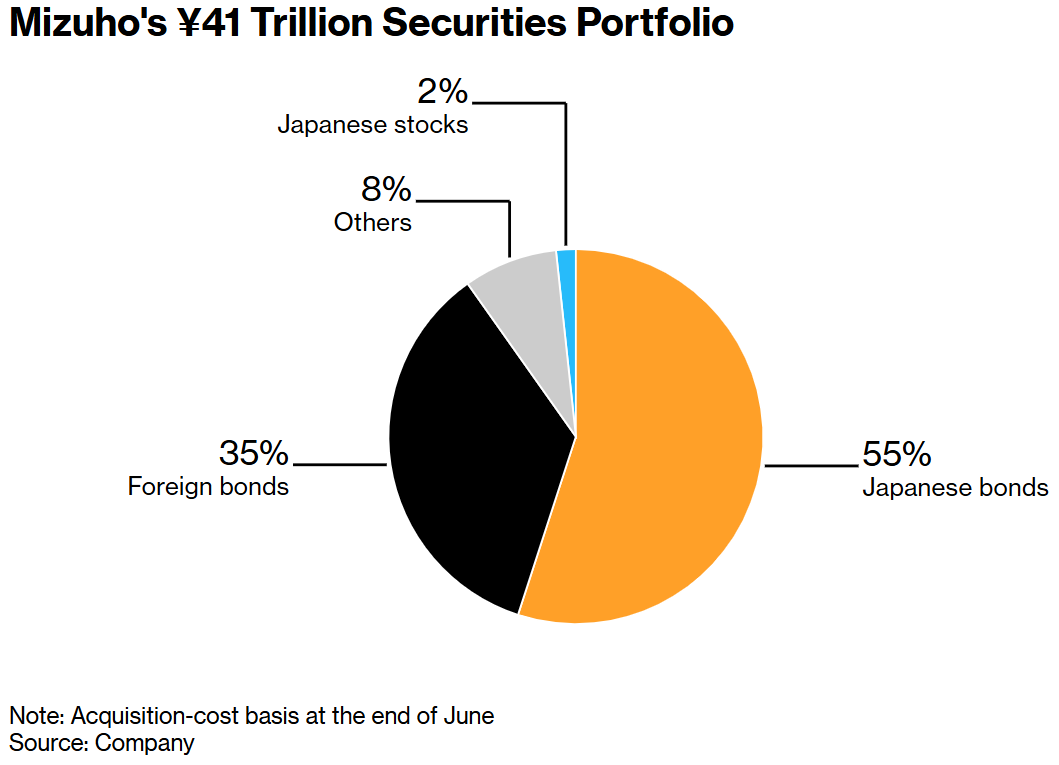
Mizuho Securities's portfolio reached 41 trillion yen
According to people familiar with the matter last week, Prime Minister Takaichi Sanae's government supports recent interest rate hikes, and the next action may be in September or October. Koshimizu said he did not rule out the possibility of raising interest rates twice before the end of the year, which would raise the policy interest rate to 1.5%.
According to Tuesday's overnight index swap market data, traders expect a 78% chance that the Bank of Japan's policy committee will raise interest rates when formulating policy on September 18.
Koshimizu said it is difficult to predict the Bank of Japan's final interest rate because it depends on how the Japanese economy is developing. He added that due to the increase in productivity brought about by the boom in equipment investment, the central bank's estimate of neutral interest rates between 1% and 2.5% may also rise.
Koshimizu said that Mizuho maintains a “conservative” attitude about investing in Japanese treasury bonds because the yield on the benchmark 10-year treasury bond, which is currently around 2.9%, is still low given Japan's nominal economic growth rate of about 4%.
As of the end of June, the bank held approximately 20.6 trillion yen of Japanese treasury bonds, but the majority consisted of short-term securities maturing within a year. As of June, the average remaining maturity of Japanese treasury bonds held by Mizuho was less than a year.
Koshimizu said, “In light of global structural changes and investment boom, inflation risks are still biased upward. Therefore, we plan to actively invest in inflation-linked treasury bonds.”
Many in the market attributed the weakening of Japan's treasury bonds to Takaichi's fiscal policies, including the decision to cut food consumption taxes for two years. But Koshimizu doesn't expect a sharp sell-off like when former British Prime Minister Liz Truss introduced an unfunded tax cut program.
“Once the yield rises to a level more consistent with the nominal growth rate, there will be considerable potential demand for Japanese treasury bonds,” Koshimizu said. He added that large Japanese banks, overseas investors, and even households may become interested buyers of Japanese treasury bonds.
Koshimizu is optimistic about Japan's growth prospects, saying that the Japanese economy is undergoing a transformation not seen in decades, which has boosted corporate activity and demand for loans. As a result, he said Japanese stocks are “a very attractive asset,” and the bank is investing in index funds.
He said, “Global structural changes are expected to have a positive impact on the Japanese economy. However, periods like these also tend to bring greater volatility to financial markets.”