


The Zhitong Finance App learned that despite the sharp rise in oil prices, Japanese companies have surrendered the biggest profit performance in five years, causing investors to expect strong profit growth in various industries to spread market gains from transactions related to artificial intelligence computing power infrastructure to a wider range of subject areas. The market is beginning to bet that the country's stock market will embrace an all-round upward spread bull market. However, there is no doubt that the unprecedented AI infrastructure construction frenzy is still a key cornerstone of profit elasticity, rising valuations, and the return of foreign capital in the Japanese technology sector and the Japanese stock market as a whole.
Compared to the US and South Korean stock markets, which have also been dominated by the recent AI computing power frenzy, what is unique about the Japanese market is that it doesn't have the most direct AI chip/DRAM memory superdominance like Nvidia, AMD, Micron, Broadcom, Google, SK Hynix, and Samsung, but it has Kioxia, Tokyo Electronics, Edwin Test, Disco, Lasertec, Socionext, SoftBank, and MLCC giants Murata, Taiyo Denyu, etc., a large number of foreign AI-related semiconductor assets embedded in the deep artificial intelligence computing industry chain. universal Japan is viewed as “the second battleground in the AI computing power infrastructure industry chain.”
However, according to the latest earnings season data, the profit growth rate of Japanese companies has begun to spread from these AI computing power-themed companies to the entire market, and the Japanese stock market is shifting from an index market driven by a small number of AI-weighted stocks to a systemic bull market supported by the breadth of corporate profits and high-quality cash flow output in the broad sense of the term.
According to data compiled by the agency, in the three months up to June, about 71% of Japanese companies' profits exceeded analysts' unanimous expectations; the total net profit of the 500 largest Japanese companies surpassed 21 trillion yen (132 billion US dollars), surpassing the record of about 18 trillion yen set a year ago.
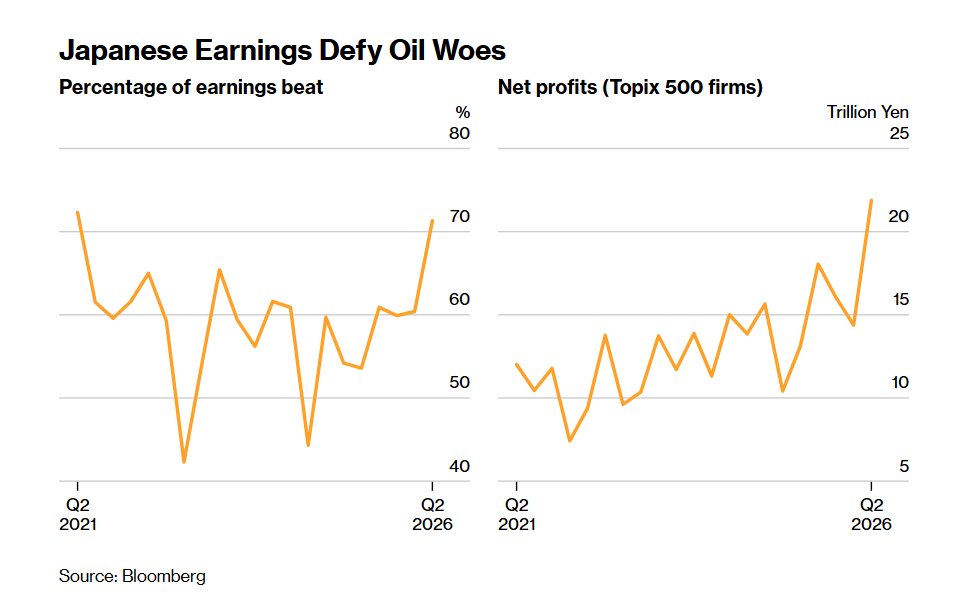
Corporate profitability has also improved markedly. The profit margin of the Topix component of Japan's TSE stock price index is expected to set a historical record of 9.3%, the highest level since comparable data began to be available more than 30 years ago. As shown in the chart above, the profit trajectory of Japanese companies does not seem to be bothered by oil prices.
From the topic of AI computing power to domestic demand in full bloom! Record profit margins and gains spread to 77% of constituent stocks
These newly compiled performance indicators suggest that the rise in the Japanese stock market may be entering a new phase. Although the Japanese stock market's gains in the last quarter and since 2025 were mainly focused on technology stocks and beneficiaries related to AI computing power infrastructure, the latest earnings season shows that profit growth is spreading to more industries as Japanese companies successfully pass on higher costs to consumers.
“It's not just exporters and AI semiconductor-related technology companies that have surpassed expectations,” said Hiroki Takei, a strategist from Resona Holdings. “We are also seeing better than expected profits for domestic demand companies. Investor interest has expanded to a wider range of fields than before, and I expect this situation to continue.”
Investors are particularly encouraged by the resilience of domestic-demand-oriented companies, as it shows that companies are gaining pricing power, which can improve profitability even when energy prices are high. Given that weak corporate profitability has always suppressed Japanese stock valuations, and recent gains have increasingly relied on the AI computing power theme, the upward trend in profit margins may also provide strong support for the further rise in the stock market.
According to dollar-denominated returns, since US President Donald Trump announced the “Liberation Day” tariffs, the TSE stock price index has risen more than 67% from the April 2025 low, roughly equal to the 69% increase in the MSCI Asia Pacific Index.
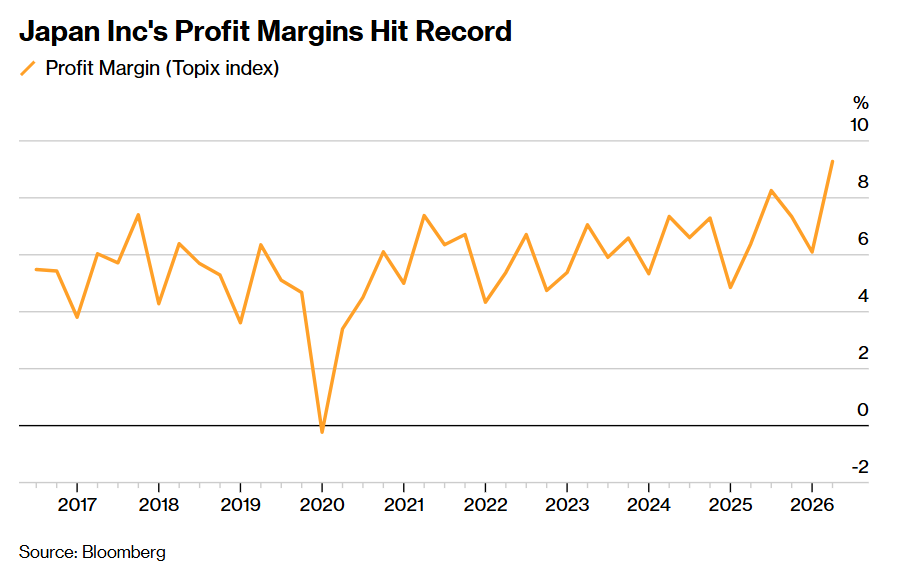
As shown in the chart above, Japanese corporate profit margins unexpectedly hit historical records.
The trend of profit diffusion is clearly visible in both export-oriented and domestic demand-oriented industries. Among companies related to the AI computing power theme, stock prices soared sharply after the profits announced by global semiconductor equipment leaders Edwin Test and Tokyo Electronics exceeded market expectations. Companies that focus on the domestic demand market, such as furniture retailer - furniture chain operator Nitori Holdings Co. The performance of the internet company LY and the software company Otsuka Corp also significantly exceeded the unanimous expectations of the market.
From an industry perspective, the decline in profits was mainly limited to the aviation and utilities sectors most affected by the Middle East conflict, and profits in most industries increased compared to a year ago.
Yasuhiko Hirakawa, head of stock investment from Rakuten Investment Management, attributed the strong performance in part to rising prices. “I feel that the effects of price increases are showing,” he said. “I had anticipated that companies would lag behind in passing on the rise in crude oil costs, leading to a deterioration in profit margins. But in reality, the opposite is true.”
When these results were announced, a preliminary estimate of the Japanese economy showed that Japan's economic growth rate unexpectedly slowed during the quarter due to weak domestic consumption and capital expenditure.
Strong earnings performance also prompted analysts to raise profit forecasts. Since the end of June, the earnings per share forecast for the TSE stock price index has risen 6.9% this year, which is significantly higher than the 4.9% increase in the S&P 500 index. Although Japan still lags behind South Korea and Taiwan's incredibly strong profit boom driven by artificial intelligence, its performance is already significantly ahead of Europe and most of the Asia-Pacific region.
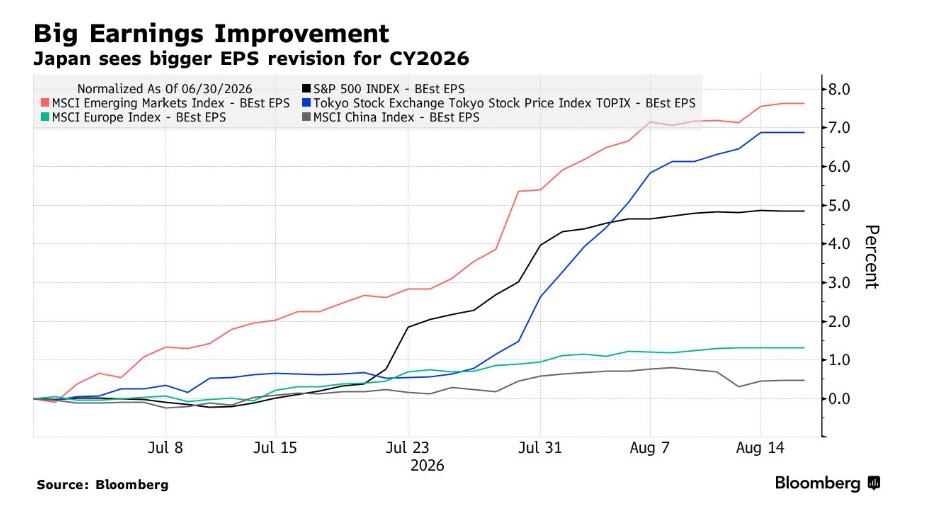
As shown in the chart above, earnings improved marked—Japan's earnings per share forecast for the 2026 calendar year increased even more.
Other favorable factors, such as the weakening yen and one-time refunds associated with tariffs during the Trump era, also supported corporate profits. Even so, market performance clearly shows that profit growth is spreading to a wider range of sectors. From July to mid-August, the AI computing power theme ceased to stand out, spreading to 77% of the constituent stocks of the Eastern Stock Exchange Stock Price Index, driving the index to a cumulative increase of 4.7% during the same period.
In contrast, in the last earnings quarter, although the TSE stock price index surged 10.5% — more than double the increase so far this quarter, only 56% of its constituent stocks rose.
This shift has further strengthened the market's expectations that the Japanese stock market still has room to rise. Chisa Kobayashi, a Japanese stock strategist at UBS SUMi TRUST Wealth Management, pointed out that industries that underperformed last quarter, such as gaming, food, and healthcare, are now attracting buying.
“We have been able to confirm that companies from all walks of life are successfully passing on higher costs through price increases,” she said. “In this sense, we have reason to expect this round of market growth to be sustainable.”
Is Japan's “AI Computing Power+Cash Flow” Combination a New Answer to Global Allocation?
As of the June quarter, about 71% of corporate profits exceeded expectations, and the net profit of the 500 largest companies broke through 21 trillion yen, surpassing the record of about 18 trillion yen a year ago; the profit margin of companies in the Tokyo Stock Price Index (TOPIX) is expected to rise to 9.3%, the highest since data were available. Since the end of June, the TOPIX index's annual earnings per share forecast has increased by 6.9%, surpassing S&P 500's 4.9%; from July to mid-August, the constituent stocks rose 77%. These signs all indicate that cost transfers, weak yen, and operating leverage are spreading profit improvements from semiconductors to domestic demand sectors such as retail, the Internet, and software. Aviation and utilities are a few industries that are still clearly pressured by high oil prices.
The unprecedented wave of AI infrastructure construction can be described as a key cornerstone of the Japanese technology sector's profit elasticity, rising valuation, and the return of foreign capital. It is also the core logic of the strong rise in the Japanese stock market in recent years. Japan's AI powerhouse does not control AI GPU design or advanced foundry, but multiple bottlenecks in the AI computing power industry chain that are extremely difficult to bypass. Therefore, the extremely strong demand related to AI computing power infrastructure directly drives the orders, product portfolios, and profit margins of companies such as Kioxia, Edwin Test, and Tokyo Electronics, and forms a rare “Japanese AI seller cluster” through semiconductor equipment, advanced packaging, testing, storage, and key passive components; however, 71% of companies exceeded expectations and 77% of component stocks rose, further proving that Japanese companies have backfired for a long time The advantage of pricing power.
Domestic demand companies successfully passed on costs, banks benefited from interest rate normalization, and exporters benefited from weak yen. Coupled with corporate governance reforms, repurchases, and capital efficiency improvements, they all formed a broad base for this round of profit expansion, further showing that the strong bull market in the Japanese stock market is a two-round market constructed by “AI high growth engine+Japan's re-inflation profit restructuring.”
At the specific investment level, using Tokyo Electronics, Edwin Test, Disco, LaserTec, and Kioxia to capture strong capital expenses related to AI computing power infrastructure, and share Japan's profit margin restructuring with price-oriented domestic demand companies and banks, it can be described as the core logic of the “version answer” of the Japanese stock market, that is, it is not an extremely crowded and high-beta technology index like the Philadelphia Semiconductor Index and the Nasdaq 100 Index. Instead, the AI computing power growth factor is embedded into a very long tradition of extreme dispersion, low concentration of positions, and high quality cash flow Industrial balanced chassis.
The most attractive thing about Japan is not simply replicating large US technology stocks, but rather allocating segmented bottlenecks with technical barriers and the ability to raise prices in the global AI supply chain, as well as high-quality domestic cash flow assets such as finance, software, consumption, and healthcare. AI equipment and storage stocks have the highest profit elasticity, but they also face the risk of capital expenditure cycles, crowded valuations, and concentrated orders; domestic demand and financial sectors can increase the breadth of portfolios and hedge against sharp fluctuations caused by deleveraging and crowded position clearing associated with AI computing power transactions.