


The Zhitong Finance App learned that after a short summer break, British households are once again being pulled back to reality by rising energy bills. According to data released by the UK Office for National Statistics (ONS) on Wednesday, the consumer price index (CPI) rose 2.9% year on year in July, up from 2.6% in June, the highest level since March this year. This reading is basically in line with economists' median forecast, slightly higher than the Bank of England's previous forecast of 2.8%, but the formal reversal of the downward trend in inflation still casts a shadow over the outlook for the UK economy.
The overall rebound was in line with expectations: energy bills became the “engine” of inflation, and the cooling of inflation in the service sector provided a hint of comfort
The central contradiction in July's inflation data is that the overall energy-driven rebound in inflation coexists with the continued cooling of domestic price pressure. According to the UK Office for National Statistics, the main driver of the rise in inflation in July was the housing and household services category. This directly reflects the quarterly price cap adjustment implemented by the UK energy regulator Ofgem on July 1 — raising the price cap on residents' gas and electricity bills by 13%, increasing the average annual household bill by about £221 to £1,862. Specifically, natural gas prices jumped 14.7% month-on-month in July, the biggest monthly increase since October 2022; electricity prices also rose 3.6%.
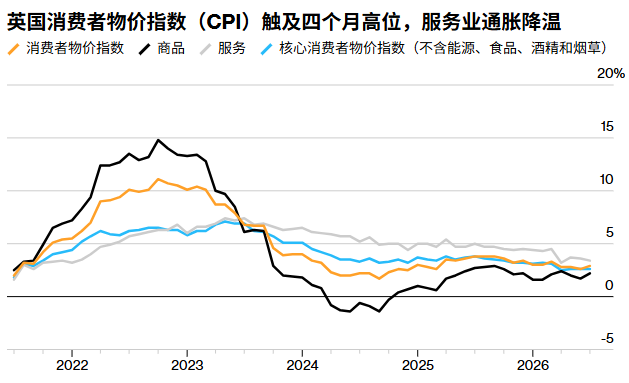
However, inflationary pressure has not spread to the wider economic sector. The core CPI excluding energy, food, alcohol and tobacco remained unchanged at 2.6% year over year, and has remained flat for the third consecutive month. This reading was slightly higher than the 2.5% expected by economists, but it did not change the basic pattern of stabilizing core inflation.
What made the Bank of England even more pleased was the unexpected cooling of service inflation. The inflation rate in the service sector, which is the most critical measure of pressure on the domestic economy, fell to 3.4% from 3.6% in June. This was mainly due to the fact that the increase in ticket prices in July this year (+11.7%) was far lower than the same period last year (+30.2%). The CPIH index, which includes the cost of housing (the UK Office for National Statistics's priority measure of inflation), rose from 2.8% to 3.1%.
Why didn't the “energy shock” evolve into “full inflation”?
There is an essential difference between this rebound in inflation and the 2022 energy crisis: the transmission mechanism is already very different. In 2022, a sharp rise in energy prices quickly spread to food, transportation, and core commodity prices, triggering full inflation. However, this time, the conduction effect is clearly limited. The decline in gasoline and diesel prices played a key hedging role — the average price of diesel fell 8.8 pence per liter in July, ticket prices fell 11.6% year over year, and the fall in crude oil and refined oil prices drove a 1.7% month-on-month drop in investment prices, effectively curbing the spread of energy shocks to a wider range of sectors.
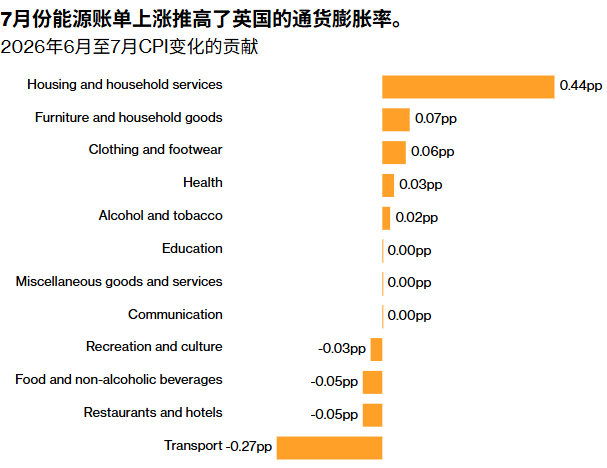
Furthermore, the continued cooling of food inflation has also provided consumers with a breathing room. In July 2026, food and non-alcoholic beverage prices rose only 1.3% year on year, down from 1.7% last month, the lowest level since September 2021. The category's contribution to the annual CPI increase was only 0.14 percentage points, which is also the lowest since 2021.
Yael Selfin, KPMG's chief economist, pointed out that unlike the general rise in overall economic costs due to rising energy prices in 2022, the current weak labor market conditions can help limit the scale of similar cost transmission. This judgment is highly consistent with labor market data released on Tuesday — the data shows that employment continues to cool down and wage growth in the private sector is slowing.
Market reaction: GBP rises slightly, interest rate hike bets cool
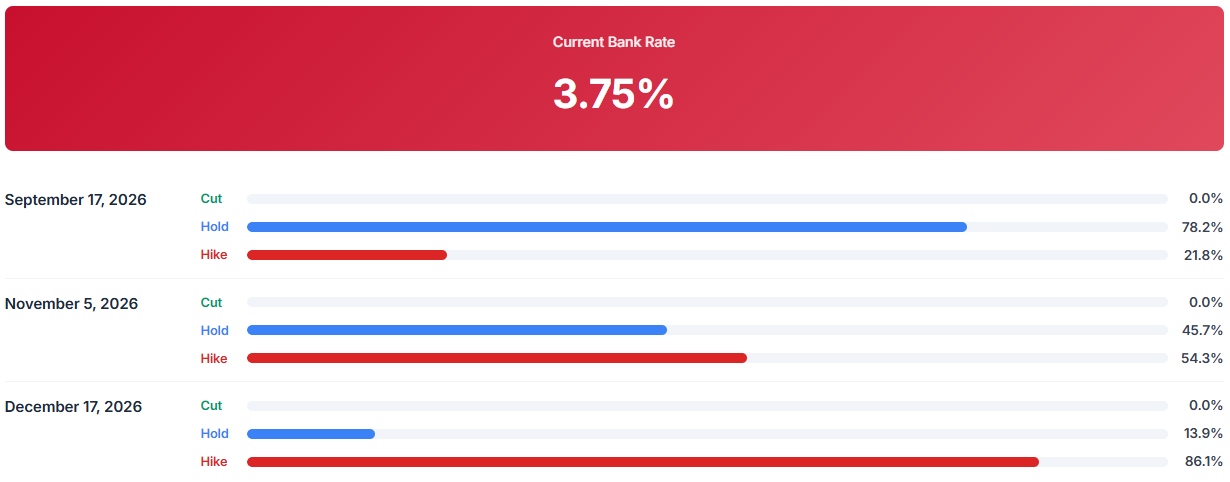
After the data was released, GBP/USD rose slightly by about 0.1% to around 1.3550, but overall it was still stuck in the weekly range below 1.3570. Traders have slightly reduced their bets on the Bank of England's interest rate hike before the end of the year. According to the latest survey, the vast majority of economists expect the Bank of England to keep the benchmark interest rate unchanged at 3.75% for the rest of 2026.
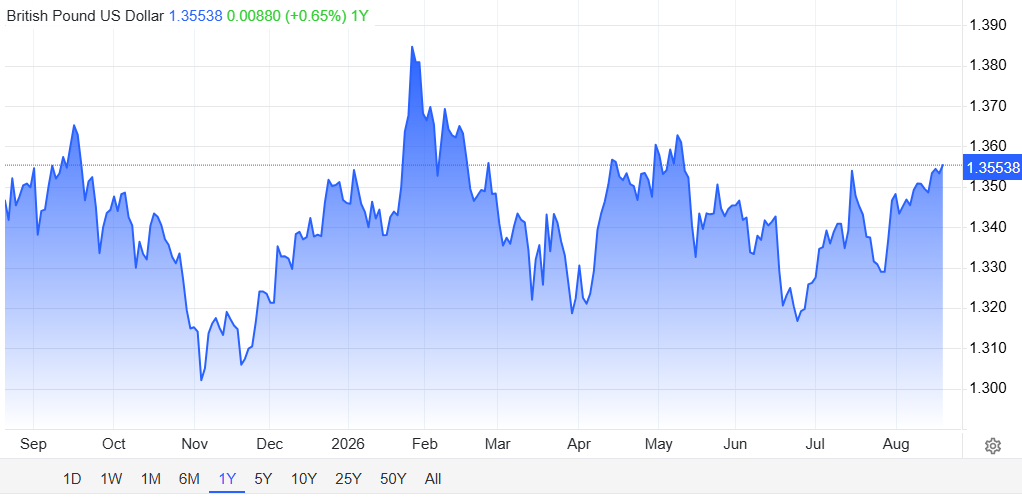
This kind of “unsurprising” market reaction just confirms that investors have already fully anticipated a rebound in inflation. Economists generally believe that the rise in inflation in July was mainly the result of base effects and one-time policy adjustments, rather than a substantial deterioration in domestic price pressure.
Weakness in the service sector is becoming a key buffer to curb the effects of the second round of inflation. Data released on Tuesday showed that the UK labor market continues to cool down, the number of non-farm payrolls is falling, and wage growth in the private sector is slowing. This weak trend limits the ability of companies to pass on higher energy costs to consumers, and also provides a reason for the Bank of England to maintain current interest rates.
The Bank of England's dilemma: inflation rebounds vs. economic weakness. How long can it last without action?
The July inflation data provided a subtle policy signal for the Bank of England.
Hawkish arguments: CPI jumped from 2.6% to 2.9%, and the Bank of England predicted that inflation would peak at 3.2% in the fourth quarter. Energy bills are likely to rise again, and with droughts and extreme weather risks likely to drive up food inflation in 2027, inflation may not have peaked yet.
The dovish argument: core inflation remained flat at 2.6% for the third month in a row, and service inflation unexpectedly cooled to 3.4%. The labour market continues to cool, and wage growth in the private sector is slowing. As KPMG's chief economist Yael Selfin pointed out, weak labor markets help limit the scale of cost transmission.
According to a survey released on August 18, about 90% of economists expect the Bank of England not to adjust interest rates in September or the rest of 2026, and the benchmark interest rate will remain unchanged at 3.75%. Although inflation is expected to remain above 2% until the second half of 2027, a small majority of economists still expect interest rate cuts at least once before mid-2027. The market expects the Bank of England to raise interest rates at least once this year, and the probability of raising interest rates in December is as high as 86%.
Chancellor of the Exchequer John Healy responded after the data was released: “Iran war inflation continues to affect domestic prices, but the British economy is resilient. ”
Inflation outlook: dark clouds have yet to dissipate
The July inflation data revealed the reality facing the UK economy: the “flood” of energy prices has only just begun. Due to delays in the implementation of the price cap policy, British households were previously largely spared the worst effects of the Iran war. The sharp rise in natural gas prices of nearly 15% in July marked the official lifting of this “protective shield”.
However, the rebound in inflation has not changed the Bank of England's policy path. The unexpected cooling of service inflation, the continued weakness of the labor market, and the stabilization of core inflation provided decision makers with reasons to “wait and see.” The real test may come in October — when energy bills will rise again (albeit moderately), and the direction of the Middle East conflict will determine whether oil prices will continue to have a fresh impact on British consumers.
David Rees, head of global economics at Schroder Investments, warned that the price of manufactured goods may rise in the next few months, and the risk of a drought and super El Niño phenomenon could drive up food inflation drastically in 2027. Furthermore, oil prices are high due to continued interruptions in the Strait of Hormuz, and the price of Brent crude oil has been pushed back above $90 per barrel. This may still be a concern of the few Bank of England policymakers advocating interest rate hikes.