


First Solar stock has produced a 132.9% return over the past 5 years, yet recent weakness and a fresh policy boost from U.S. tariffs leave investors weighing what the latest valuation signals really say about the current US$220.01 share price.
- A 132.9% gain over 5 years suggests long term holders in First Solar have already captured a substantial return, so any new position or add now hinges on whether the stock still offers a margin between price and value.
- The recent 15% U.S. tariff on polysilicon imports can support First Solar's revenue and margin potential, while any reversal of trade protection or pressure on domestic solar incentives may limit how much value investors are willing to ascribe to those future cash flows.
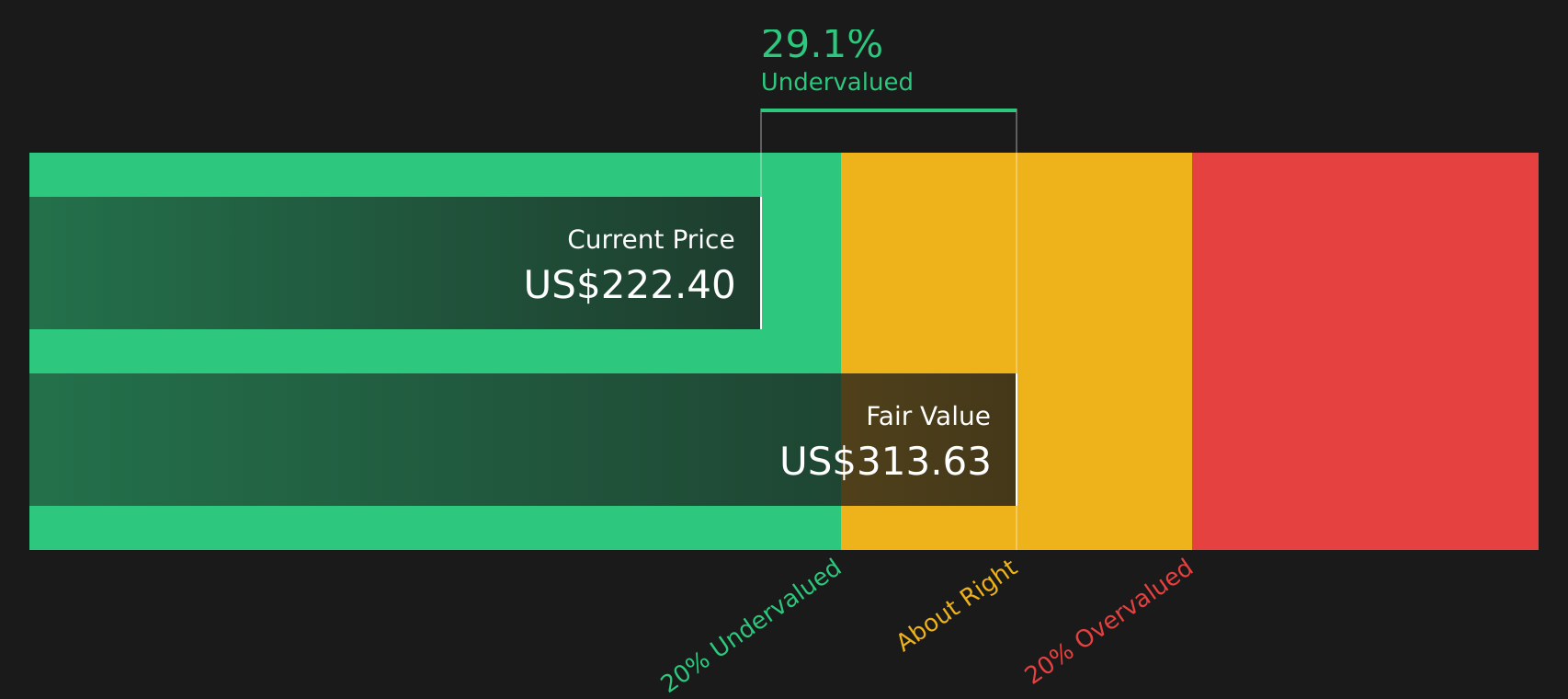
- The Discounted Cash Flow (DCF) intrinsic value estimate points to the stock trading about 29.8% below that value. The broader checks also lean cheap, with First Solar screening as undervalued on 5 of 6 tests according to our valuation work.
The issue now is whether that apparent discount to intrinsic value gives enough room for error after the policy driven rally and recent share price swings.
Find out why First Solar's 4.3% return over the last year is lagging behind its peers.
Is First Solar a Bargain on Cash Flow?
The Discounted Cash Flow (DCF) approach values First Solar on the cash it is expected to generate for shareholders. On this model, the latest twelve-month free cash flow is about $836.2 million, and analysts expect growing cash flows over the coming decade based on the 2 Stage Free Cash Flow to Equity framework.
Those projections translate to an estimated intrinsic value of about $313 per share, compared with the current $220.01 share price. That implies First Solar stock is trading at roughly a 29.8% discount to this cash flow based estimate. Because the recent 15% U.S. tariff on polysilicon imports directly targets one of First Solar's key cost and pricing pressures, the market price still appears to lag what these projected cash flows suggest.
On this DCF view, First Solar stock appears undervalued relative to the cash the business is expected to generate.
Our Discounted Cash Flow (DCF) analysis suggests First Solar is undervalued by 29.8%. Track this in your watchlist or portfolio, or discover 50 more high quality undervalued stocks.
Is First Solar a Bargain on Earnings?
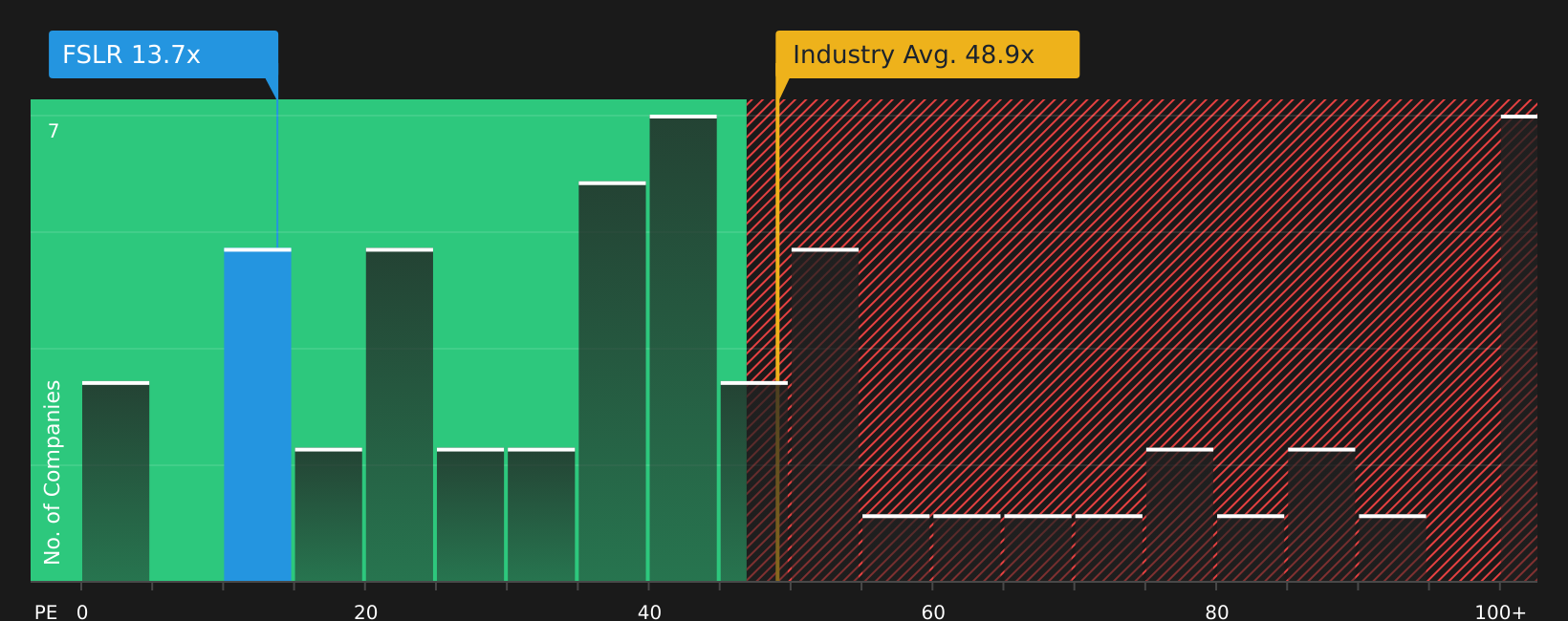
The P/E ratio is often a useful way to value First Solar because it links what you pay today to the earnings the business is already generating. At the moment, First Solar trades on a P/E of about 13.5x, which is well below the wider semiconductor industry average of around 50.9x and also below the peer group average of roughly 66.8x.
On Simply Wall St's model, a company specific fair P/E for First Solar is about 30.5x. That is more than double the current multiple, which suggests the market is pricing the stock at a sizable discount to what this framework implies based on its sector, size and risk profile. Even after the recent tariff driven jump in sentiment, the gap between price and this earnings multiple benchmark remains wide.
On the P/E yardstick, First Solar stock appears undervalued relative to what this model implies investors might typically pay for its earnings.
See what the numbers say about this price — find out in our valuation breakdown.
The First Solar Narrative: What Would Justify Today's Price?
Simply Wall St Narratives for First Solar pick up where the valuation puzzle leaves off and focus on the specific future paths that would make the current market price look high or low. They set out the growth, margin and earnings assumptions that would need to hold for First Solar's stock to be worth materially more or less than today. Where a ratio or model gives a single figure, Narratives unpack the future conditions behind it so you can watch whether those assumptions continue to line up with reality on Simply Wall St's Community page.
The community is split on First Solar, with one camp focused on policy and technology upside and the other on how fragile that policy support might prove.
Bull case: 13% undervalued
"Recent U.S. policy changes, specifically strengthened incentives and tighter restrictions against foreign entities of concern, are boosting First Solar's competitive moat, supporting robust demand for domestically produced modules..."
Read the full Bull Case to see why First Solar could be undervalued
Bear case: 28% overvalued
"On the cautious side, several bearish analysts frame First Solar as heavily exposed to policy risk, particularly around U.S. tax credits..."
Read the full Bear Case to see why First Solar could be overvalued
Do you think there's more to the story for First Solar? Head over to our Community to see what others are saying!
The Bottom Line
For First Solar, both the Discounted Cash Flow (DCF) intrinsic value estimate and the market multiple view still point to the stock as undervalued. The broader valuation checks also sit on the stronger side, which supports the idea that the current price embeds a cautious read on its prospects rather than optimism. What matters from here is whether First Solar can sustain the cash flow and earnings profile implied in those models in the face of changing policy support. The key question for investors is whether the current discount compensates enough for that policy and execution risk.
This article by Simply Wall St is general in nature. We provide commentary based on historical data and analyst forecasts only using an unbiased methodology and our articles are not intended to be financial advice. It does not constitute a recommendation to buy or sell any stock, and does not take account of your objectives, or your financial situation. We aim to bring you long-term focused analysis driven by fundamental data. Note that our analysis may not factor in the latest price-sensitive company announcements or qualitative material. Simply Wall St has no position in any stocks mentioned.
Have feedback on this article? Concerned about the content? Get in touch with us directly. Alternatively, email editorial-team@simplywallst.com