


The Zhitong Finance App learned that some media reported, citing information revealed by people familiar with the matter, that SpaceX (SPCX.US), an American supertech giant founded by Musk and focused on “AI+ space exploration”, recently contacted Cognition AI Inc., an AI programming intelligence leader supported by Silicon Valley venture capital godfather Peter Thiel to discuss a potential acquisition; if this deal can finally be reached, it will be the second major transaction implemented by SpaceX in recent months after completing the acquisition of AI programming startup Cursor The acquisition strengthens its growing strength in the AI application competition, strives to achieve a trillion-dollar revenue scale by 2030 or even earlier, and the grand narrative that “the AI business accounts for 99% of SpaceX's value” earlier than 5 years.
A person familiar with the matter said that Cognition has not actively engaged in this acquisition proposal. People familiar with the matter mentioned above said that the two sides are still discussing cooperation matters, including the possibility of arranging Cognition to use SpaceX's AI computing power infrastructure resources. Since the relevant information has not been made public, these individuals requested anonymity.
After SpaceX took Cursor, it also came into contact with Cognition. The core motive was undoubtedly to seize the most important enterprise-level AI application superportal in the AI era — the software development workflow and the high-quality feedback data it generates. Judging from the $28.5 trillion “space AI empire” superplan described in SpaceX's own prospectus, the strategic significance of winning Cursor and Cognition is even more clear. This $28.5 trillion forecast is no less impressive than the US nominal GDP of nearly 32 trillion US dollars in the first quarter of 2026; of these, the enterprise-side super application market surrounding AI is estimated at 22.7 trillion US dollars, which is about 70% of the total output of the US economy.
After Musk bought Cursor for 60 billion US dollars, the battle for enterprise-level AI agents entered the era of computing power mergers and acquisitions
According to a recent media report, Cognition's valuation in the May round was 26 billion US dollars, and preliminary discussions have begun with institutional investors on the new round of financing to seek a valuation of at least 40 billion US dollars.
SpaceX and Cognition did not respond to requests for comment. Cognition CEO Scott Wu said in response to media reports on social media on Wednesday local time that the company “will not be sold now, and we have never had relevant negotiations.”
This acquisition agreement highlights Musk's willingness to continue to invest huge sums of money to participate in the AI computing power arms race and the global AI application supercompetition. SpaceX recently completed a $60 billion acquisition of Cursor; Cursor is a rapidly growing AI programming startup and a core player in the tech industry's “vibe coding” (vibe coding) era. Cognition also focuses on VIBE coding to help companies automate large-scale engineering tasks with high efficiency.
Musk's companies have always been committed to building more advanced artificial intelligence application tools to simplify various AI application tasks, including enterprise programming matters, on a large scale. Musk's artificial intelligence business is currently called SpaceXAI. The business lags behind AI application competitors such as OpenAI and Anthropic in terms of sales to enterprises, and has implemented a series of layoffs and restructuring.
The rapid attainment of a strong growth trajectory in the AI business is a key pillar of Musk's growth strategy for SpaceX. SpaceX has evolved into a comprehensive large-scale technology enterprise spanning rocket, satellite communication and artificial intelligence applications, and AI computing power infrastructure businesses, and has received strong growth impetus by completing a historic initial public offering this summer.
Cognition was founded in 2023. Its flagship product is an artificial intelligence agent called Devin, which aims to automate the programming process for engineers. It has received support from top venture capital institutions such as General Catalyst and Founders Fund under Peter Thiel, the godfather of Silicon Valley venture capital. Some people familiar with the matter said SpaceX's interest in Cognition stemmed not only from its technology, but also from the progress of its business.
Using AI agents for full-process proxy workflows and fully automated programming has probably become the most popular racetrack in the field of artificial intelligence applications. The strongest leaders in AI applications such as Anthropic PBC, OpenAI, and SpaceX have invested a large part of their business into their own project-level engineering products.
Cognition AI itself is one of the purest targets in this “Agentic Software (AI agent-led software)” investment line. Its core product, Devin, is positioned as an autonomous AI agent software engineer who can independently plan, write, test, and deliver production code in a real code base and development tool environment.
According to information, after completing the acquisition of Windsurf, the company also formed a complete AI application software engineering platform “Windsurf/Devin AI agent collaborative development+Devin responsible for asynchronous autonomous execution in the cloud+Devin for Terminal undertaking complex engineering tasks”; Devin is a “cloud autonomous AI engineer”, Devin for Terminal is a “local command line entry”, and Devin Desktop is a desktop IDE where managers collaborate with multiple agents/ Console; the three are used jointly by customers and engineering teams. For example, Mercedes-Benz (Mercedes-Benz) has deployed its products to global R&D and IT systems. In a four-week pilot, Devin analyzed more than 200,000 lines of COBOL code, shortening the modernization work originally anticipated in eight months to eight days.
According to Cognition's official website, the company has established partnerships with a number of large companies, including the Mercedes-Benz Group and General Electric Aerospace. Cognition's commercial partnership may help SpaceXAI increase its appeal to potential customers.
According to reports, Scott Wu has always made it clear that he has no intention of selling the company, both in public and in communication with investors. In an interview with Bloomberg in May of this year, he said that the $1 billion financing “allows us to remain independent and continue to grow as an independent business, which is very important to us.”
Buy a developer portal for 60 billion US dollars and go after independent software engineers! Musk points to SpaceX's full-stack AI empire
SpaceX's ambitions in the field of AI applications are indeed extremely ambitious, but they must be accurately distinguished: the $28.5 trillion disclosed in the prospectus is the company's overall quantifiable potential market (TAM), not the AI revenue target; the AI application software-related market is $26.5 trillion, including $2.4 trillion in AI computing power infrastructure support, $760 billion in consumer subscriptions, $600 billion in digital advertising, and the most critical $22.7 trillion enterprise applications.
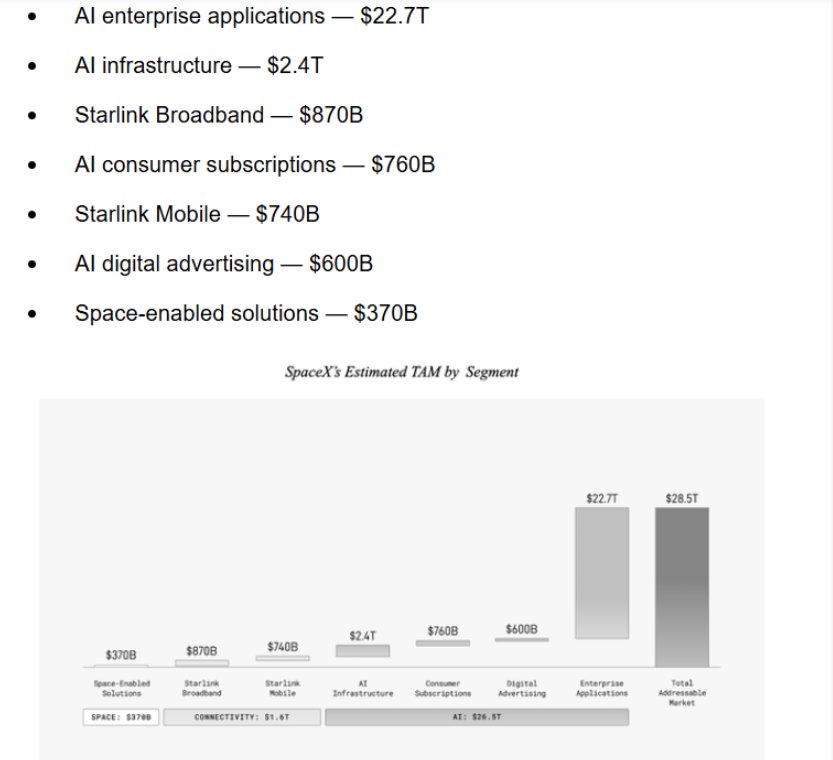
In other words, Musk is not satisfied with selling GPU computing power or operating Grok, but is trying to integrate “Nvidia GPU and data center - Grok basic model - Cursor developer workflow - Devin-style autonomous agent - X real-time data - Starlink global connectivity - Starship and orbital computing” to transform SpaceX into a full-stack AI superplatform spanning infrastructure, models, and application layers.
SpaceX took Cursor and then came into contact with Cognition. The core motivation was undoubtedly to do its best to seize the most important enterprise entry in the AI era — software development workflow and the high-quality feedback data it generates. Cursor brings professional developer distribution channels, corporate seat revenue, and code interaction data; Cognition has autonomous agents that can continuously perform complex engineering tasks, as well as large corporate relationships such as Mercedes-Benz and GE Aerospace. Connecting these applications to Colossus and Grok can improve the utilization rate of its own computing power, reduce the cost of third-party models and per token, and form a “user task - code execution - result evaluation - model retraining” data flywheel; at the same time, it can also directly improve SpaceX's internal R&D efficiency in rocket, satellite, communications, and data center engineering. Cursor has become a wholly-owned subsidiary of SpaceX, but in response to Cognition's unanswered acquisition contacts and potential computing power cooperation, it must not be stated that the deal has already been reached.
Cognition's flagship business, Devin, is positioned as an “autonomous AI software engineer”: it can independently plan, write, test, and deliver production code after receiving targets, and can also perform cross-code base migrations, troubleshooting, code reviews, and long-term engineering projects. Cursor's core is an AI-native editor and multi-model workflow platform embedded in the developer's daily work environment, which emphasizes human collaboration, codebase retrieval, completion, editing, debugging, and proxy programming. In layman's terms, Cursor is more like an intelligent cockpit that engineers have always used, and Devin is more like a digital employee who can independently receive work orders and deliver results; however, as Cursor strengthens cloud-based agents and Cognition integrates Windsurf, the product boundaries between the two are rapidly converging.
Financial data has proven that AI application ambitions are not SpaceX's pure vision: revenue related to SpaceX's AI business reached 2.6 billion US dollars in the second quarter, up 247% year on year, and the adjusted EBITDA reached positive 1.1 billion US dollars for the first time; out of the company's capital expenditure of 18.4 billion US dollars, about 15.8 billion US dollars was invested in AI computing power infrastructure. The computing power capacity support rose from 1 GW in the first quarter to 1.4 GW. The goal is to exceed 2 GW by the end of 2026 and close to 10 GW by the end of 2027.
SpaceX management expects to reach an annualized recurring revenue operating rate of at least $100 billion in December 2026 and advance the annual revenue target of $1 trillion to 2030 — even with an annualized operating rate of $100 billion as a starting point, a compound annual expansion of about 78% is implied. This is an extremely challenging internal plan rather than a low-risk financial guideline.
According to Wall Street financial giant Morgan Stanley, the market only gives SpaceX an implied value of about $12 per share, and predicts that Cursor's annualized revenue may reach 33 billion US dollars by 2030, giving a benchmark target of 300 US dollars and a bull market scenario of 600 US dollars; however, the market's reaction to huge capital expenses and long-term goals after the financial report also shows that investors will not unconditionally accept Musk's grand narrative that “the AI business accounts for 99% of SpaceX's value after five years.” What really determines the market's revaluation of SpaceX is not the $28.5 trillion TAM, but whether computing power can be stably launched, whether Cursor integration can improve gross profit margins, whether the Grok AI application platform can achieve enterprise-level competitiveness, whether potential Cognition-like intelligence can form auditable returns on productivity, and whether huge mergers and acquisitions and debt issuance can be converted into free cash flow.