


The Zhitong Finance App learned that Omdia published an article stating that as the automotive industry continues to move into the software-defined era, its rapidly changing pace is providing an important reference for industries that are still in the early stages of transformation, such as manufacturing and robotics. Currently, changes in architecture choices, operating models, organizational culture, and ecosystem construction in the automotive industry are key elements that manufacturers need to learn from to achieve software-defined manufacturing (SDM) and modern digital manufacturing upgrades. Today, a “Software-Defined Everything (SDX)” trend covering multiple industries is taking shape, and different industries are converging based on a common underlying framework.
Basic facts: SDV maturity and timing are progressive
Omdia divides the maturity of software-defined automotive SDV into five levels:
SDV Level 0-1 (basic stage): The vehicle has software functions or networking capabilities, but the functions are basically fixed, and remote upgrades (OTA) are mainly limited to firmware and security patches
SDV Level 2 (semi-SDV): OTA can add new features, but is mainly limited to infotainment systems (infotainment).
SDV Level 3 (true SDV): The vehicle is continuously upgraded, and the software can continuously evolve across multiple functional domains.
SDV Level 4: Enables a unified software platform, completely decouples hardware and software, and is portable across generations.
SDV Level 5: Introducing an Agentic Orchestrator (Agentic Orchestrator) to enable autonomous AI workflow collaboration within the vehicle and across ecosystems.
Omdia predicts that by 2026, 90% of the new car market will still be non-software-defined vehicles (SDV 0-2), and SDV class 2 (semi-SDV) will peak in 2028 and continue to dominate the market until 2031. For traditional car companies, this will be a costly and complex transition phase. Omdia anticipates that 2032 will be a watershed year towards SDV as the dominant market, with SDV-related revenue reaching $2.6 trillion. By 2037, SDV (Class 3-5) will account for 81% of the new car market, while non-SDV will drop to 6%. The key point is clear: the path to maturity is a 15-20 year transition, not an overnight transition.
Why automotive is a benchmark industry for software-defined transformation
Automotive isn't the first industry to pursue software-defined transformation, but it's uniquely suited as a benchmark. Electrification lowers the entry threshold for the industry by reducing powertrain complexity, enabling companies without historical baggage to enter the market. The legacy of history is the hardest obstacle to any software-defined transformation; unfettered disruptors such as Tesla and Xiaomi are not only deploying SDV today, but are also rapidly advancing the concept. The path of these companies shows what possibilities will arise if companies design around software-first value creation from the beginning, and also provides a clear reference path for other industries.
In contrast, traditional OEMs must dismantle architectures, supplier contracts, and operating models developed over decades. Their approach, including platform integration, next-generation electrical/electronic (E/E) architectures, centralized software organizations, and large-scale investments in OTA and cybersecurity, has provided real-world experience for other industries. Examples of software platform resets and project delays for major car companies also show that this transformation is difficult but necessary, and that other industries can learn from both successful experiences and setbacks.
Crucially, the automotive industry has experienced more and faster transformation than the industry that started earlier. Compared to the telecommunications industry, the industry has compressed multiple waves of change in just a few product cycles: electrification, new E/E architectures, platform-based software, and new business models.
Finally, SDV combines security-critical controls, consumer-grade experiences, and cloud-scale data and AI capabilities. This makes automobiles an ideal reference for the operation and digital modernization of physical systems such as manufacturing, robotics, and industrial automation.
Why is the software-defined blueprint for automobiles migrating to manufacturing?
Software-defined data centers (SDDC) and software-defined networking (SDN) primarily address the virtualization of digital assets and information flows. However, software-defined automation (SDA) and software-defined vehicles (SDV) represent a paradigm shift to “software-defined physics (software-defined physics),” where code directly controls dynamic motion and mechanical safety. Both verticals require complex decoupling of hardware and control logic to achieve lifecycle agility, yet they are still fundamentally bound by the deterministic requirements of real-world cyberphysical interactions.
Therefore, their evolution is a transformation, and software must master the strict requirements of functional safety and physical environments.
SDV promotes the convergence of modern technology stacks: integrated computing, high-speed Ethernet networks, service-oriented software, and CI/CT/CD with telemetry driven feedback loops. These same elements can now orchestrate industrial robots, machines, and production lines. In fact, technology stacks that achieve levels 3-4 capabilities are increasingly appearing in advanced factories.
The three best migration models to learn from:
Architectural convergence: Central computing and regional networks in vehicles are mapped in time-sensitive networks that orchestrate, distribute, and execute containerized workloads at the edge nodes of the workshop.
Digital twins and simulation: An advanced digital twin tool chain for validating SDV functionality is now being adopted to accelerate commissioning and process optimization in digital manufacturing.
Platform operation: In addition to common OTA/remote updates, concepts pioneered by SDV such as software bill of materials (SBOM), signatures, and phased rollout represent the logical evolution of industrial operations. Although not widely used, these frameworks are expected to be adopted in a customized form as manufacturers seek greater safety and life cycle stability.
From SDV to SDX: Common patterns that recur across industries
The reason why SDV can be extended to SDX is that software-defined transformation in different industries relies on the same core competencies:
The reality: Software-defined automation (SDA) is still in its early stages
The current state of development of the manufacturing industry is very similar to the early SDV stage of the automotive industry:
Software-defined control is nothing new to manufacturers. In the process industry, 54% of manufacturers are using PC-based DCS.
Omdia's data also shows strong network convergence: over 50% of manufacturers have achieved highly connected and converged networks. However, this investment has yet to be fully capitalized at the application level:
More than 20% of manufacturing companies are still in the basic local OT-IT system integration stage, using single push down data flow, and another 20% are still using isolated local software systems.
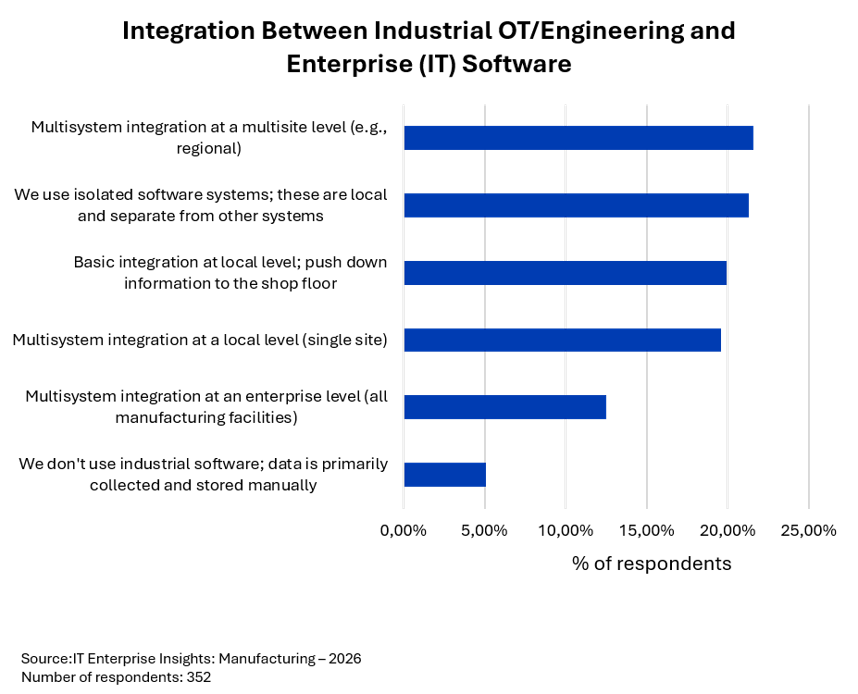
Despite increasing adoption of virtualization, nearly 40% of manufacturers are still operating non-virtualized monolithic systems.
Human and organizational barriers to digital project implementation currently exceed technical limitations. IT/OT collaboration is insufficient to consistently rank high among all priorities: over 60% of digital transformation projects are IT-led, while only 20% of reports show equal participation in IT-OT.
The digital maturity of the manufacturing industry is mixed. Although the market activity is real, it is still fragmented overall. The implementation of digitalization usually begins with a customized proof of concept (PoC) tied to a proprietary ecosystem. Its core experience is not only to avoid lock-up effects that hinder large-scale expansion, but also to establish a unified operating model covering software, security, and production.
Five lessons the manufacturing industry should learn from SDV
Expect a long evolutionary path, not a jump: Plan a transition phase where virtualized control, containerized applications, and edge orchestration coexist with traditional PLC/fieldbus systems and emerging Ethernet/TSN networks.
The main bottlenecks are organizational rather than technical: SDV leaders' early investments should focus on changing operating models: platform product management, security and cybersecurity governance, and a unified pace for hardware and software teams. Establish a joint IT-OT platform organization before expanding the pilot.
The “half” phase is painful but essential: In the automotive industry, the semi-SDV phase is a time when CI/CT/CD, OTA policies, and safety case tools mature. On the factory side, use the semi-SDA phase to bridge the brownfield gap: standardize software sources and workload partitions to bridge the gap between traditional reliability and software agility.
Aiming at the low-hanging fruits of data: The project initially prioritized networked services and cockpit experiences with a clear return on investment. In intelligent manufacturing, it starts with predictive maintenance, quality application, and energy optimization using data availability provided by SDA.
Don't wait for the perfect definition to begin: leaders create advantage through delivery, measurement, and improvement. In software-defined manufacturing, coding learning outcomes into reusable building blocks: standard device APIs, common data models, and repeatable deployment models.
A phased roadmap for manufacturing companies to refer to
Networking: Establishing a converged network backbone and unified data semantics. Focus on asset identity and edge observability. It's the 0-1 level foundation for any software-defined vehicle and the platform foundation for a factory.
Enhancement: Decouple non-critical functions and applications at the edge for monitoring, analysis, and management. Introduce lifecycle operations and remote updates and patches.
Adaptive: Extend virtualization and container orchestration. Execute in real time through production line orchestration virtualization. Transition to virtual commissioning and phased software rollout. Unify digital twins and achieve cross-system optimization.
Intelligence: Move towards autonomous closed-loop optimization under a clear strategic fence. Integrate factories into vertical ecosystems such as supply chains or smart grids. This is an analogy of level 5 in the SDV framework in a workshop.
Leveraging SDV's approach to managing risk
Safety and real-time: Decouple hard real-time control from soft real-time optimization; certification must be deterministic content, iterable where possible.
Cybersecurity is managed throughout the entire lifecycle: Enforce signed artifacts, SBOM, and ongoing vulnerability management at the industrial edge.
Economics shifts from capital expenditure to total cost of ownership: planning computations, networks, and tools for years of software evolution rather than one-time purchases.
Ecosystem strategy: Prioritize open interfaces and avoid a single vendor control plane to maintain flexibility and scale.
Data governance: Align the architecture with data sovereignty and retention requirements common in industrial environments.
Summarize
The manufacturing industry is evolving along the “software-defined” path that the automotive industry has taken. Facing similar physical constraints, the two will eventually converge with similar technical architectures and operating models. SDV is not a fully mature and replicable solution, but it provides a clear direction for development: software value does not come from one-time deployment, but continues to accumulate as the platform architecture and organizational capabilities continue to evolve. SDM and smart manufacturing will follow the same logic. Consolidate the platform foundation, rank use cases by return, industrialize governance, and maintain conscious iteration. The sooner factories understand the SDV blueprint and acknowledge that it is a gradual long-term path, the more opportunities they have to move from pilot to scale advantage more quickly.