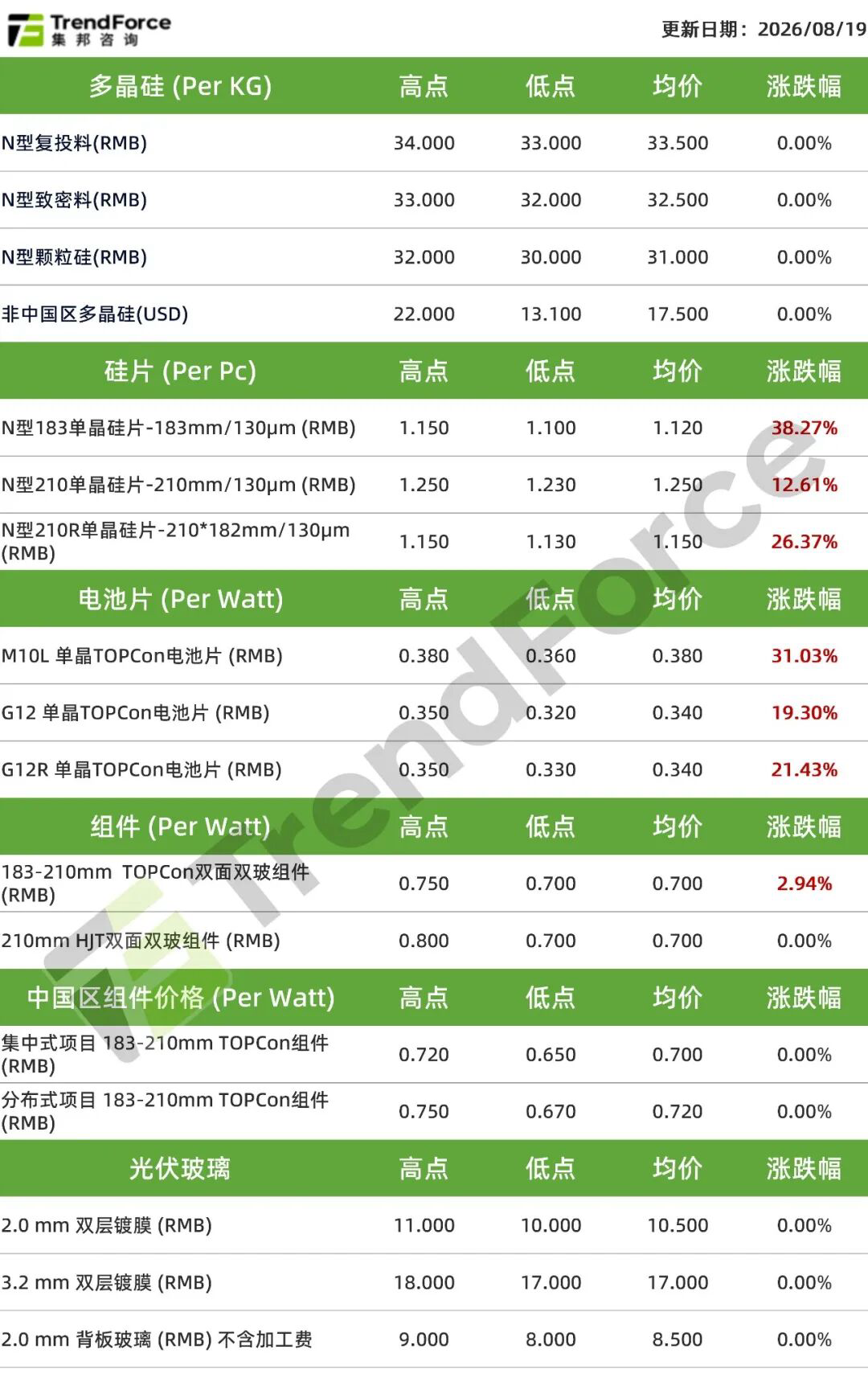
The Zhitong Finance App learned that on August 20, Jibang Consulting released the PV Weekly Price Watch. The PV module market is currently still dominated by domestic demand. Although supported by the cost transmission and policy expectations of upstream silicon wafer and cell price increases, module companies are strongly willing to raise prices. Leading manufacturers raised their prices to 0.72-0.75 yuan/W, and second-tier companies raised prices to around 0.7 yuan/W, but price transmission is not smooth. Actual mainstream market transactions have remained low in the early stages. The market is still full of all kinds of low-cost components. As low-price orders gradually declined, the price focus of the component market moved slightly higher than the previous period by about 0.02 yuan/W. In the absence of sufficient support from overseas demand, component price increases are mainly driven by upstream costs. There may be limited room for subsequent increases, so we need to focus on the actual situation of subsequent implementation of domestic policies.
Silicon material
Currently, silica stocks remain above 530,000 tons. Overall, stocks continue to accumulate, and mismatch pressure between supply and demand still exists.
Although the price of silicon materials has clearly risen, driven by anti-roll policy expectations and the sharp rise in downstream silicon wafer prices, the price of Tongwei Dense materials has now risen to around 43 yuan/kg, and the price of GCL granular silicon has risen to around 41 yuan/kg. However, since the details of the policy have not yet been fully implemented, the upstream and downstream wait-and-see sentiment is strong, and transactions are basically at a standstill, making it difficult for the market's traditional supply and demand regulation mechanism to work effectively for the time being.
In the short term, although policy expectations are bullish, due to weak demand for terminals and the impact of high inventories of large manufacturers in Lajing, silicon material manufacturers do not have an advantage in the price game, and market prices lack support for a sharp rebound.
silicon wafer
The silicon wafer removal process has achieved remarkable results, and the current inventory has dropped to around 25GW. Affected by changes in overseas policies, silicon wafer exports increased markedly, compounded by the market's “buy up, not buy down” sentiment, and high-price orders were quickly implemented.
Prices of silicon wafers of different sizes showed a divergent trend. The actual transaction prices of 183, 210R and 210 reached 1.12 yuan, 1.15 yuan, and 1.25 yuan/sheet, respectively. Among them, the price of 183 size silicon wafers experienced a strong rebound due to strong overseas demand and low initial operating rates; while demand for 210 size silicon wafers was still dominated by the domestic market, the overall performance was relatively lackluster, and the price increase was significantly lower than that of 183 size silicon wafers.
The strong export trend is expected to continue until mid-September, and prices are expected to remain high in the short term, but we need to be wary of the risk of subsequent export decline and policy implementation falling short of expectations.
Cell
Cell inventory continues to decline, and the current inventory has dropped to around 8 days. Under the influence of the policy, demand for 183 and 210R size batteries in overseas markets grew rapidly, compounded by the low production capacity of 183 cells in the early stages, leading to a tight phased supply and demand relationship, driving the high price of 183 size batteries to around 0.38 yuan/W; while 210 size batteries were affected by the price of centralized domestic projects, the transaction price remained around 0.35 yuan/W.
In the short term, the battery market sentiment is still optimistic, but the high price of around 0.38 yuan/W is also beginning to have a certain impact on the purchasing intentions of some exporters.
Since there has been no substantial increase in silicon prices, some exporters worry that current battery prices are at risk of inflating. If silicon prices are confirmed to rise steadily, battery prices are expected to remain high in the short term; if the increase in silicon falls short of expectations, battery prices may face the risk of falling back. In the future, we need to pay attention to the effects of policy implementation and the potential impact of changes in export demand on prices after mid-September.
Weekly price list