


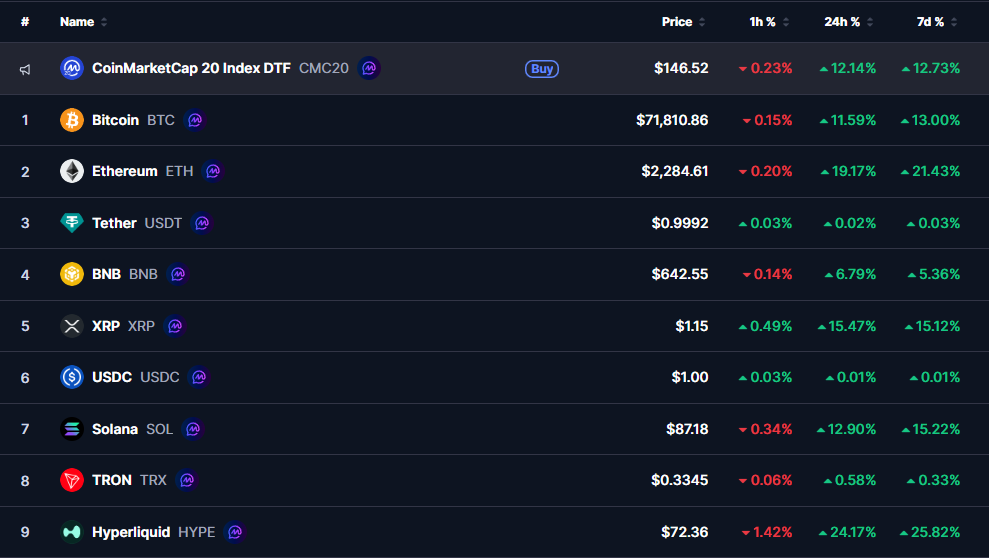
The Zhitong Finance App learned that Bitcoin surpassed $70,000 for the first time in more than two months, boosted by the US Treasury's expansion of the scale of long-term treasury bond repurchases driving the decline in US bond yields, and US President Trump's high-level talks with crypto industry leaders. Bitcoin has risen more than 11% in the past 24 hours to $71,871 as of press time. Other major cryptocurrencies surged one after another, with Ethereum rising more than 19% and SOL rising nearly 13%. Additionally, HPE, the token linked to the offshore exchange Hyperliquid, rose more than 24%. Earlier, Trump said that the US is studying a plan to allow the derivatives trading platform to operate in the US.
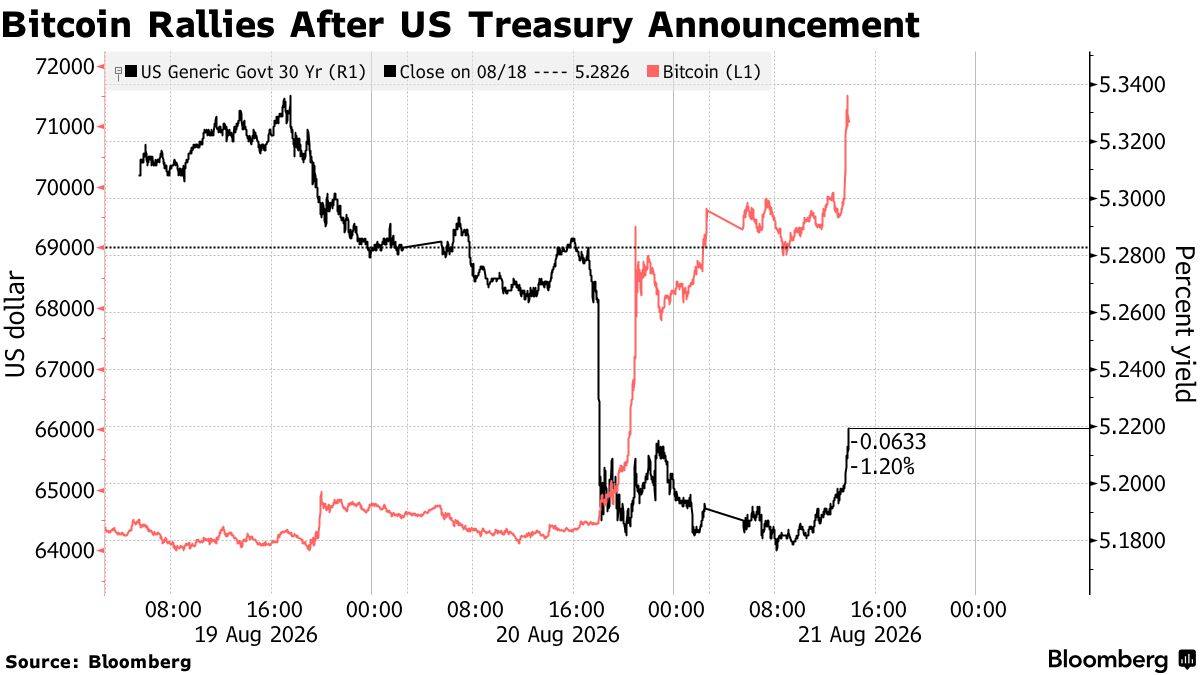
Recently, when long-term US bond yields have climbed to a high level for many years, the US Treasury Department unexpectedly announced that it will step up its repurchases of long-term US bonds. Just after announcing the current quarter's bond repurchase plan two weeks ago, the US Treasury Department said on Wednesday that it would “at least double the scale of liquidity support repurchase operations” for bonds in the 10-30 year range. US Treasury Secretary Bezent launched a bond repurchase program last year and sees it as part of the Treasury's “complete set of tools that can be introduced when necessary” to deal with disruptions in the US bond market. After the news was announced, US bond yields fell across the board, while the US dollar fell to a three-month low.
Jeff Mei, chief operating officer of BTSE, said: “When US bond yields fall and the dollar weakens, risk assets tend to rise, and we have seen Bitcoin rise driven higher by this news.” Rajiv Sawhney, head of international portfolio management at Wave Digital Assets, said that yield curve control “is the second largest factor in our list of potential catalysts and can drive Bitcoin's continued rise.” He added that the biggest catalyst would be the government authorizing the purchase of bitcoin as a national reserve.
Meanwhile, positive sentiment returned to the cryptocurrency market after Trump met with cryptocurrency company executives including Coinbase, Payward, and Blockchain.com Group on Wednesday. This move has rekindled market optimism about the Digital Market Asset Clarity Act — also known as the CLARITY Act. The bill aims to structure the cryptocurrency market, but previously failed to get a vote before the US Senate adjourns in August. The legislation has been at a standstill due to controversy surrounding the provisions of the Code of Ethics. Trump urged the Senate to pass the bill, and the Senate is expected to review the bill again after it reconvenes in mid-September.
It's worth mentioning that large Bitcoin holders (also known as Bitcoin giant whales) and institutional buyers also returned to the market this week. Over the past 60 days, the Bitcoin giant whale has increased its Bitcoin holdings by about $2.75 billion. Meanwhile, spot Bitcoin exchange-traded funds (ETFs) listed in the US experienced large inflows from Monday to Wednesday — 13 ETFs have accumulated more than 1 billion US dollars in capital inflows so far this week, while last week they recorded an outflow of 389.7 million US dollars.
Vladimir Tikhomirov, co-founder of decentralized finance company Algebra, said: “The latest inflow data from US cryptocurrency spot ETFs further proves that institutional demand for crypto assets is growing steadily.”
Cryptocurrency traders have been searching for the bottom of the market in a bear market for months. This bear market began in October of last year, when Bitcoin once surpassed $126,000, then experienced a sharp sell-off, and has continued until now.
On the technical side of the market, some analysts pointed out that the technical damage suffered by Bitcoin in the past few months may be nearing its end, and the rebound driven by ETF capital flows, the weakening dollar, and institutional buying will begin from the end of the fourth quarter of 2026 to the beginning of 2027.
However, the negative factors in the crypto market are still significant. The US crypto industry's legislative process is progressing slowly, and there is great uncertainty about regulatory policies. If inflation rebounds, the Federal Reserve's continued high interest rates will continue to suppress risky assets such as cryptocurrencies. Even if there is a phased rebound, the upward pressure on Bitcoin will still limit Bitcoin's upside.
Furthermore, Bitcoin's latest rise has reactivated options trading. According to Deribit data, Bitcoin call options worth $1.5 billion are currently executed at an execution price of $70,000 — this type of contract generates a return when the price of Bitcoin rises above the set price. Meanwhile, the execution price of a put option with an execution price of $60,000 is $1.4 billion, and this type of contract generates gains when Bitcoin falls below that level. The two are close in size, indicating that traders are preparing for market fluctuations.