


The Zhitong Finance App learned that although US Treasury Secretary Scott Bessent is trying to curb interest rates on long-term bonds, Aegon Asset Management is still betting that the spread between short-term and long-term US borrowing costs will continue to widen.
The US Treasury Department announced on Wednesday that it will “at least double” the scale of liquidity support repurchase operations for 10-year to 30-year treasury bonds, raising the upper limit of a single repurchase from 2 billion US dollars to at least 4 billion US dollars. After the news was released, the bond market reacted positively. The 10-year US bond yield fell 6 basis points to 4.65%, and the 30-year yield plummeted by nearly 10 basis points to 5.18%. On the previous trading day, the 30-year US bond yield once broke through 5.33%, a record high since 2007.
However, according to Aegon portfolio manager James Lynch, expanding the scale of long-term US bond repurchases “does not make much sense” and will not change his view that the yield curve in the US and Europe will continue to steep.
The US Treasury yield curve flattened after the US Treasury announced an expansion of repurchases
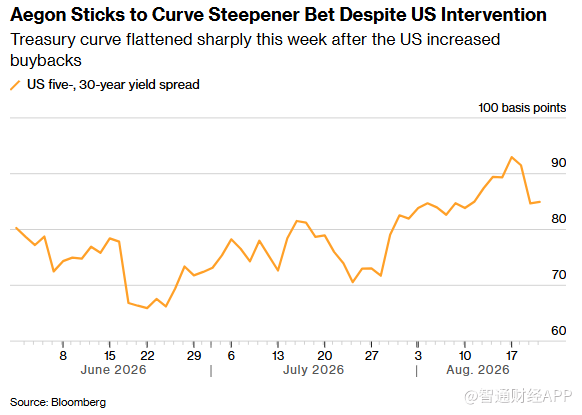
According to the data, Aegon's Absolute Return Bond Fund (Absolute Return Bond Fund) has performed more than 80% of similar products in the past month. Lynch said that one of his successful strategies was based on “multiple structural factors” to bet that 30-year US bond yields would rise faster than 5-year US bonds.
Lynch said, “Fiscal issues — huge deficits, the influx of large-scale corporate debt into the market, the inflation rate is still above target levels, and the Federal Reserve's lack of clear communication are all injecting an additional premium into the market. I don't think these factors will go away anytime soon.”
Across the world, steepener trades (steepener trades) are increasingly favored by hedge funds and other asset managers. The core logic is that as the supply of government bonds continues to increase, long-term yields must rise further to attract enough buyers.
Long-term bonds have become the focus of intense investors' attention. On the one hand, inflationary pressure persists; on the other hand, the debt-driven AI boom is making the government compete for buyers in the same market with high-rated, large-scale financing tech giants (i.e. “hyperscale enterprises”).
Currently, the yield on US 30-year Treasury bonds has surpassed 5%, hitting the highest level in nearly 20 years. Meanwhile, short-term yield gains have narrowed over the past month due to market signs that the Federal Reserve is not in a hurry to raise interest rates.
Aegon's £165 million (US$225 million) bond fund has a return rate of 2.36% so far this year. Revenue sources include short-term bond allocation, active long-term management, and steep trading. Lynch adopted a steep trading strategy for US debt as early as mid-June. Furthermore, he is betting that long-term European and British bonds will perform less well than short-term bonds.
He is considering gradually shifting his steep position to directly holding long-term bonds as we enter 2027, but he is cautious about the timing of direct betting on rising bond prices.
“The situation is a bit chaotic right now, but I think this might be a good opportunity to go long,” Lynch said. “Unfortunately, no one is going to sound the alarm and tell you, 'Yes, now is a good time to do more. '”
What does Wall Street think of the new US debt buyback deal?
After the US Treasury took action, the US bond market experienced a rebound. Despite this, Wall Street's views on this repurchase adjustment are still divided.
J.P. Morgan said bluntly that the US Treasury expanded the buyback to “treat the symptoms rather than the root causes.” J.P. Morgan strategists, including Jay Barry, pointed out that this operation essentially only deals with the “symptoms” of rising long-term yields, and does not touch on the fundamental problem — the current US economy is close to full employment, the fiscal deficit still accounts for about 6% of GDP, and continued high demand for financing is the core reason why long-term interest rates are under pressure. The bank warned that if the Ministry of Finance becomes more “opportunistic” in debt management and further deviates from the traditional “regular and predictable” issuance principle, investors may instead demand higher term premiums, ultimately driving up long-term financing costs. J.P. Morgan predicts that the US financing gap will exceed 3.5 trillion US dollars in the next few fiscal years. Unless fiscal consolidation is substantially promoted, the impact of this repurchase adjustment on long-term interest rates is likely only temporary.
Barclays believes that although the actual market impact is limited, the significance of policy signals cannot be ignored — investors clearly know that if long-term yields continue to rise, the US Treasury is willing to adjust the issuance structure. In the future, the US Treasury could further increase the scale of repurchases or clearly reduce the issuance of long-term treasury bonds at the November financing conference. However, the bank quoted Japan's experience as reminding that reducing the supply of long-term bonds can only buy time. After Japan cut the issuance of ultra-long-term treasury bonds in 2025, the 40-year yield once fell by about 50 basis points, but then hit a new high again. In the end, a return to fiscal consolidation is necessary to truly resolve the issue.
In contrast, Citi's stance is more positive. The bank proposed buying 20-year US Treasury bonds, believing that the US Treasury's move was intended to limit the rise in long-term yields, and determined that with the cooling of inflation, there is a strong chance for the US bond market to rebound in the next few months.
From Aegon's firm bet on steeping, to J.P. Morgan Chase's “cure the symptoms, not the root causes” warning, to Citi's optimistic layout, it shows that the market's game on the trend of US bond interest rates is far from over.