


United Parks & Resorts has delivered a 23.7% gain year to date, yet valuation checks still suggest the stock may trade below an estimate of its intrinsic value based on a Discounted Cash Flow (DCF) model and market multiples.
- The stock is up 23.7% year to date, which means investors are already pricing in a more optimistic outlook than they had at the start of 2026.
- The valuation hinges on how reliably United Parks & Resorts can convert visitor volumes into stable cash flows. Any slowdown in attendance or higher operating costs may cap how much investors are willing to pay for that cash flow stream.
- The company screens as undervalued in 4 of 6 checks, which points to a mixed picture rather than a clear bargain or clear overvaluation on the broader assessment of metrics such as cash flows and multiples, according to this valuation summary.
The issue now is whether the current share price gives United Parks & Resorts investors enough margin between market price and that intrinsic value estimate to justify taking on the business risks involved.
Find out why United Parks & Resorts' -12.6% return over the last year is lagging behind its peers.
Is United Parks & Resorts a Bargain on Cash Flow?
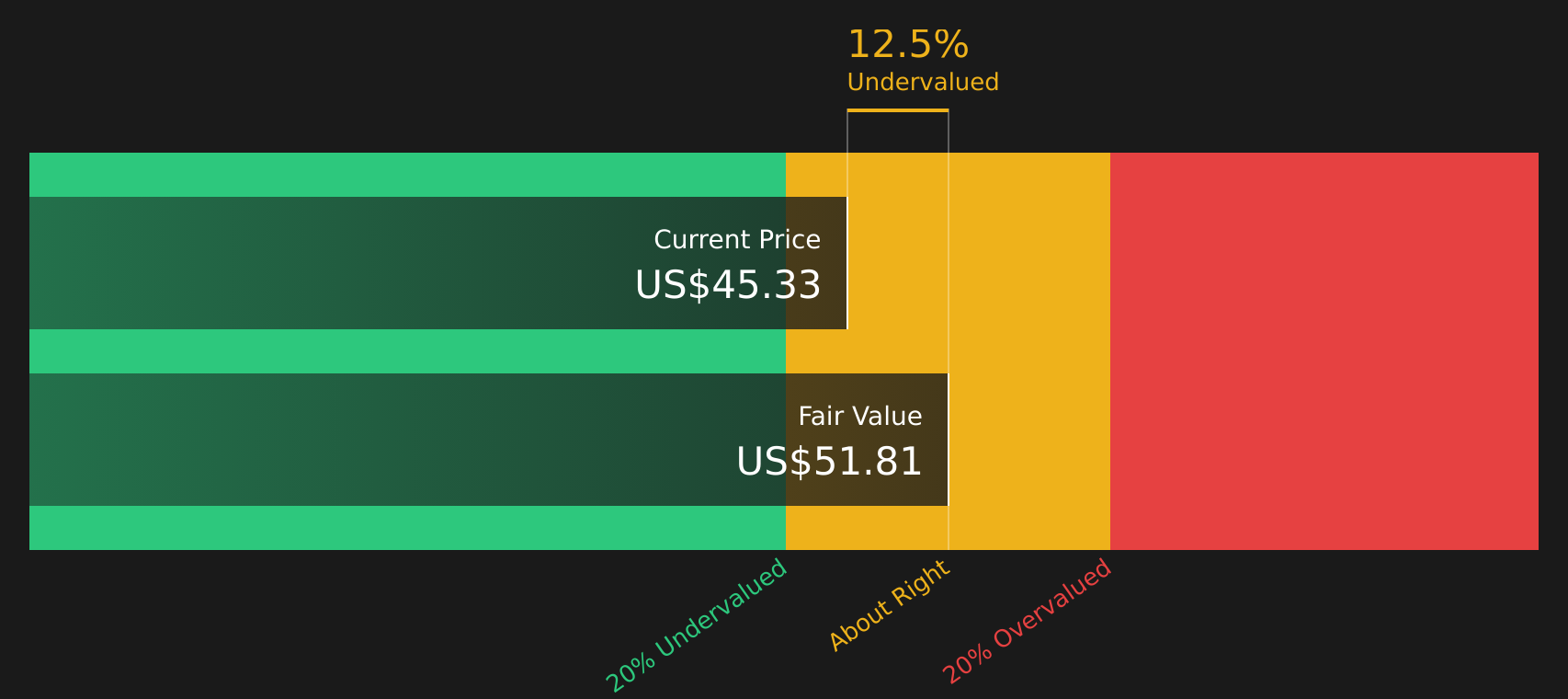
The Discounted Cash Flow (DCF) model values United Parks & Resorts by projecting the cash it can return to shareholders over time and discounting that back to today. Based on the latest twelve month free cash flow of about $163 million and analyst projections that assume growing but moderate future free cash flows, the model points to an intrinsic value of about $51.84 per share.
Compared with the current market price, this implies United Parks & Resorts trades at roughly a 13.6% discount to that intrinsic value estimate. The margin is not huge, yet it suggests investors are paying less than what the projected cash generation might justify, as long as free cash flow remains broadly in line with these projections.
On this Discounted Cash Flow view, the stock currently appears undervalued relative to the cash it is expected to generate.
Our Discounted Cash Flow (DCF) analysis suggests United Parks & Resorts is undervalued by 13.6%. Track this in your watchlist or portfolio, or discover 50 more high quality undervalued stocks.
Is United Parks & Resorts a Bargain on Earnings?
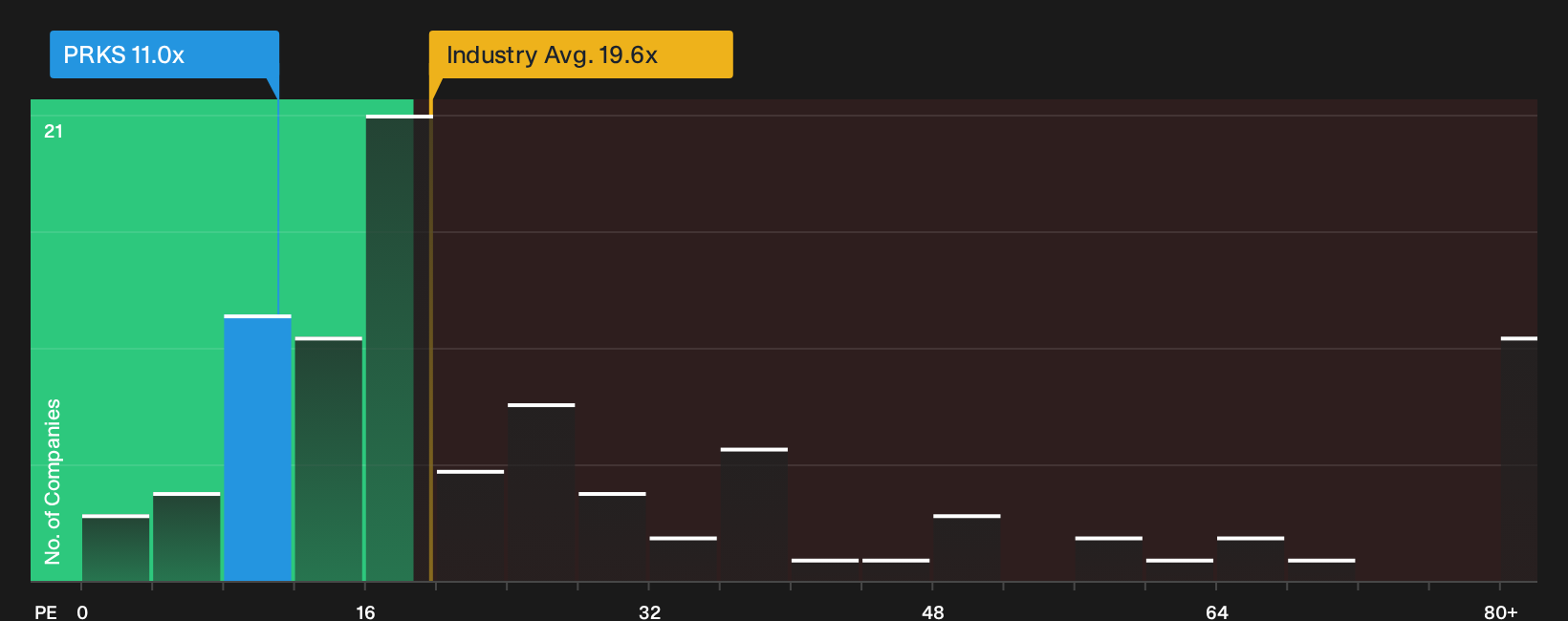
P/E is a useful cross check for United Parks & Resorts because earnings capture the company’s ability to turn its visitor base and pricing into profit. On this measure, the stock trades on a P/E of about 15.2x, which is well below both the Hospitality industry average of roughly 23.7x and a peer group average of about 26.6x.
A fair P/E for United Parks & Resorts, based on its mix of growth expectations, margins, size and risk profile, is estimated at about 18.3x. That is still above where the stock trades today, which points to a discount even after adjusting for company specific factors rather than just using broad industry benchmarks.
On the P/E multiple, United Parks & Resorts appears undervalued compared with where similar companies trade and where its own earnings profile might justify.
See what the numbers say about this price — find out in our valuation breakdown.
The United Parks & Resorts Narrative: What Would Justify Today's Price?
Simply Wall St Narratives pick up where the valuation checks leave off for United Parks & Resorts. They explain which assumptions on future growth, margins and earnings would need to hold for the stock to be worth significantly more or less than today’s price. Each Narrative also presents United Parks & Resorts' fair value as a thesis about the business that you can revisit over time as new information arrives on the Community page.
One of the top community narratives on United Parks & Resorts: 5% undervalued
"Real estate and hotel partnership opportunities centered on valuable, underutilized land holdings have not been fully credited in the current valuation, presenting potential upside..."
Read one of the top narratives on United Parks & Resorts
Do you think there's more to the story for United Parks & Resorts? Head over to our Community to see what others are saying!
The Bottom Line
United Parks & Resorts screens as undervalued on both the Discounted Cash Flow (DCF) intrinsic value estimate and the earnings multiple view, although the broader checks are mixed rather than overwhelmingly strong. That points to a stock that may be modestly mispriced rather than a clear bargain. The key question from here is whether United Parks & Resorts can keep converting visitor volumes into resilient cash flows without a meaningful squeeze on costs. The answer will help determine whether the current discount reflects opportunity or simply compensates for ongoing business risk.
This article by Simply Wall St is general in nature. We provide commentary based on historical data and analyst forecasts only using an unbiased methodology and our articles are not intended to be financial advice. It does not constitute a recommendation to buy or sell any stock, and does not take account of your objectives, or your financial situation. We aim to bring you long-term focused analysis driven by fundamental data. Note that our analysis may not factor in the latest price-sensitive company announcements or qualitative material. Simply Wall St has no position in any stocks mentioned.
Have feedback on this article? Concerned about the content? Get in touch with us directly. Alternatively, email editorial-team@simplywallst.com