


The Zhitong Finance App learned that during Scott Colbert's 40-year bond investment career, he rarely felt the need to drastically adjust his strategy. But he said that right now is such a critical moment. Colbert works for Clayton Commercial Bank in Missouri as a fixed income director with a management scale of 28 billion US dollars. He didn't anticipate the economic cloud coming to a head — on the contrary, he expected economic growth to accelerate in the coming months. The problem is that the current price of corporate debt is too high, and there is very little room for fault tolerance, so the potential return is no longer sufficient to cover the risks taken.
The yield on bonds issued by US blue-chip companies, from AT&T (T.US) and J.P. Morgan Chase (JPM.US) to Amazon (AMZN.US), is only 0.8 percentage points higher than US Treasury bonds. This premium level almost hit the nearly 30-year low set earlier this year. This means that as long as the spread widens by about 12 basis points, it will be enough to offset the excess yield of these bonds compared to treasury bonds for a full year.
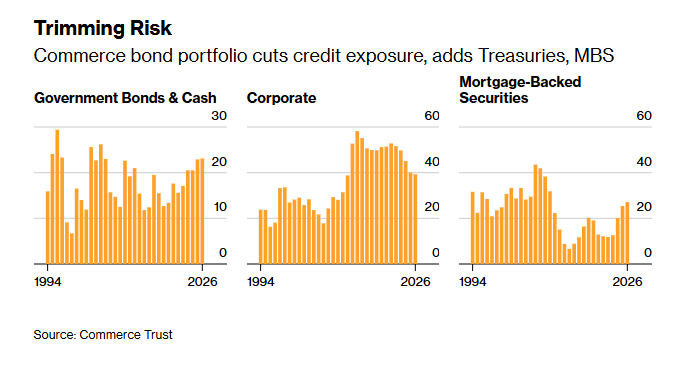
This is part of the reason Colbert cut its corporate credit allocation exposure to its lowest level since 2012. At the same time, he raised the safest asset allocation ratio in the fixed income market such as US Treasury bonds, government agency bonds, and cash to the highest level since 2005.
Colbert, 65, has managed the $1.1 billion Commerce Bond Fund since 1994, and is also the longest-serving fund manager among similar funds rated by Morningstar. “The opportunities in the market are really limited,” he said. The return on the risk I took was the lowest since I started in the business.”
This adjustment has yet to yield significant returns. So far this year, the overall US Treasury bond index has declined by about 0.1%, and its performance is slightly lower than that of corporate bonds and the overall fixed income market. The reason is that concerns about inflation and deficits have driven long-term yields close to a 20-year high. To ease the pressure, US Treasury Secretary Scott Bessent unexpectedly announced an increase in long-term treasury bond repurchases on Wednesday.
However, Colbert remained patient — his fund has beaten 94% of similar products over the past 15 years. He has been steadily reducing risk for quite some time. According to the latest data, by the end of June, the share of corporate bonds in mutual funds and separate accounts had fallen to 39%, far lower than about 53% in 2021.
Meanwhile, the ratio of treasury bonds to cash holdings rose from less than 16% five years ago to 23%. Meanwhile, the share of some mortgage-backed securities (MBS) with government guarantees more than doubled during this period to 27%.
The adjustment in favor of higher quality assets raised the average credit rating of its portfolio from A+ to AA-, the highest level in history.
The background of this realignment is that investors are pouring into the credit bond market, attracted by absolute yields at unusually high levels since the financial crisis, and economic resilience has not abated. These capital inflows have further lowered the premium on corporate bonds compared to treasury bonds, making it close to the narrowest level since 1997. Even as technology companies issue large amounts of debt to invest in artificial intelligence (AI), supply surges.
Colbert pointed out, “If there's ever a time to moderately reduce risk, then it is now — because you give up the least amount of benefits.”
Historically, Colbert's credit risk has always been higher than the benchmark — the Bloomberg US Composite Bond Index. Even after the cuts, his current corporate debt exposure is still about 15 percentage points higher than the benchmark that should be dominated by treasury bonds.
Therefore, this position reduction operation is not a bet on a downturn in the economy, but rather a risk management strategy.
Colbert admits, “If the market actually crashes, I will also be hurt. So I don't expect that to happen. It's just, on the margins, I don't want to take as many risks as before.”
Worries about the “AI bubble”
One risk that Colbert keeps a close eye on is the stock market.
The AI boom has driven the total market value of the US stock market to about $82 trillion, equivalent to more than 250% of the total US economy — about 100 percentage points higher than during the peak of the internet bubble.
Colbert doesn't think the AI boom — he calls it a “bubble” — will burst any time soon. However, he is worried that once the stock market fluctuates, it may impact consumer spending, and the latter is supported by the increase in residents' wealth.
Colbert Ben, a person with a background in nuclear engineering, entered the investment industry in 1986. At the time, he was employed by Armco Steel, one of the largest steel manufacturers in the US at the time, and was responsible for managing the company's pension fund's bond investments.
He recalls, “When I first arrived, they said to me, 'We'll leave the stock to smart people in Chicago, New York, and London to take care of. But bonds can be managed by any layman. ' ——I am that 'layman.'”
However, the timing for his career was just right. Paul Walker was working to curb inflation at the time, starting a decades-long boom in bonds. Colbert joined Commerce Bank in 1993 and took over Commerce Bond Fund the following year.
Unlike some investors who bet on interest rate trends, he kept his portfolio's long-term (an indicator of interest rate risk) close to the benchmark. Instead, he obtained excess income through spread products such as corporate bonds, mortgage-backed securities, and asset-backed securities.
This strategy continues to deliver consistent excellent performance. Over the past 15 years, the fund has had an average annual return of 2.5%, far exceeding the benchmark.
Colbert pointed out that the current market environment reminds him of the internet bubble in the late 90s of the last century. At the time, after Federal Reserve Chairman Alan Greenspan warned of “irrational prosperity” in 1996, the stock market pulled back briefly, and then continued to rise for many years.
Colbert concluded that the lesson is that high valuations may last far beyond investors' expectations, so it is almost impossible to accurately determine market inflection points. Instead of betting on the timing, it is better to calmly reduce risk while adjusting the low cost.
He said, “At a time when things are going great, I'd rather take it easy. Don't be greedy.”