


Lockheed Martin stock has delivered a strong 80.8% total return over the past five years, and the current valuation checks now point to the shares trading below an internally estimated intrinsic value rather than at a clear premium to that run.
- An 80.8% gain over five years suggests investors have already been rewarded, so any further upside case rests on what the current price implies about future cash flows.
- Progress on long term defense programs such as Japan’s Aegis System Equipped Vessel and new missile technology platforms like Strigo can support cash flow expectations, while heavy reliance on government defense budgets may limit how much investors are willing to pay for that growth.
- Lockheed Martin screens as undervalued on most of Simply Wall St's checks, with a high value score of 5 out of 6 that is backed up by a Discounted Cash Flow (DCF) estimate and earnings multiple view, both pointing to an undervalued stock.
The issue now is whether the current market price of Lockheed Martin still leaves enough upside to the intrinsic value estimate to justify the risks investors are taking on.
Is Lockheed Martin Still Cheap on Cash Flow?
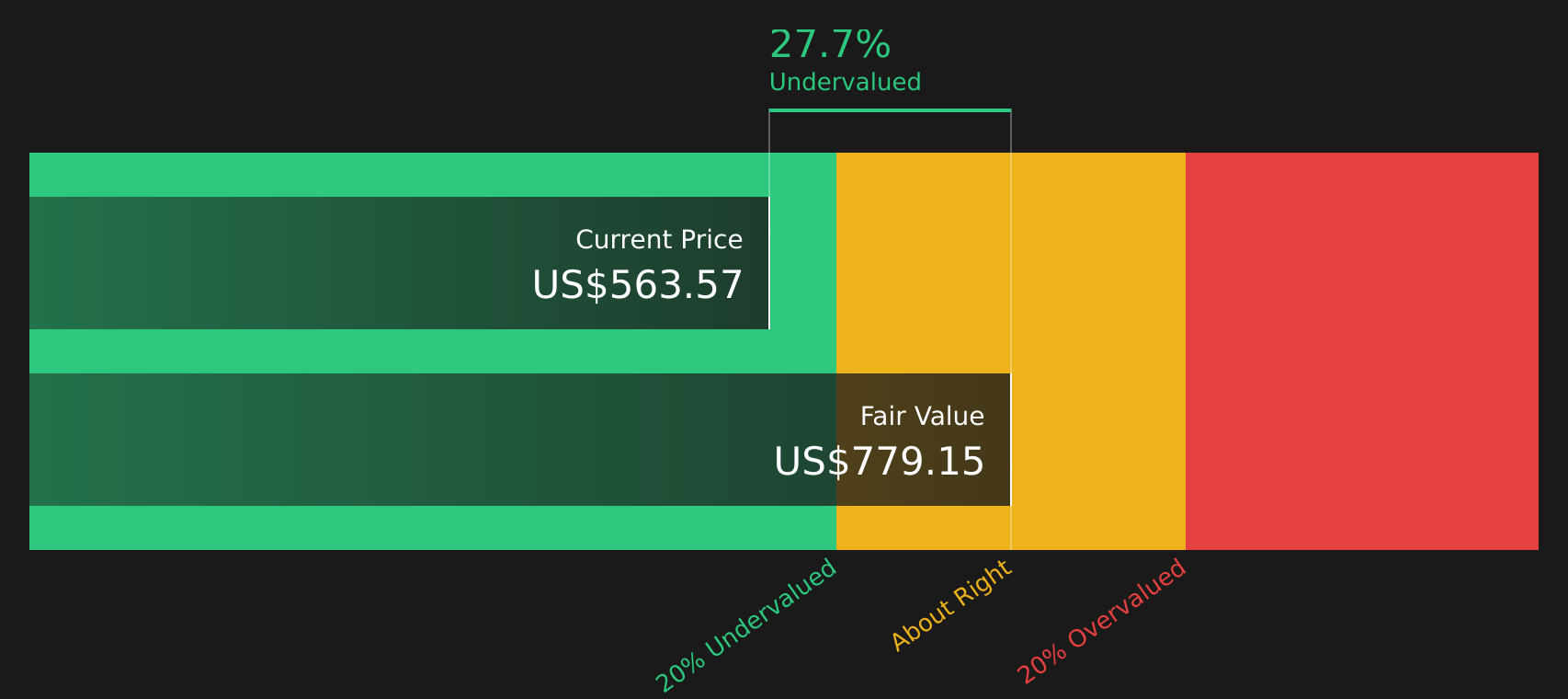
The Discounted Cash Flow (DCF) approach values Lockheed Martin by estimating the cash it can return to shareholders over time. The model uses latest twelve month free cash flow of about $8.6b and assumes cash flows grow from this base rather than shrink. On that basis, the 2 Stage Free Cash Flow to Equity model arrives at an estimated intrinsic value of about $779 per share.
Compared with the current share price, this implies a 26.6% discount, so the stock screens as undervalued on this cash flow view. The DCF is consistent with a business that already produces sizable free cash flow and is modeled to keep growing it, instead of relying on a sharp turnaround story. The recent validation of Japan’s first Aegis System Equipped Vessel suggests large, long duration defense programs are feeding into those projected cash flows, even if the market is not fully pricing that in today.
On the DCF numbers, Lockheed Martin stock currently looks undervalued relative to its modeled cash generation.
Our Discounted Cash Flow (DCF) analysis suggests Lockheed Martin is undervalued by 26.6%. Track this in your watchlist or portfolio, or discover 50 more high quality undervalued stocks.
Is Lockheed Martin Still Cheap on Earnings?
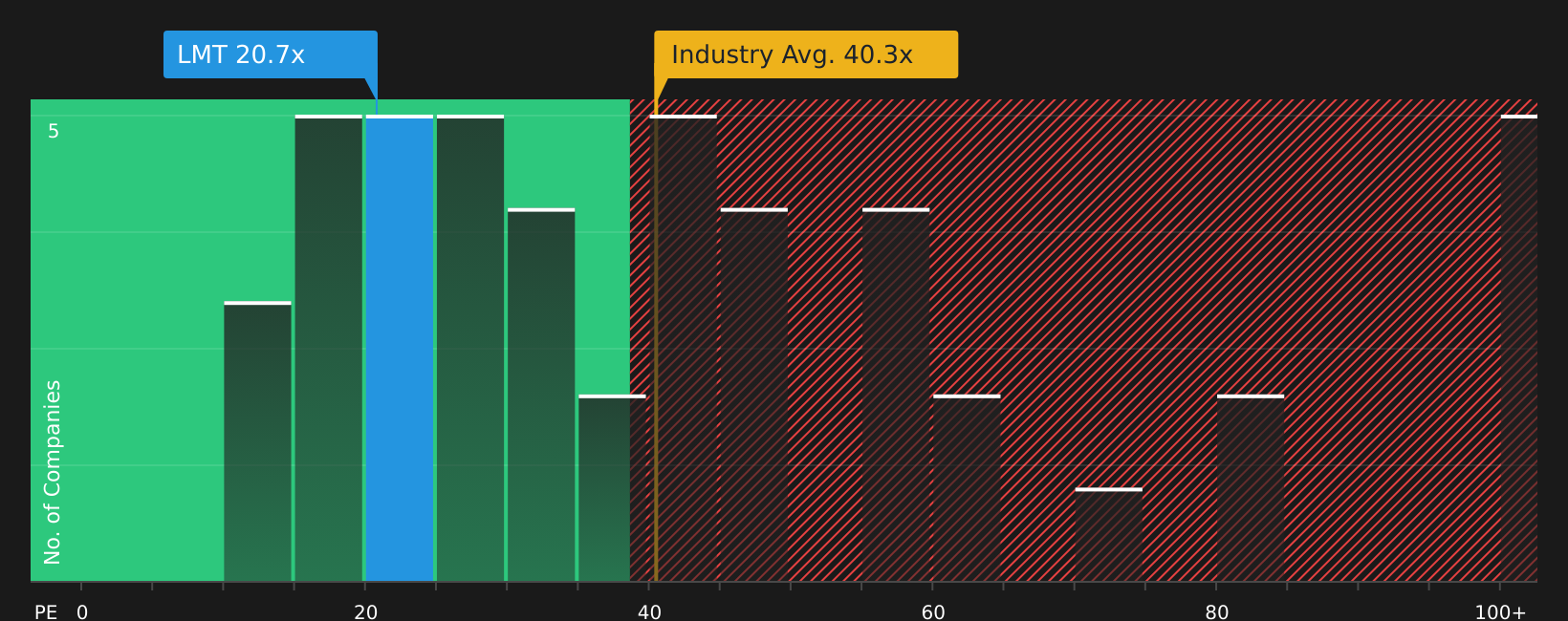
P/E is a useful cross check for Lockheed Martin because earnings are a key focus for mature, cash generative defense contractors. The stock trades on a P/E of about 21.0x, which is roughly half the Aerospace & Defense industry average of 40.5x and sits well below the broader peer group average of 45.2x. That places Lockheed Martin at a clear discount to many competitors on an earnings basis.
A fair P/E ratio of about 31.3x is implied once factors such as scale, margins, industry position and risk profile are taken into account. The current 21.0x multiple is well under this fair ratio, which indicates that earnings are being priced conservatively given the company’s role as a major defense supplier to the U.S. and allied governments.
On this P/E comparison, Lockheed Martin stock appears undervalued relative to both tailored and industry earnings benchmarks.
See what the numbers say about this price — find out in our valuation breakdown.
The Lockheed Martin Narrative: What Would Justify Today's Price?
Simply Wall St Narratives take the valuation puzzle for Lockheed Martin and turn it into clear, explicit assumptions about future growth, margins and earnings that would need to hold for the stock to be worth materially more or less than today’s price. These Narratives sit on the company’s Community page. Each Narrative treats its fair value as a thesis about Lockheed Martin's business that you can revisit over time to see how it holds up against new information.
The community is split on Lockheed Martin, with one side focused on missile backlogs and contracts and the other on budget risk and margin pressure.
Bull case: 9% undervalued
"Demand for advanced platforms such as the F-35, PAC-3, THAAD, and hypersonic weapons is being reinforced by actual combat use and rising geopolitical tensions, with multiple U.S. and international customers increasing orders and strong backlog growth likely, positioning Lockheed Martin for robust top-line (revenue) growth going forward…"
Read the full Bull Case to see why Lockheed Martin could be undervalued
Bear case: 12% overvalued
"Persistent cost overruns and newly identified reach-forward losses on legacy and classified programs highlight ongoing supply chain pressures and potential future margin compression, especially as fixed-price contracts become more common, this is likely to weigh on net profit margins for multiple years…"
Read the full Bear Case to see why Lockheed Martin could be overvalued
Do you think there's more to the story for Lockheed Martin? Head over to our Community to see what others are saying!
The Bottom Line
For Lockheed Martin, both the Discounted Cash Flow (DCF) intrinsic value estimate and the P/E comparison point to an undervalued stock rather than one priced for perfection. The broader valuation checks are strong and the two frameworks are broadly telling the same story, which reduces the chance that the discount is just a quirk of one model. What really decides it from here is whether Lockheed Martin can defend margins and execution on long term defense programs while managing budget and contract risk. The key question for investors is whether the current discount reflects opportunity or is simply compensation for those execution and policy uncertainties.
This article by Simply Wall St is general in nature. We provide commentary based on historical data and analyst forecasts only using an unbiased methodology and our articles are not intended to be financial advice. It does not constitute a recommendation to buy or sell any stock, and does not take account of your objectives, or your financial situation. We aim to bring you long-term focused analysis driven by fundamental data. Note that our analysis may not factor in the latest price-sensitive company announcements or qualitative material. Simply Wall St has no position in any stocks mentioned.
Have feedback on this article? Concerned about the content? Get in touch with us directly. Alternatively, email editorial-team@simplywallst.com