


The Zhitong Finance App learned that the US Treasury unexpectedly increased the repurchase of long-term treasury bonds, highlighting the global financial market's concerns about its debt burden. Gold spot and futures trading prices are expected to rise for three consecutive weeks. As far as the price curve of gold is concerned, it is receiving a “dual path benefit” structure triggered by the US government's repurchase of long-term US bonds of 10 years or more — the decline in risk-free yield earns the opportunity cost of holding, and when the yield is out of control, it earns a credit premium. The spot price of gold traded steadily above the key mark of $4,500 per ounce at the beginning of the Asian market on Friday. Previously, it surged more than 4% in a single day on Wednesday, causing investors who are optimistic about the long-term gold bull market to chant “the familiar gold bull market from half a year ago has finally returned.”
With the spot price of gold trading around $4,530 per ounce, the cumulative increase is expected to exceed 3% this week. Although the 30-year US Treasury yield returned to around 5.27% in the intraday market on Thursday, almost erasing the decline in US bond prices after the US Treasury announced an expansion of repurchases, the “declining long-term US bond yields+weakening dollar” intervention effect brought about by the US Treasury's unexpected injection of strong liquidity on Wednesday EST and increasing safe-haven demand continued to boost gold trading prices and bullish market expectations.
On Thursday EST, US Treasury Secretary Scott Bessent said that the US Treasury is ready to expand the repurchase scale of debt with high comprehensive financing costs, and revealed that the government will soon announce a fiscal measure to deal with the highest benchmark borrowing costs in the US bond market in many years.
The repurchase of long-term US bonds itself is not the Federal Reserve's quantitative easing (QE), nor will it reduce US government debt. However, the Treasury's US bailout bonds have instead fueled a new round of gold's bull market.
As far as expectations of a new round of gold bullish markets are concerned, the real significant impact is to change the market's expectations about the policy response function of the Federal Reserve and the US government: once investors believe that the administration will stop long-term financing costs from getting out of control with larger dollar investments, lower real interest rates, or more active debt term management, the gold price distribution will show a clear upward bias, driven by the continued depreciation of the US dollar and the decline in risk-free returns for a period of 10 years and longer.
Market debt anxiety compounded by the storm in Hormuz: Gold rose 11% a month, ready for a new round of bull market
Although the yield on 10-year and more long-term treasury bonds recovered most of the decline caused by the Treasury Department's repurchase action in the latter half of this week, the move reflects market concerns about a sharp rise in US government debt. As investors generally actively seek alternative safe-haven assets, the pessimistic theme of Western countries' escalating fiscal deficits is one of the most important factors driving the gold market upward for many years before.
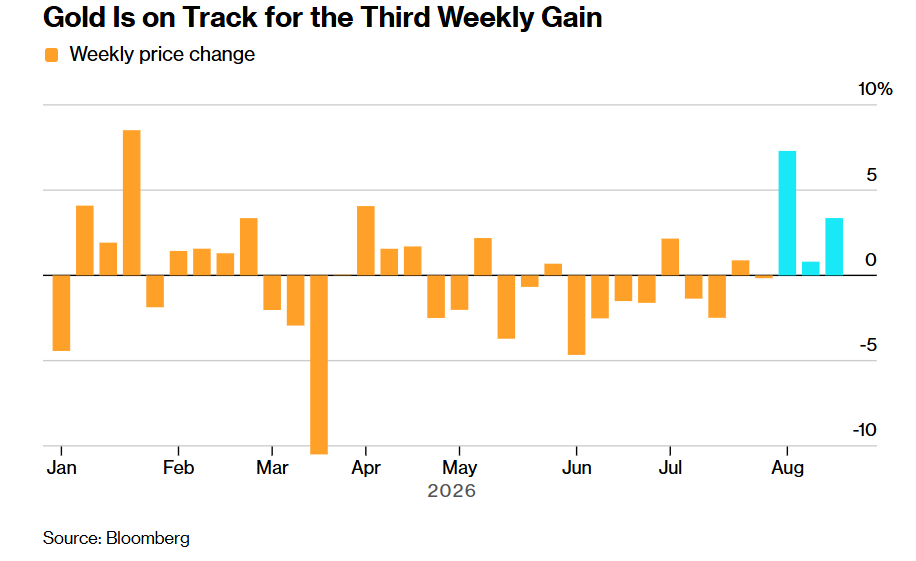
As shown in the chart above, the price of gold is expected to rise for three consecutive weeks.
The US Treasury raised the maximum single liquidity support repurchase limit for 10-30-year long-term treasury bonds from $2 billion to at least $4 billion, initially causing the 30-year yield to fall by about 9-10 basis points, the dollar fell and drove a sharp rise in gold, but the yield then recovered most of the decline, indicating that repurchases only improved the liquidity of old securities, neither wrote off government debt, nor solved the fiscal deficit, interest expenses, and the crowding out of long-term capital by large AI-related technology companies.
As a result, the positive market effects brought about by the US Treasury's intervention policy are rapidly declining. Instead, they have revealed to global investors the fragility of long-term treasury bonds requiring official backing, and strengthening “fiscal dominance” and “sovereign currency credit dilution transactions” (Debasement Trade): the authorities may be more willing to accept the continued weakening of the dollar and the trajectory of marginal easing of financial conditions to suppress unsustainable financing costs. However, this logic of “saving the US dollar is abandoning the dollar” should be understood as trading logic, not the US officially abandoning the strong dollar policy
This has also enabled gold to obtain a rare “double path benefit” structure with upward convexity: if expanded repurchases lower real interest rates and the US dollar, the opportunity cost of holding interest-free gold falls; if repurchases fail and long-term bond yields continue to rise due to financial risks, gold will also benefit as a sovereign credit hedging tool. The price of gold is currently around 4,530 US dollars per ounce and is expected to rise for the third consecutive week, with a cumulative increase of about 11% this month.
Gold has accumulated an increase of about 11% so far this month, but rising expectations of broad inflation and interest rate hikes triggered by a rebound in energy prices may curb its gains, as this causes inflation risks and interest rate hikes to continue.
US President Donald Trump has threatened to completely destroy Iran's economy, further weakening hopes of reaching an agreement and reopening the Strait of Hormuz in the short term. Combined with ongoing attacks by the Houthis on Saudi Arabia, the scale of shipping in the Mander Strait, another critical Middle Eastern energy transit strait, has been drastically reduced, and crude oil prices are expected to record a significant weekly rise. The White House said it will release details of the plan on Monday.
Since mid-July, gold has remained above the key support level of $4,000 per ounce; previously, the war-induced decline pushed the price of gold into a bearish range in June, and then dips began to be bought. Gold is still about 15% below the level before the US-Iran conflict broke out at the end of February.
As of 8:11 a.m. Singapore time, spot gold rose 0.2% to $4,522.90 an ounce. Silver rose 0.1% to $68.16 an ounce. Platinum and palladium are also both rising. The Bloomberg Dollar Spot Index, which measures the dollar's trend, fell 0.1%.
Precious metals investors need to be wary of this path — if inflation forces the Federal Reserve to tighten beyond expectations and the real yield continues to rise at the same time as the US dollar, gold may continue to be under pressure; however, as long as the rise in long-term yields is mainly due to fiscal credit risk rather than actual growth improvement, gold may break the traditional long-term logical relationship of “rising yield and falling gold prices” to achieve the dual benefits of “falling interest rates, earning opportunity costs from falling interest rates and uncontrolled interest rates to earn credit premiums.”
Is the familiar gold bull market back? Gold regains 4,500 US dollars, and Wall Street targets are focused on 4,900 to 6000 US dollars
As the spot price of gold has remained at the key support level of 4,000 US dollars since mid-July and has remained stable at the 4,500 US dollar mark recently, it shows that the gold market is no longer just a technical recovery after the US-Iran conflict, but a structural revaluation driven by US debt exceeding 40 trillion US dollars, the long-term yield curve effect of policy intervention, and the diversification of global reserves.
The Treasury Department expanded the repurchase of 10-30 US Treasury bonds, creating a “dual path benefit” structure with upward convexity for gold. The first path is that the policy works: the Ministry of Finance absorbs long-term risks, lowers nominal and real returns, and weakens the dollar, thereby reducing the opportunity cost of holding interest-free gold; the second path is policy failure: if repurchases only briefly depress yields, then long-term bonds are sold off again, the market will further price fiscal deficits, term premiums, and dollar credit dilutions, while gold receives a higher risk premium as a non-sovereign reserve asset. After the announcement of this buyback, yields and the US dollar fell first, and gold surged, while long-term bond yields then quickly rebounded, which just happened to allow these two bullish logics to be verified by the market.
Wall Street's target range is also moving up at the same time: Citi strategist Dirk Willer sees gold at $5,000 to $6,000 per ounce in the next year, based on Treasury intervention, risk of losing control of US bond maturity premiums, weakening of the US dollar, and the restart of “de-dollarization” transactions; Deutsche Bank's year-end benchmark target is 4700—5100 dollars, relying on the central bank's gold purchases and ETFs to return two non-price-sensitive demand — the net inflow of gold ETFs over the past 30 days, with a cumulative increase of about 4 million ounces during the first quarter of 2026 The amount of funds purchased by the central bank reached 38.88 billion US dollars. It is worth noting that the $6,400 in Deutsche Bank's calculation model is a statistically upward scenario and is not an official benchmark target.
The strategist team led by Bank of America senior strategist Michael Hartnett, who has the title of “Wall Street's Most Promising Strategist”, proposed “going long on gold is the best solution right now”, and the so-called “gold is in an explosive upward phase” and the underlying logic of other Wall Street banks bullish on gold essentially points to the same main structural investment line: the US government's increasingly huge debt, $1.4 trillion interest expenses and the wave of AI companies' debt issuances compete for long-term capital and push up the maturity price; Endangering fiscal sustainability and risk Assets, policy departments must also try to reduce financing costs, so gold becomes an asset to hedge against the cycle of “damage to bond values — policy intervention — decline in the actual purchasing power of the US dollar.”
The reason Michael Hartnett listed “going long on gold” as the best current deal is that it is the best tool to hedge against the depreciation of the US dollar, debt disorder, and asset inflation. The underlying judgment is that US debt may approach 50 trillion US dollars around 2029, and the AI financing frenzy is further competing for institutional capital originally belonging to long-term treasury bonds.
According to Wall Street financial giants such as Bank of America and Deutsche Bank, gold is likely to be entering a new upward period in a long-term structural bull market, but it is not yet possible to assert that a single-day surge alone has restarted the linear gold main upward wave in the short term. After the geopolitical situation in the Middle East gets out of control, if sharp energy inflation forces the Federal Reserve to continue to raise interest rates and real yields rise again, gold may still retreat to a low of around 3,900 US dollars.
Wall Street's long-term bullish target price for gold is “consistent in direction and amplitude divergence”: Deutsche Bank's latest year-end range is $4,700—5,100; Goldman Sachs maintained its year-end target at $4,900 after shifting to more hawkish interest rate assumptions; Bank of America's bullish target for 2026 is $5,000; Morgan Stanley and UBS respectively expect the price of gold to rise to 5,200 dollars in the second half of this year or the next 12 months; J.P. Morgan Chase expects the average price to reach $6,000 in the fourth quarter of 2026. Based on $4,500, these targets roughly correspond to 4% to 33% of potential space. $4,700 is likely to be the first target area, while $5,000 to $5,100 is the core testing area for the institutional benchmark scenario. $6,000 would require further depreciation of the US dollar, accelerated return of ETF funds or accelerated expansion of fiscal deficits, and sharp deterioration in AI-related credit risks.