


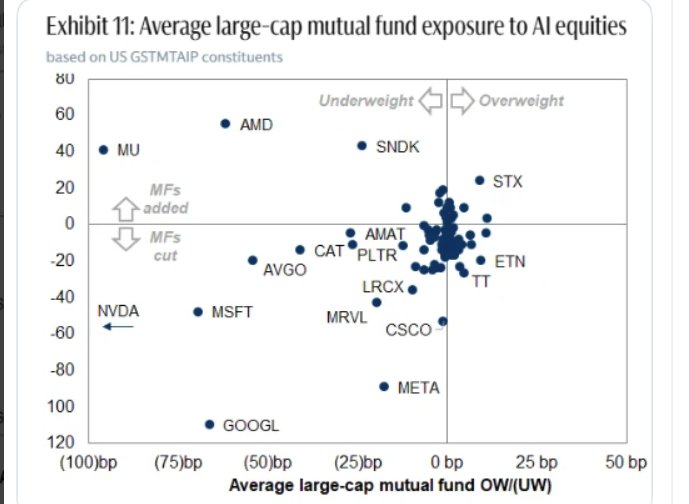
The Zhitong Finance App learned that according to a chart recently compiled by Wall Street financial giant Goldman Sachs and shared by well-known American financial writer and investment analyst Mike Zacardi, mutual fund institutions that focus on US large-cap stocks are still drastically under-equipped with NVDA.US (NVDA.US), the “AI chip superhegemon” with a current market capitalization of over 5 trillion US dollars. The chart shows that among the artificial intelligence-related stocks tracked, Nvidia's low allotment level was the most significant, with large cap mutual funds having an average low allocation margin of about 100 basis points.
Some of the other leaders in the AI computing power industry chain are also underrated by mutual fund institutions. For example, Nvidia's strongest competitor in the PC and high-performance computing chip fields — AMD (AMD.US), another GPU technology route leader, also ranks among the most under-allocated stocks, with a low allocation margin of about 60 basis points; Google (GOOGL.US) and Microsoft (MSFT.US), which rank among the top seven US tech giants (“Mag 7”), also rarely have “low allocations” — the specific low allocation ranges are about 70 basis points and 50 basis points, respectively cardinal points.
Facebook's parent company Meta Platforms (META.US) was underallocated by about 30 basis points; the US-based memory chip giant Micron Technology (MU.US) was an exception; the US large-cap mutual funds overallocated it by about 40 basis points.
The chart also shows that a number of popular AI computing power stocks are unexpectedly on the “overallocated” side of mutual funds, including Seagate Technology (STX.US), the US HDD storage hegemon with an overallocation of about 15 basis points, and the US NAND flash memory leader SanDisk (SNDK.US), which topped the S&P 500 index, with an annual increase of about 25 basis points lower than mutual funds on the chart position scale.
At the same time, statistics compiled by Goldman Sachs also show that in August, the capital flow of the TMT sector, which is the most popular sector in the US stock market for a long time, was almost driven by active going long rather than making up shorts, and the net allocation position benchmark index of the “Big Seven US Tech Giants” rebounded from about 14% to 18%, which largely indicates that real venture capital is re-betting on the main line of AI computing power investment. Large-cap mutual funds are underrated by Nvidia, AMD, Google, and Microsoft compared to the benchmark allocation, which means that once these stocks continue to outperform and the fundamentals of the AI computing power industry chain continue to usher in a major positive catalyst, the potential large-scale capital requirements of fund institutions that are forced to fill positions to reduce tracking errors and relative performance pressure are still considerable.
After the summer low, the “Big Seven Tech Giants” and TMT stocks dominated large-scale capital inflows in August
According to recent data compiled by Goldman Sachs's main brokers, in August of this year, Wall Street institutional forces were significantly returning to large technology stocks in the US stock market, as well as technology, media, and telecommunications (TMT) stocks, which became the main leaders in this round of capital return.
So far this month, stocks in the TMT sector have become the sector with the largest net purchases in the US stock market in a broad sense. What is particularly noteworthy is that this round of capital inflow was almost entirely driven by active purchases by institutional bulls rather than short returns, indicating that investors' bullish confidence in the growth prospects of this technology-led sector is rapidly recovering.
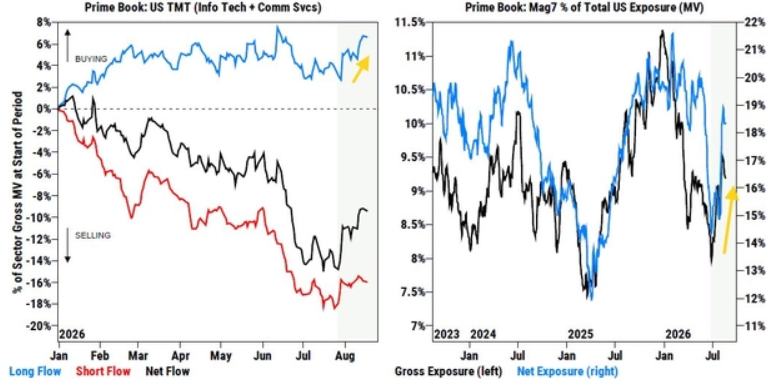
This aggressive buying spree is also rushing to the seven “big seven tech giants” with huge market capitalization in the US stock market — including Google (GOOGL.US), Amazon (AMZN.US), Apple (AAPL.US), Meta (META.US), Microsoft (MSFT.US), Nvidia (NVDA.US), and Tesla (TSLA.US). After experiencing a fall back in early summer, these tech giants have recorded significant net inflows since the beginning of August. According to the data, the net allocation ratio of institutional investors such as hedge funds to the “Big Seven” has risen sharply to about 18%, a significant rebound from the annual low of about 14% at the end of June.
The so-called “seven tech giants” (Mag 7), which occupy a high weight (over 40%) of the S&P 500 Index and the Nasdaq 100 Index, include: Nvidia, Apple, Microsoft, Google, Tesla, Amazon, and Facebook's parent company Meta Platforms. They are the core driving force behind the S&P 500 Index's record highs, and are also regarded by top Wall Street investment institutions as the most capable of bringing huge sums to investors in the context of the biggest technological transformation since the Internet era A combination of rewards.
The S&P 500 Index's “AI Super Bull Market”, which has accumulated a cumulative increase of more than 30 trillion US dollars over the past three years, is largely driven by the giants that are regarded by the market as the best beneficiaries of the AI boom — the world's largest tech giants (that is, the top seven tech giants in the US stock market), and also largely by chip companies (such as Micron, TSMC, and Broadcom), and power system suppliers (such as Constellation) Strongly driven by Energy).
The large-scale flow of capital closely linked to artificial intelligence on a global scale under the influence of “AI belief” focuses on the two most popular investment axes: AI computing power infrastructure construction and AI application revenue generation trajectory. For the US stock market and the MSCI global stock market benchmark stock index, which has set a record high in recent years and has entered a new round of long-term bull market trajectory, the increasingly fanatical “AI belief” of global investors in recent years has played the core and most powerful bullish driving force in the bull market. It can be said that as long as this wave of “AI faith” continues to heat up and sweep through the global stock market, the US stock market and even the global stock market will continue to have an extremely strong bull market fanatic curve.
From Micron's supply and demand gap to Nvidia being under-allocated, the AI funding frenzy has yet to reach its end
The AI computing power trading theme did not hit the limit of positions in the sense of the entire market. The probability that subsequent capital will continue to flow into the AI computing power theme is still high, but it will shift from a phase of comprehensive conceptual rise that relies on premium computing power themes to a structural increase stage driven by order visibility, free cash flow, and irreplaceable bottlenecks.
According to Wall Street strategists, the most important change in the semiconductor sector of the current global stock market is that the July “AI congestion transaction settlement” is becoming more and more like an extreme leverage and speculative position clearance, rather than a reversal of the fundamentals of the AI computing power industry chain. According to the latest market data, the Philadelphia Semiconductor Index (SOX) once plummeted nearly 29% from a historical high on June 22 to a low on July 29, but then rebounded about 20% in just three weeks, which can be described as re-entering a technical bull market in a short period of time.
South Korea, which has the title of “AI computing power weather vane,” magnified this “fundamentals are not broken, AI leverage first” semiconductor counterattack market to the extreme: the benchmark index KOSPI rose 11.5% last week, ending a seven-week decline. Samsung Electronics and SK Hynix rose 19% and 16% respectively; based on the closing of 5,593.56 points on July 30, the benchmark KOSPI had rebounded about 24.75% by August 14. More importantly, South Korea's single-share leveraged ETF assets plummeted from about 50 billion US dollars to 17 billion US dollars. J.P. Morgan predicted that hedge fund deleveraging had been completed by about 90%, compounded by a net foreign purchase of about 3 trillion won on August 14 — this means that the global semiconductor market is shifting from “forced sales” to “hedge funds and other institutions take risks again.” If the financial strength of low semiconductor positions continues to catch up, it is expected to form positive feedback on a “rise — fill up — push back up — rise again.”
According to Goldman Sachs data, large stock mutual funds are about 100 basis points lower than the benchmark for Nvidia, while under-allocating AMD, Google, and Microsoft; this does not mean that the fund is bearish or holding net shorts; rather, its position weight is lower than the benchmark. As these leaders continue to outperform, funds will be pressured by tracking errors, relative performance, and professional risk, thus forming potential “benchmarking purchases.” However, Micron has been overallocated by about 40 basis points, indicating that the capital is not simply chasing the entire AI sector, but has prioritized more deterministic computing power bottlenecks such as storage; in combination with the net allocation of the “Big Seven” institutions rebounded from about 14% to 18% at the end of June, and mainly from active purchases by bulls, it is enough to determine that the position filling process on AI computing power topics has begun, but it has not yet completely ended.
Fundamentals provide profit support for this round of capital return: Micron's customer demand is equivalent to about 150% of its promised supply, which means that the supply gap is about 50%; the five-year strategic agreement further transforms volatile spot demand into long-term order visibility. As HBM, DRAM, and NAND jointly determine GPU utilization, inference throughput, and cost per token, storage is being upgraded from standardized products to system-level infrastructure requiring collaborative design with accelerators, which is conducive to improving product portfolio, bargaining power, and profit margin stability. Micron spent $10 billion to build an AI storage R&D facility, which also shows that management is allocating capital according to long-term structural needs rather than short-term cycle highs.
Nvidia's strong fundamentals and its impact on the entire AI computing power industry chain have strengthened the powerful catalyst for “low allotment positions+valuation discounts”: The Bank of America analyst team believes that even if the potential risk of investments, guarantees, and underwriting commitments within the approximately $300 billion ecosystem is included, its free cash flow classification plus valuation still shows that the stock price is undervalued by 34% to 50%, so it maintains a “buy” rating and a target price of $350. As deduced from this, if GPU rental prices, cluster utilization, and AI capital expenditure continue to be strong, while Nvidia returns more free cash flow to shareholders through repurchases, institutional position replenishment may be converted into a valuation revaluation; conversely, if the circularity, off-balance sheet guarantee, or return on capital expenditure of AI project financing deteriorates, purchases will also cool down rapidly.