


What Main Street Capital’s latest equity offering means for investors
Main Street Capital (MAIN) recently filed and completed an at the market follow on equity offering involving millions of new common shares, putting fresh attention on how this financing approach might affect existing shareholders.
The company’s filing outlined an offering of up to 20,000,000 common shares through at the market transactions. It then reported completed tranches that together added several hundred thousand shares, including 2,428,582 shares priced around US$55.85 with a stated discount of US$0.5585 per share.
For investors watching Main Street Capital, this activity raises classic follow on questions: How does ongoing issuance change the share count over time? What could the company use the proceeds for? And how might these factors influence perceptions of the stock’s value and income profile?
See our latest analysis for Main Street Capital.
Over the past year, Main Street Capital has seen mixed momentum, with the share price showing a 30 day return of 7.77% and a 90 day return of 17.67%. The year to date share price return is down 5.43% and the 1 year total shareholder return is down 4.13%, set against much stronger 3 year and 5 year total shareholder returns of 86.18% and 105.93% respectively.
If this equity issuance has you reassessing income focused financials, it can help to widen the lens with other dividend heavy business development companies and specialty lenders. One place to start is a curated group of resilient balance sheet and cash flow stories, including 21 top founder-led companies
After this at-the-market raise around US$55 to US$56 and a recent push toward US$58, the real tension for Main Street Capital investors is simple. Is most of the upside already in the price or not yet?
Most Popular Narrative: 1.8% Undervalued
The most followed narrative puts Main Street Capital’s fair value at $59.50, just above the last close at $58.40. This keeps the equity raise in sharp focus for valuation watchers.
The analysts have a consensus price target of $59.5 for Main Street Capital based on their expectations of its future earnings growth, profit margins and other risk factors.
However, there is a degree of disagreement amongst analysts, with the most bullish reporting a price target of $70.0, and the most bearish reporting a price target of just $52.0.
The fair value story for Main Street Capital leans heavily on a specific revenue path, slimmer profit margins, and a richer future earnings multiple. Investors may want to examine which assumptions really carry that price and how sensitive they might be to slower growth or weaker credit marks.
Result: Fair Value of $59.50 (ABOUT RIGHT)
Have a read of the narrative in full and understand what's behind the forecasts.
However, Main Street Capital’s income story still faces pressure from higher nonaccrual risk and the possibility of weaker supplemental dividends, which may affect sentiment on future payouts.
Find out about the key risks to this Main Street Capital narrative.
Another View on Main Street Capital’s valuation
While the current fair value narrative suggests Main Street Capital is roughly in line with analyst targets, the SWS DCF model paints a different picture. At a share price of $58.40 and a future cash flow value estimate of $39.53, the stock screens as expensive using this cash flow lens. That is a wide gap. Which set of assumptions do you trust more?
Look into how the SWS DCF model arrives at its fair value.
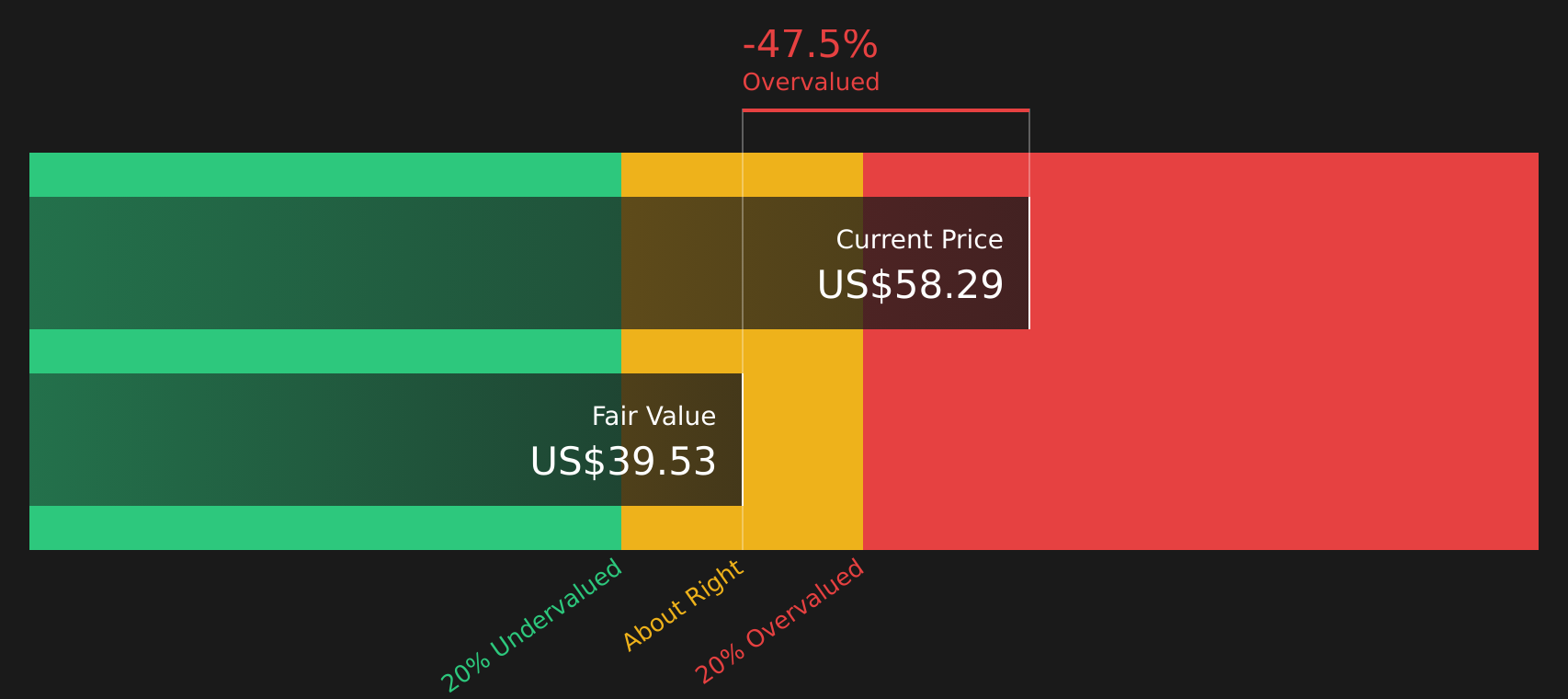
Simply Wall St performs a discounted cash flow (DCF) on every stock in the world every day (check out Main Street Capital for example). We show the entire calculation in full. You can track the result in your watchlist or portfolio and be alerted when this changes, or use our stock screener to discover 50 high quality undervalued stocks. If you save a screener we even alert you when new companies match - so you never miss a potential opportunity.
Next Steps
If this mix of fair value models and equity issuance leaves you unsure about Main Street Capital, act quickly and check the underlying numbers for yourself. To see both the potential upside and the key concerns in one place, start with the 1 key reward and 5 important warning signs.
Looking for more Main Street Capital style investment ideas?
Do not stop with Main Street Capital. The next step is to line up a few fresh stock ideas so you are not relying on a single opportunity.
- Spot potential bargains early and tap into screener containing 19 high quality undiscovered gems before they appear on everyone else’s radar.
- Focus on financial strength and filter for companies with the solid balance sheet and fundamentals stocks screener (50 results) that can better handle tough conditions.
- Prioritize resilience and check out 79 resilient stocks with low risk scores if you want ideas designed to smooth out the rougher edges of a portfolio.
This article by Simply Wall St is general in nature. We provide commentary based on historical data and analyst forecasts only using an unbiased methodology and our articles are not intended to be financial advice. It does not constitute a recommendation to buy or sell any stock, and does not take account of your objectives, or your financial situation. We aim to bring you long-term focused analysis driven by fundamental data. Note that our analysis may not factor in the latest price-sensitive company announcements or qualitative material. Simply Wall St has no position in any stocks mentioned.
Have feedback on this article? Concerned about the content? Get in touch with us directly. Alternatively, email editorial-team@simplywallst.com