


The Zhitong Finance App learned that the China Index Research Institute published an article stating that since 2026, the national real estate market is still in a continuous adjustment stage, and first-tier cities continue to gain strength with strong urban competitiveness and policies, and are taking the lead in getting out of the adjustment period. Judging from the real estate transaction data and the 100 cities price index monitored by the China Index, in July, new housing transactions in first-tier cities increased 14% year on year, and the cumulative transactions in January-July decreased slightly by 0.7% year on year; second-hand housing transactions increased 9.5% year on year, and cumulative transactions in January-July increased 6.6% year on year. The overall trend is stabilizing, but the pattern of differentiation between cities is still quite obvious.
Transactions: New homes rose year-on-year in July, with second-hand housing led by Beijing and Shanghai
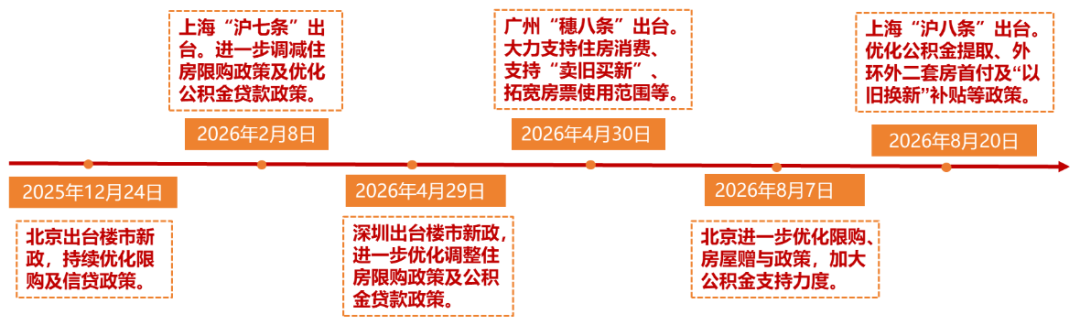
At the policy level, first-tier cities continue to step up their combo punches. Since this year, Shanghai's “Shanghai Seven Rules” were first introduced in February. At the end of April, Shenzhen followed up and optimized the purchase restriction policy, and Guangzhou also introduced the “Sui Eight Rules” policy. The policy mainly revolves around reducing the length of social security, optimizing the number of units purchased by families with many children, increasing the amount of provident fund loans, and easing replacement certification. Combining multiple measures has drastically lowered the threshold for buying a home. In August, Beijing further optimized purchase restrictions, housing grants, and provident fund policies to lower entry thresholds and financial pressure for some homebuyers. Shanghai then introduced the “Shanghai Eight Rules” to further optimize policies such as withdrawing from the Provident Fund, down payment for a second home outside the Outer Ring Road, and “trade-in” subsidies.
Figure: First-tier cities have continued to optimize real estate policies since the end of 2025
Source: Comprehensive compilation by the China Index Research Institute
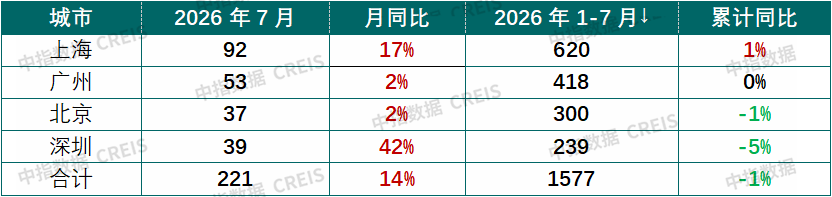
New home sales: According to monitoring data from the China Index, the transaction area of newly built commercial housing in first-tier cities increased 14% year on year in July, while Beijing, Shanghai, Guangzhou and Shenzhen increased 2%, 17%, 2%, and 42% year on year, respectively. Cumulatively, the transaction area of newly built commercial housing in first-tier cities in January-July was 15.77 million square meters, a slight decrease of 0.7% over the previous year.
Table: New commercial residential transactions in first-tier cities in July 2026 (unit: 10,000 square meters)
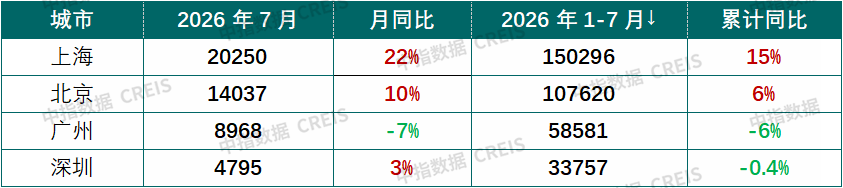
Second-hand housing sales: Second-hand housing sales in Beijing, Shanghai, and Shenzhen continued to increase year-on-year. In July, second-hand housing sales in Beijing and Shanghai sold 14,000 and 20,000 units respectively. Under a high base, second-hand housing transactions in Beijing and Shanghai increased by 10% and 22%, respectively. The volume of second-hand housing transactions in Beijing and Shanghai increased for 5 consecutive months. From January to July, the cumulative volume of second-hand housing transactions in Beijing and Shanghai all hit a new five-year high. Second-hand housing transactions in Shenzhen increased 3.0% year on year in July, and the increase was narrower than the previous month; Guangzhou's second-hand housing transactions fell 7% year on year in July, the only city where second-hand housing transactions declined among first-tier cities.
Table: Second-hand housing transactions in first-tier cities in July 2026 (unit: unit)
Price: Second-hand differentiation intensifies, Beijing, Guangzhou and Shenzhen second-hand listing prices continue to be under pressure
Judging from the month-on-month data, the price differentiation of second-hand housing is quite obvious. According to the China Index 100 Cities Price Index, prices of newly built commercial housing continued to rise structurally in first-tier cities in July. Shanghai led the month-on-month increase in new housing prices, while Beijing, Shenzhen, and Guangzhou maintained slight increases. In terms of second-hand housing, second-hand housing listing prices in first-tier cities fell 0.25% month-on-month, internal cities were divided, Shanghai maintained an upward trend, and Beijing, Shenzhen, and Guangzhou all fell month-on-month.
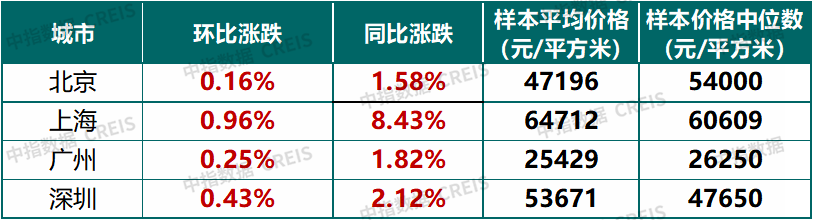
New housing prices. According to the China Index 100 Cities Price Index, the price of newly built homes in first-tier cities rose 0.63% month-on-month and 5.40% year-on-year in July. Specifically, Shanghai had the highest month-on-month increase of 0.96%, up 8.43%; Shenzhen's new home price rose 0.43% month-on-month, 2.12%; Guangzhou's new home price rose 0.25% month-on-month, up 1.82% year on year; and new housing prices in Beijing rose 0.16% month-on-month, or 1.58% year on year.
Table: Changes in the price index of newly built homes in first-tier cities in July 2026
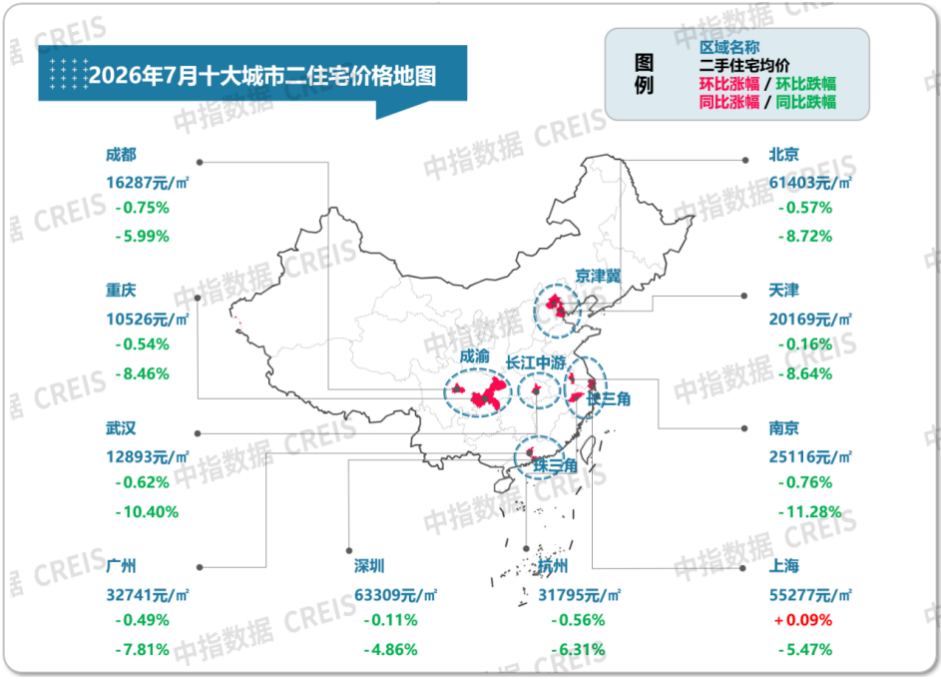
Second-hand housing listing price: According to the China Index 100 Cities Price Index, second-hand housing prices in first-tier cities fell 0.25% month-on-month in July, an increase of 0.09 percentage points over the previous month. Among them, the average price of second-hand housing listings in Shanghai rose 0.09% month-on-month. It has been rising for five consecutive months and falling 5.47% year-on-year. Second-hand housing prices in Beijing fell 0.57% month-on-month and 8.72% year-on-year. Second-hand housing prices in Guangzhou fell 0.49% month-on-month and 7.81% year-on-year. Second-hand housing prices in Shenzhen fell 0.11% month-on-month and 4.86% year-on-year. Overall, among first-tier cities, second-hand housing listings in Shanghai showed signs of bottoming out. Prices in Shenzhen fluctuated slightly, and declines in Beijing and Guangzhou were also significantly narrower than in the second half of last year.
Affected by the contraction in supply, the overall inventory size of new homes declined
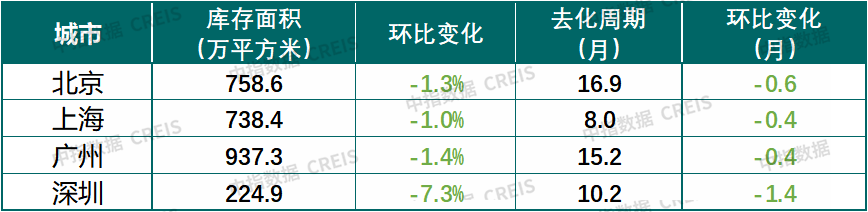
In terms of inventory: Affected by continued contraction in supply, the overall inventory scale of first-tier cities continued to decline. Inventory area fell 1.8% month-on-month and 12.4% year-on-year in July. Specifically, the inventory area of newly built homes in Shenzhen fell 7.3% month-on-month, down 22.7%; Guangzhou's newly built residential inventory area fell 1.4% month-on-month, down 10.6%; Beijing's newly built residential inventory area fell 1.3% month-on-month, down 21% year on year; Shanghai's newly built housing inventory area fell 1.0% month-on-month, but due to the high level of new supply, there was a slight increase of 0.3% year over year.
In terms of the removal cycle, the overall removal cycle of newly built homes in first-tier cities maintained a continuous improvement trend. In July, the removal cycle of all cities showed a downward trend month-on-month and year-on-year. Based on the average monthly sales rate of the past 6 months, the removal cycle for newly built homes in Shanghai at the end of July was only 8 months, down 0.4 months from the previous month; the removal cycle for newly built homes in Shenzhen was 10.2 months, down 1.4 months from the previous month and 3.3 months from the previous year; the removal cycle for newly built homes in Guangzhou was 15.2 months, down 0.4 months from the previous month and 2.3 months from the previous year; and the removal cycle for newly built homes in Beijing was 16.9 months, down 0.6 months from the previous month and 4.8 months from the previous year.
Table: Inventory and removal cycle of newly built homes in first-tier cities in July 2026
Prospect -- Building the foundation continues, differentiation is still the main theme
Looking ahead to the future market, as the “gold nine silver ten” traditional marketing node approaches, housing companies' promotion and promotion efforts are expected to increase. Combined with recent policy optimizations in Beijing and Shanghai, market activity may pick up somewhat. However, the division between regions and between new and second-hand housing is likely to continue.
On the transaction side, new supply, promotional activities, and policy effects may drive a phased recovery in new housing transactions. The markets in Shanghai and Shenzhen may be relatively resilient, and Beijing and Guangzhou still need to pay attention to policy transmission and project supply. In terms of second-hand housing, the volume of transactions in Beijing and Shanghai is expected to remain high in the context of the “sell one buy one” replacement chain continues to run smoothly; second-hand housing transactions in Guangzhou may still face some pressure.
On the price side, prices of new homes are expected to maintain a structural rise, driven by the entry of improved projects into the market. Second-hand housing listing prices may continue to fluctuate slightly. If transaction activity improves and listing volume stabilizes during the “Golden Nine Silver Ten” period, there may be room for narrowing in price declines, but continued stabilization still depends on residents' housing purchase expectations and substantial improvement in the relationship between supply and demand.