


- Earlier this week, Viasat reported Q2 revenue of US$1.16 billion, a 1.2% decline year on year that fell 4.4% short of analyst expectations, even as earnings per share came in ahead of forecasts.
- The results highlight a tension between cost control and top-line pressure as competition from larger telecom players and newer satellite entrants intensifies across Viasat’s core markets.
- We’ll now examine how this revenue shortfall, set against rising competitive pressure, may influence Viasat’s longer-term investment narrative.
We've uncovered the 12 dividend fortresses yielding 5%+ that don't just survive market storms, but thrive in them.
Viasat Investment Narrative Recap
To own Viasat, you need to believe its expanded satellite network and defense-focused services can offset pressure in consumer broadband and aviation connectivity. The latest US$1.16 billion revenue miss reinforces that near term, the key catalyst is execution on new capacity and contracts, while the biggest risk is that competitive and technological pressure keeps clipping top-line growth. For now, this quarter looks more like a reminder of that tension than a decisive break in the story.
Against this backdrop, the recent U.S. Space Force Swarm 1 contract stands out as most relevant. It underlines how government and defense work can support Viasat’s thesis of secure, resilient connectivity even as core broadband revenues soften. If this kind of multi-year program scales, it could become an important offset to weakness in more competitive commercial segments and a test of whether defense demand can meaningfully reshape the near term risk and reward profile.
Yet, despite these contract wins, the growing risk that investors should be aware of is...
Read the full narrative on Viasat (it's free!)
Viasat's narrative projects $5.5 billion revenue and $626.3 million earnings by 2029. This requires 6.2% yearly revenue growth and about a $655.7 million earnings increase from -$29.4 million today.
Uncover how Viasat's forecasts yield a $101.44 fair value, a 37% upside to its current price.
Exploring Other Perspectives
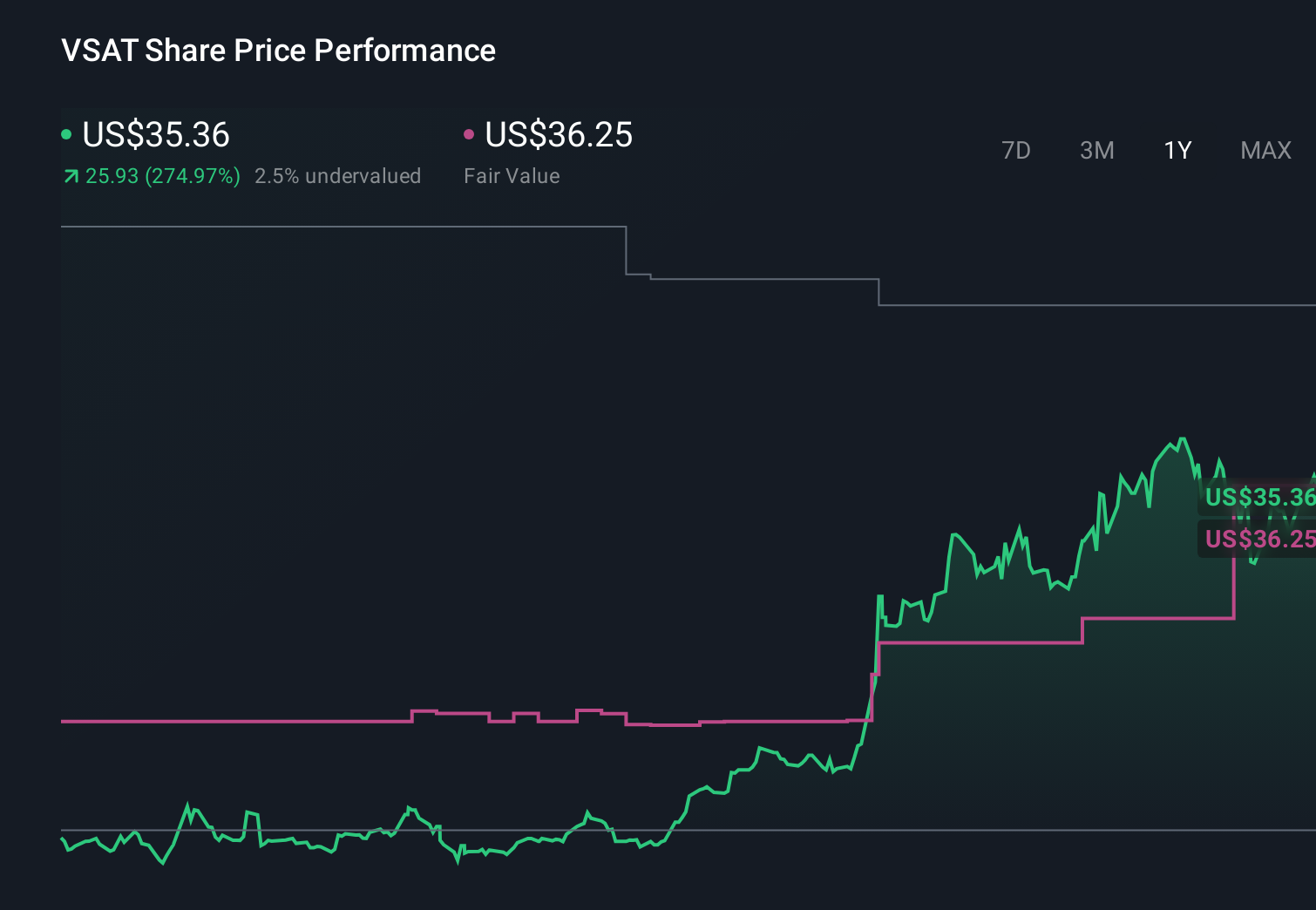
Some of the most pessimistic analysts were already assuming only about 3.3% annual revenue growth and no profits by 2029, so this revenue shortfall could push their already cautious view even further.
Explore 8 other fair value estimates on Viasat - why the stock might be worth 34% less than the current price!
Form Your Own Verdict
Don't just follow the ticker - dig into the data and build a conviction that's truly your own.
- A great starting point for your Viasat research is our analysis highlighting 4 important warning signs that could impact your investment decision.
- Our free Viasat research report provides a comprehensive fundamental analysis summarized in a single visual - the Snowflake - making it easy to evaluate Viasat's overall financial health at a glance.
Interested In Other Possibilities?
Opportunities like this don't last. These are today's most promising picks. Check them out now:
- Capitalize on the AI infrastructure supercycle with our selection of the 54 best 'picks and shovels' of the AI gold rush converting record-breaking demand into massive cash flow.
- This technology could replace computers: discover 24 stocks that are working to make quantum computing a reality.
- The future of work is here. Discover the 38 top robotics and automation stocks leading the charge in AI-driven automation and industrial transformation.
This article by Simply Wall St is general in nature. We provide commentary based on historical data and analyst forecasts only using an unbiased methodology and our articles are not intended to be financial advice. It does not constitute a recommendation to buy or sell any stock, and does not take account of your objectives, or your financial situation. We aim to bring you long-term focused analysis driven by fundamental data. Note that our analysis may not factor in the latest price-sensitive company announcements or qualitative material. Simply Wall St has no position in any stocks mentioned.
Have feedback on this article? Concerned about the content? Get in touch with us directly. Alternatively, email editorial-team@simplywallst.com