


Citigroup stock has delivered very strong gains over the past three years, yet current valuation checks suggest the market price may still sit below what the intrinsic value models imply. With both the Excess Returns estimate and earnings multiples pointing to possible undervaluation, the recent pullback adds a fresh twist for investors trying to price the latest news.
- Citigroup has returned 246.0% over the past three years, which puts current pricing in the context of a stock that has already created significant shareholder value.
- New initiatives such as the Custody+ platform, including planned Bitcoin custody, can support expectations for future fee and services revenue, while exposure to credit and market cycles remains a key risk for how sustainable those cash flows prove to be.
- The company scores 3 out of 6 on Simply Wall St’s valuation checks, which points to a mixed picture rather than a clear bargain or a clearly expensive stock.
The issue now is whether Citigroup's recent three year surge has already captured the value suggested by the intrinsic value models or if there is still a margin between price and estimated worth.
Is Citigroup Still Cheap on Excess Returns?
The Excess Returns model looks at how much value Citigroup creates over and above the required return on its equity base. For Citigroup, the inputs point to a bank that is expected to earn more than its theoretical cost of equity on a sizeable book of capital.
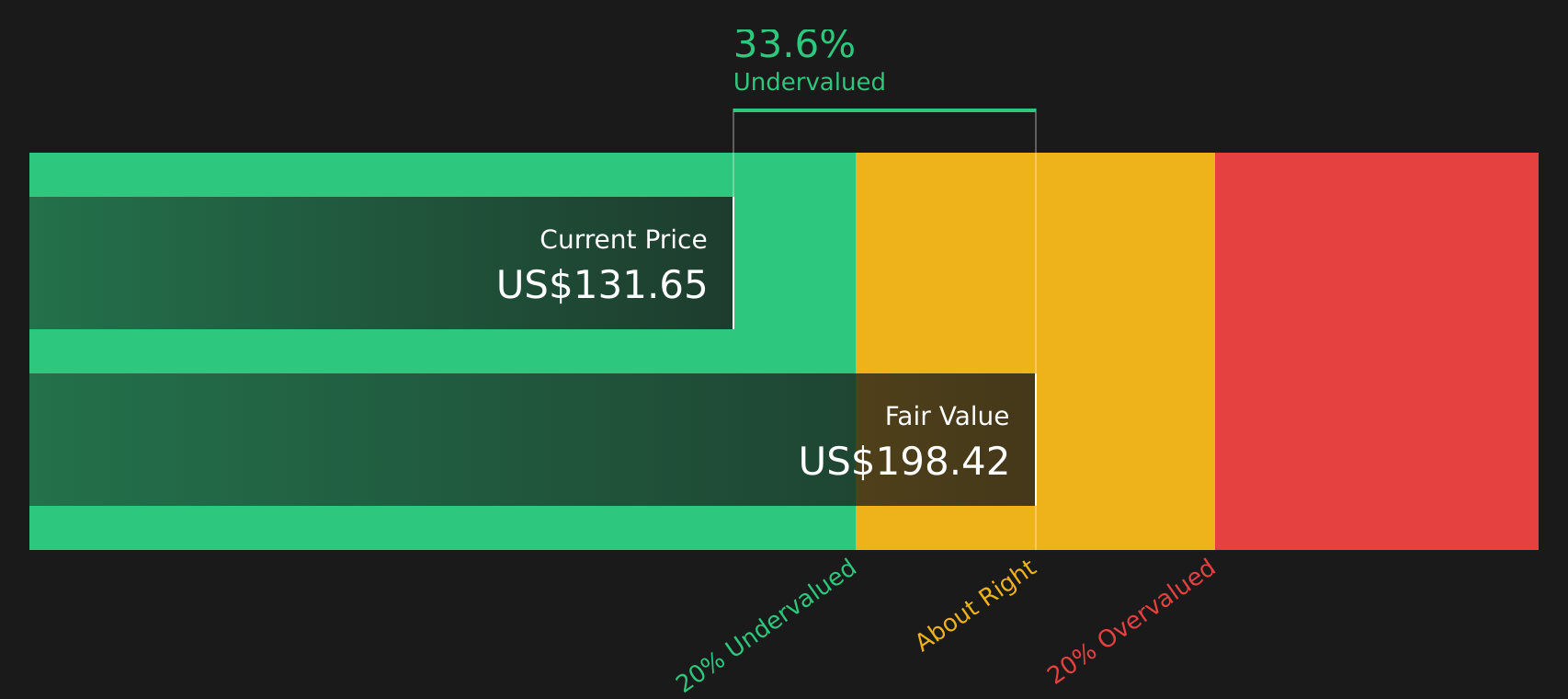
The model uses a Book Value of $114.74 per share and a Stable EPS of $13.31 per share, based on weighted future Return on Equity estimates from 14 analysts. With a Cost of Equity of $10.24 per share, the implied Excess Return is $3.07 per share on an Average Return on Equity of 10.44%. That is applied to a Stable Book Value of $127.54 per share, sourced from future book value estimates from 12 analysts, to arrive at an intrinsic value of about $198 per share.
Against the current share price, this Excess Returns estimate suggests Citigroup stock trades at roughly a 34.6% discount and screens as undervalued. Despite the launch of the Custody+ platform, including planned Bitcoin custody, giving the story a new growth angle, the market price still trails the value implied by expected returns on equity.
On this model, Citigroup looks undervalued, with the share price sitting well below the intrinsic value implied by its projected excess returns.
Our Excess Returns analysis suggests Citigroup is undervalued by 34.6%. Track this in your watchlist or portfolio, or discover 50 more high quality undervalued stocks.
Does Citigroup Look Undervalued on Earnings?
P/E is usually the cleanest way to compare large banks like Citigroup, since earnings already factor in credit costs, fees and trading results. It gives you a single number that lines up well across the sector.
Citigroup trades on a P/E of about 13.2x, which is slightly above the Banks industry average of 11.8x and close to the peer average of 12.7x. However, the tailored fair P/E ratio for Citigroup is higher at about 16.2x. This indicates that the current multiple is below what might be expected when taking into account its size, risk profile and analyst expectations for returns on equity.
Even with recent headlines around Custody+ and Bitcoin custody shaping interest in the stock, the market is still valuing Citigroup at a P/E that sits under this fair ratio benchmark.
Taken together, the P/E comparison indicates that Citigroup stock appears undervalued on this earnings multiple.

See what the numbers say about this price — find out in our valuation breakdown.
The Citigroup Narrative: What Would Justify Today's Price?
Simply Wall St Narratives for Citigroup pick up where the valuation puzzle leaves off. They map out the specific assumptions on growth, margins and earnings that would need to hold for Citigroup's stock to be worth materially more or less than today's price, and they sit on the company’s Community page. Where a single ratio or model gives one number, these narratives unpack the future that number relies on so you can monitor whether it is playing out.
One of the top community narratives on Citigroup: roughly fairly valued
"Citigroup is focusing on organizational simplification, which is expected to reduce expenses over time, improve the bank’s efficiency ratio, and support net margins."
Read one of the top narratives on Citigroup
Do you think there's more to the story for Citigroup? Head over to our Community to see what others are saying!
The Bottom Line
Citigroup screens as undervalued on both the Excess Returns intrinsic value estimate and its current P/E multiple, even though the broader valuation checks are mixed. The gap between price and intrinsic value hinges on whether the bank can earn the returns on equity that analysts currently expect on its capital base. For you as an investor, the key question is whether that discount reflects genuine opportunity or a fair pricing of execution and cycle risks around initiatives such as Custody+ and related fee streams.
This article by Simply Wall St is general in nature. We provide commentary based on historical data and analyst forecasts only using an unbiased methodology and our articles are not intended to be financial advice. It does not constitute a recommendation to buy or sell any stock, and does not take account of your objectives, or your financial situation. We aim to bring you long-term focused analysis driven by fundamental data. Note that our analysis may not factor in the latest price-sensitive company announcements or qualitative material. Simply Wall St has no position in any stocks mentioned.
Have feedback on this article? Concerned about the content? Get in touch with us directly. Alternatively, email editorial-team@simplywallst.com