


Corteva stock has delivered a 90.1% total return over the past five years, yet its current valuation picture is split. The Discounted Cash Flow (DCF) intrinsic value estimate points to meaningful upside from today's share price, while earnings-based multiples lean expensive and the broader valuation checks are cautious.
- A 90.1% return over five years suggests Corteva has already rewarded long-term holders, so fresh buyers need to think carefully about what is already reflected in the price.
- Expectations for steady cash generation from its crop protection and seed businesses can support the intrinsic value case, although any pressure on margins or weaker free cash flow would quickly challenge that view.
- Corteva screens as undervalued on the DCF estimate, yet with a low value score of 2 out of 6 checks, the broader framework suggests the stock is not an obvious bargain on all measures.
The issue now is whether Corteva's current share price already reflects most of its long-term cash flow potential or if the intrinsic value estimate still leaves a reasonable margin of safety.
Is Corteva Still Cheap on Cash Flow?
The Discounted Cash Flow (DCF) model for Corteva focuses on the cash the business can generate for shareholders over time. In this framework, Corteva is treated as a company with room for growing free cash flow rather than as a low growth utility style asset.
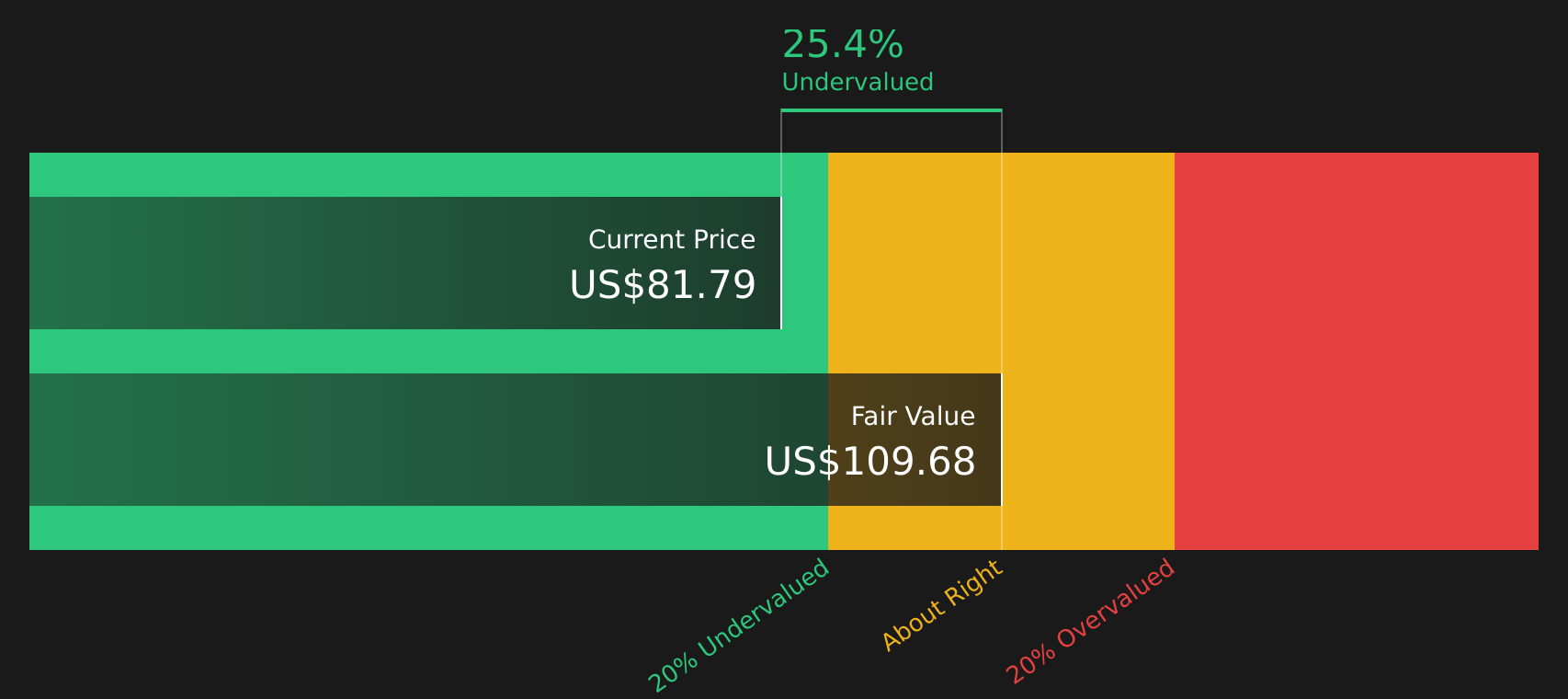
The latest twelve month free cash flow is about $615 million, and the model assumes this recovers and grows toward multi billion dollar annual levels over the next decade. On those cash flow projections, the 2 Stage Free Cash Flow to Equity model points to an intrinsic value of about $109 per share. Compared with the current share price, that implies Corteva trades at roughly a 27.4% discount to the DCF estimate.
Taken on its own, the Discounted Cash Flow result suggests Corteva stock appears undervalued relative to the cash it is expected to generate.
Our Discounted Cash Flow (DCF) analysis suggests Corteva is undervalued by 27.4%. Track this in your watchlist or portfolio, or discover 50 more high quality undervalued stocks.
Does Corteva Look Pricey on Earnings?
The P/E ratio suits Corteva because earnings remain a key yardstick for mature, cash generative businesses in the chemicals sector.
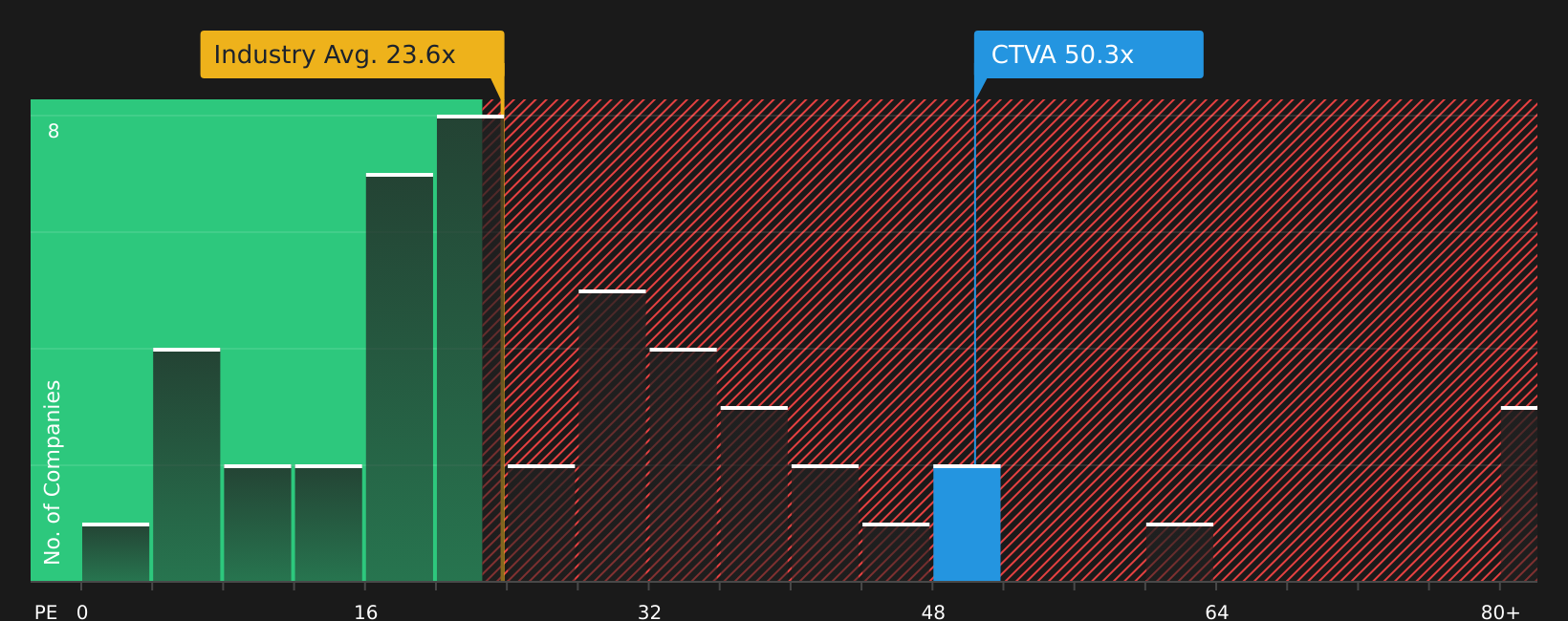
Corteva currently trades on a P/E of about 48.9x. This is more than double both the chemicals industry average of 23.6x and the peer average of 15.9x. The fair P/E ratio estimate, which blends factors such as Corteva's growth profile, margins, size and risk, sits at about 25.0x. That is roughly half the current earnings multiple, so investors are paying a clear premium earnings price for Corteva stock.
Even after considering the fair ratio adjustment, Corteva still prices well above what this framework suggests as a reasonable earnings multiple.
On the P/E measure, Corteva stock screens as overvalued relative to both sector norms and its modeled fair earnings multiple.
See what the numbers say about this price — find out in our valuation breakdown.
The Corteva Narrative: What Would Justify Today's Price?
Simply Wall St Narratives are the link between Corteva's valuation puzzle and the specific future paths that could justify a higher or lower share price. Each Narrative explains what would need to happen to Corteva's growth, margins and earnings for the stock to align with a different value. Each one connects its figure to a concrete view of where growth, margins and risks may go next, which you can revisit as new information is released on the Community page.
Share a narrative on Corteva that lays out your number-driven view on how its growth, margins, and execution may develop from here, and be one of the first voices in the Simply Wall St community to track how that thesis holds up as new results come through.
Do you think there's more to the story for Corteva? Head over to our Community to see what others are saying!
The Bottom Line
For Corteva, the Discounted Cash Flow (DCF) estimate points to meaningful upside, while the P/E based view signals the stock is overvalued relative to peers. The gap reflects a DCF that leans on longer term cash generation versus a multiple that embeds already high expectations and cautious broader valuation checks. What matters most from here is whether Corteva converts its business profile into the level and consistency of free cash flow that the intrinsic value case assumes. If that cash flow delivery disappoints or the earnings multiple compresses, the current valuation could prove demanding.
This article by Simply Wall St is general in nature. We provide commentary based on historical data and analyst forecasts only using an unbiased methodology and our articles are not intended to be financial advice. It does not constitute a recommendation to buy or sell any stock, and does not take account of your objectives, or your financial situation. We aim to bring you long-term focused analysis driven by fundamental data. Note that our analysis may not factor in the latest price-sensitive company announcements or qualitative material. Simply Wall St has no position in any stocks mentioned.
Have feedback on this article? Concerned about the content? Get in touch with us directly. Alternatively, email editorial-team@simplywallst.com