


The Zhitong Finance App learned that under the impetus of the AI memory chip supercycle, Samsung Electronics is giving back to shareholders with unprecedented strength. On August 21, the world's largest memory chip manufacturer held a board meeting and officially approved the 2026 shareholder return plan. It is estimated that the return of capital to shareholders will reach 90 trillion to 110 trillion won (about 65 billion to 80 billion US dollars) for the whole year. This figure not only set a new record for shareholder returns in Korean corporate history, but also propels Samsung into the ranks of the world's top dividend giants — the scale is close to the $110 billion share repurchase plan approved by Apple in 2024.
Just two days ago, competitor SK Hynix just announced a 40 trillion won (about 28.6 billion US dollars) share repurchase and cancellation plan. In just one week, South Korea's two largest storage giants promised to return up to 150 trillion won (about US$108.6 billion) of capital to shareholders — this “money throwing competition” spawned by the AI chip supercycle is pushing the Korean stock market into a new era of valuation.
Dismantling of the plan: 30 trillion dividend first, the remaining portion to be settled in January next year
According to the regulatory documents submitted by Samsung to the Korea Exchange, the specific arrangements for this shareholder return plan are as follows:
Third quarter (finalized by the board of directors in October): Cash dividends of approximately 30 trillion won were distributed. Based on the regular quarterly dividend of around 2.45 trillion won, this means that the special dividend for the third quarter is expected to reach 27.55 trillion won. The dividend per share (DPS) is expected to reach approximately 5,570 won, far exceeding the previous regular 1,400 won range.
Employee incentives: The board of directors also approved a stock repurchase plan of approximately 15 trillion won for employee compensation incentives.
Remaining portion (Board decision in January 2027): The remaining shareholder returns will be finalized after confirmation of the company's annual results in January 2027, taking into account cash dividends, stock repurchases and cancellations.
This record return is based on Samsung's 2024-2026 three-year shareholder return policy, which promises to return 50% of the three-year cumulative free cash flow to shareholders. From 2024 to 2025, Samsung has distributed a total of 19.6 trillion won in regular dividends, 1.3 trillion won in special dividends, and completed 8.4 trillion won in share repurchases and cancellations, totaling 29.3 trillion won. With 2026 returns, Samsung's total shareholder returns are expected to reach 120 trillion to 140 trillion won over the three-year period 2024 to 2026.
The “driving force” of the AI supercycle: quarterly profit of 89.5 trillion yuan is the highest in history
The motivation for Samsung to dare to issue this “sky-high check” comes from the epic profits brought about by the AI memory chip supercycle. In the second quarter of 2026, Samsung Electronics handed over the strongest quarterly report in the company's history: revenue of 171.5 trillion won, up 130% year on year; operating profit of 89.49 trillion won, surging 1814% year on year, both setting new historical records. Among them, the Equipment Solutions Division, which is responsible for the memory chip business, achieved revenue of 127.5 trillion won and operating profit of 89.2 trillion won during the quarter. Demand for AI server-driven memory chips is the core driver of the explosion in performance.
By the end of the second quarter, Samsung's cash reserves had expanded enough to support the scale of this “money throwing” operation. According to LSEG data and Reuters estimates, Samsung and SK Hynix will hold a total net cash reserve of 263 billion US dollars by the end of the year. This figure is more than double Nvidia's estimated net cash (102 billion US dollars), and also exceeds the sum of the cash of the remaining six technology companies in the US “Big Seven”.
The AI boom spawns a “cash tsunami”: Samsung and SK Hynix's competition for rewards
Samsung's “big effort” to give back to shareholders is directly due to the explosive growth in demand for AI memory chips. As demand for high-bandwidth memory (HBM) and DRAM in AI data centers continues to rise, Samsung's cash flow is rapidly expanding. Meanwhile, on August 19, SK Hynix took the lead in announcing a 40 trillion won (approximately US$28.6 billion) share repurchase and cancellation plan. The buyback will commence on August 20 and will last for about three months. All repurchased shares will be cancelled. This is the largest cancellation of treasury shares in the history of a Korean listed company.
SK Hynix also promised to use at least 50% of the cumulative free cash flow from 2025 to 2027 for shareholder returns. Goldman Sachs anticipates that this buyback is only the beginning of a larger shareholder return plan — based on about 55% of free cash flow used in return calculations, SK Hynix may return approximately 140 trillion won to shareholders in the future.
The combined net cash of the two South Korean storage giants is expected to reach $263 billion, even exceeding Nvidia's estimated cash size. Faced with increasing pressure from investors, Samsung and SK Hynix finally chose to “settle the bag” AI dividends.
Tom Kang, research director at Counterpoint, said: “This may help trigger broader structural changes in the Korean stock market. We think this is a solid step towards a more shareholder-centered management style—a style closer to what is typical in the US market.” Albert Yong, managing partner of Petra Capital Management, pointed out that preferred stocks had “significant discounts” before, and this rise may reflect the market's expectations for higher dividends on preferred shares.
Market reaction: Expectations are full, “buy the expected sell fact” after the market
Despite the record scale of the plan, the market reaction showed the classic characteristics of “buying expectations, selling facts”.
Driven by expectations before the announcement of the plan, Samsung Electronics closed up 3.87% during the regular trading session on Friday to 281,500 won. SK Hynix closed up 2.31% on the same day. South Korea's KOSPI Index closed up 0.88% to 6912.95 points, boosted by two major storage giants.
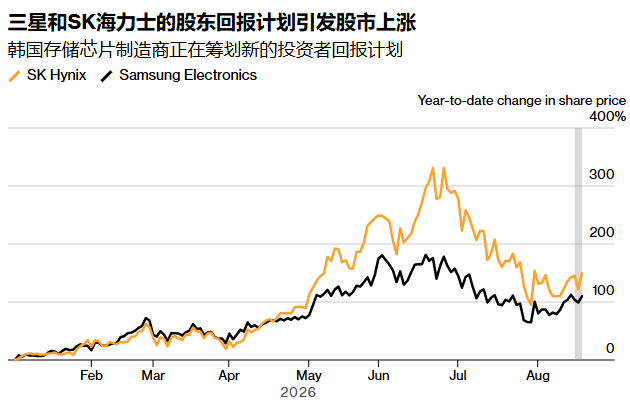
However, in post-market trading, Samsung Electronics' stock price fell by about 3.91% during the NXT after-hours trading due to the fact that some investors had previously expected returns of up to 150 trillion won, and the announcement was already within expectations. “Some investors recently expected shareholder returns of up to 150 trillion won, which explains the share price fluctuation after listing,” said Kim Minji, fund manager of Must Asset Management.
Meanwhile, the won strengthened further on Friday, rising 1% to 1,380.35 won against the US dollar.
Jung In Yun, CEO of Fibonacci Asset Management Global, stated that the key issue for investors is no longer the nominal amount, but “how will the remaining funds be returned — the ratio of funds allocated to share buybacks and cancellations to special dividends.”
A 'historic turn' in the Korean capital market
Samsung's 110 trillion won and SK Hynix's 40 trillion won — In just one week, South Korea's two major storage giants promised to return a total of 150 trillion won (about US$108.6 billion). This “money throwing competition” spawned by the AI chip supercycle is fundamentally reshaping the investment logic of the Korean stock market.
For a long time, the Korean stock market has been criticized by international investors as a “Korea Discount” (Korea Discount) due to undervaluation and low dividends. Today, when Samsung pushes three-year shareholder returns to 120 trillion to 140 trillion won, and when SK Hynix kicks off the first round with a 40 trillion repurchase and cancellation, this shareholder return revolution driven by AI dividends is becoming the strongest catalyst for disrupting the “Korean stock discount.”
The successive actions of Samsung and SK Hynix show that huge profits in the AI era are forcing chaebol companies to switch to more shareholder-friendly capital allocation strategies. As Counterpoint Research Director Tom Kang said, Korea is “moving towards a more shareholder-centered management style.” However, this historic transformation, led by the storage duo, has only just begun.
The final pricing of the market still depends on the quality of returns — including whether share repurchases are accompanied by cancellations, the ratio of special dividends to regular dividends, and how the remaining tens of trillions of won are distributed. As the January 2027 board meeting approaches, whether Samsung can further refine its return path will be the focus of continued investors' attention.