


TechnipFMC (FTI) is in focus after announcing a significant contract from Azule Energy for the West Hub Tails project, which is part of the Block 15/06 Agogo Integrated Development offshore Angola.
See our latest analysis for TechnipFMC.
TechnipFMC’s latest contract news lands against a backdrop of strong momentum, with a 30 day share price return of 4.02% and a year to date share price return of 64.07%, while the five year total shareholder return is above 10x.
If this contract has you looking at energy infrastructure and services more broadly, it could be a good moment to size up 39 power grid technology and infrastructure stocks
TechnipFMC’s surge and outsized five year return can look like a pure sentiment swing, or a reset toward the underlying business and contract pipeline. The valuation section next helps you judge which explanation fits better.
Most Popular Narrative: 2.1% Overvalued
TechnipFMC’s most followed narrative puts fair value at $76.00, slightly below the last close of $77.62, which frames the recent share strength in a tight valuation range.
Analysts expect earnings to reach $1.4 billion (and earnings per share of $3.97) by about June 2029, up from $1.1 billion today. However, there is some disagreement amongst the analysts with the more bullish ones expecting earnings as high as $1.7 billion.
Want to see what sits behind that earnings bridge? The narrative is based on steady revenue gains, firmer margins, and a future earnings multiple that is anything but casual.
Result: Fair Value of $76.00 (OVERVALUED)
Have a read of the narrative in full and understand what's behind the forecasts.
However, TechnipFMC’s narrative could quickly shift if subsea order awards slow, or if projects in geopolitically sensitive regions are delayed or repriced.
Find out about the key risks to this TechnipFMC narrative.
Another View on TechnipFMC’s Valuation
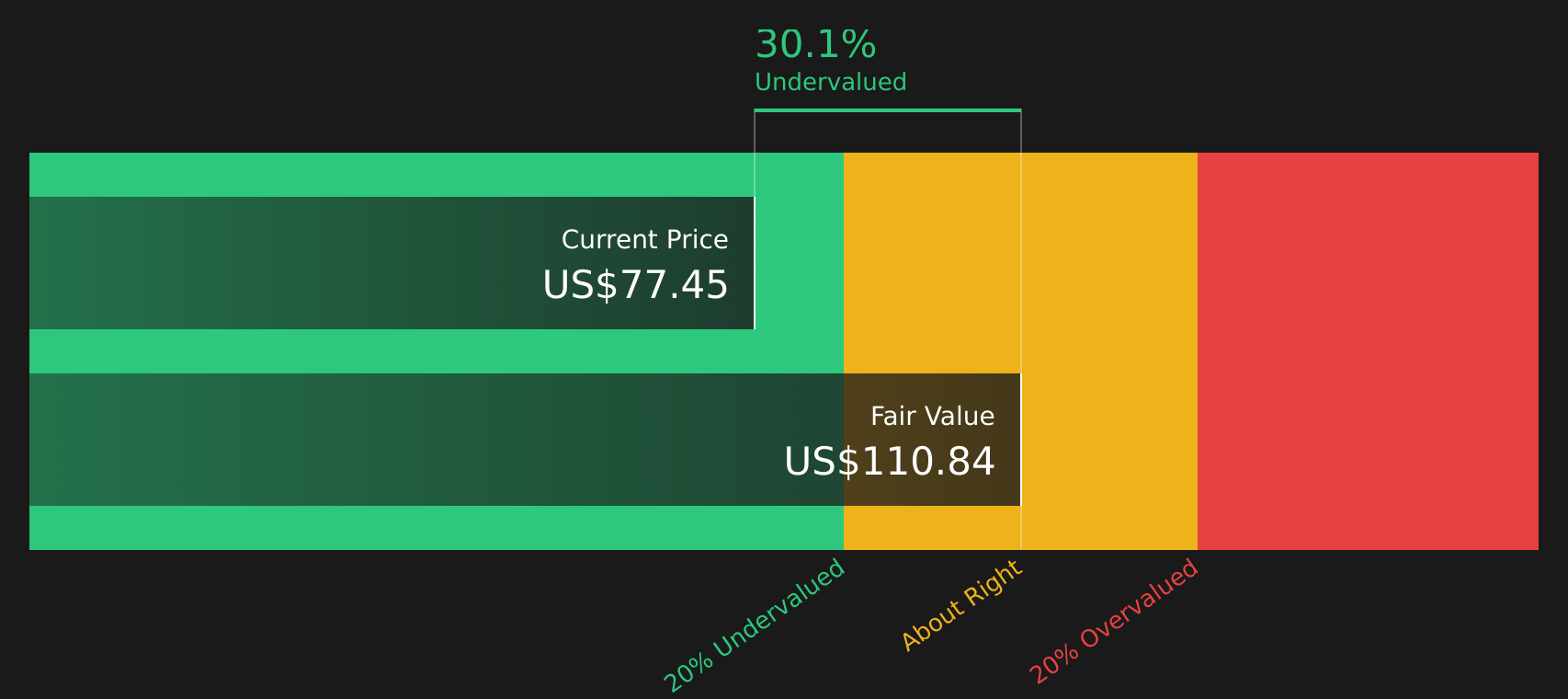
The first take on TechnipFMC uses a narrative fair value of $76.00, which points to the stock being 2.1% overvalued versus the last close of $77.62. Our DCF model presents a different perspective, with a future cash flow value of $110.62 that suggests the shares trade at a sizeable discount.
Both approaches rely on long range assumptions about contracts, margins, and capital returns. The SWS DCF model focuses more directly on cash generation over time, which raises a question: which set of assumptions do you trust more when the gap is this wide?
Look into how the SWS DCF model arrives at its fair value.
Next Steps
The split between TechnipFMC’s narrative valuation and DCF outcome creates a clear tension for investors. It can be helpful to review the underlying numbers yourself and decide what feels reasonable. If you want to see why some investors are optimistic about its potential rewards, start by checking the 3 key rewards.
Looking for more TechnipFMC investment ideas?
If TechnipFMC has caught your attention, now is the time to broaden your watchlist with other focused ideas that could sharpen your overall portfolio decisions.
- Target potential mispricings by reviewing companies highlighted in the 50 high quality undervalued stocks that may warrant a closer look.
- Strengthen your income focus by scanning opportunities in the 12 dividend fortresses that could complement your existing holdings.
- Reduce portfolio stress by checking stocks in the 78 resilient stocks with low risk scores that score well on resilience and stability.
This article by Simply Wall St is general in nature. We provide commentary based on historical data and analyst forecasts only using an unbiased methodology and our articles are not intended to be financial advice. It does not constitute a recommendation to buy or sell any stock, and does not take account of your objectives, or your financial situation. We aim to bring you long-term focused analysis driven by fundamental data. Note that our analysis may not factor in the latest price-sensitive company announcements or qualitative material. Simply Wall St has no position in any stocks mentioned.
Have feedback on this article? Concerned about the content? Get in touch with us directly. Alternatively, email editorial-team@simplywallst.com