


After a strong 26.2% gain over the past year but a decline of 38.2% over five years, Polaris now trades at a level where its intrinsic value estimate from a Dividend Discount Model (DDM) points to a price that is close to fair, while the market multiples suggest the stock may still offer some value.
- The share price has declined 38.2% over the last five years, which raises the question of whether recent weakness has already reset expectations or if it reflects deeper concerns.
- Expectations around future demand for Polaris' off-road and powersports lineup may support the valuation, while any disappointment in cash generation to fund ongoing dividends could weigh on what investors are willing to pay.
- Polaris scores 4 out of 6 on Simply Wall St's broader valuation checks, which points to a mixed picture rather than a clear bargain or clear overvaluation, as shown in this valuation summary.
The issue now is whether the recent share price, set against this fair DDM estimate and mixed valuation score, still leaves enough potential return for Polaris to compensate investors for the risks they are taking.
Does Polaris Look Fairly Valued on Dividends?
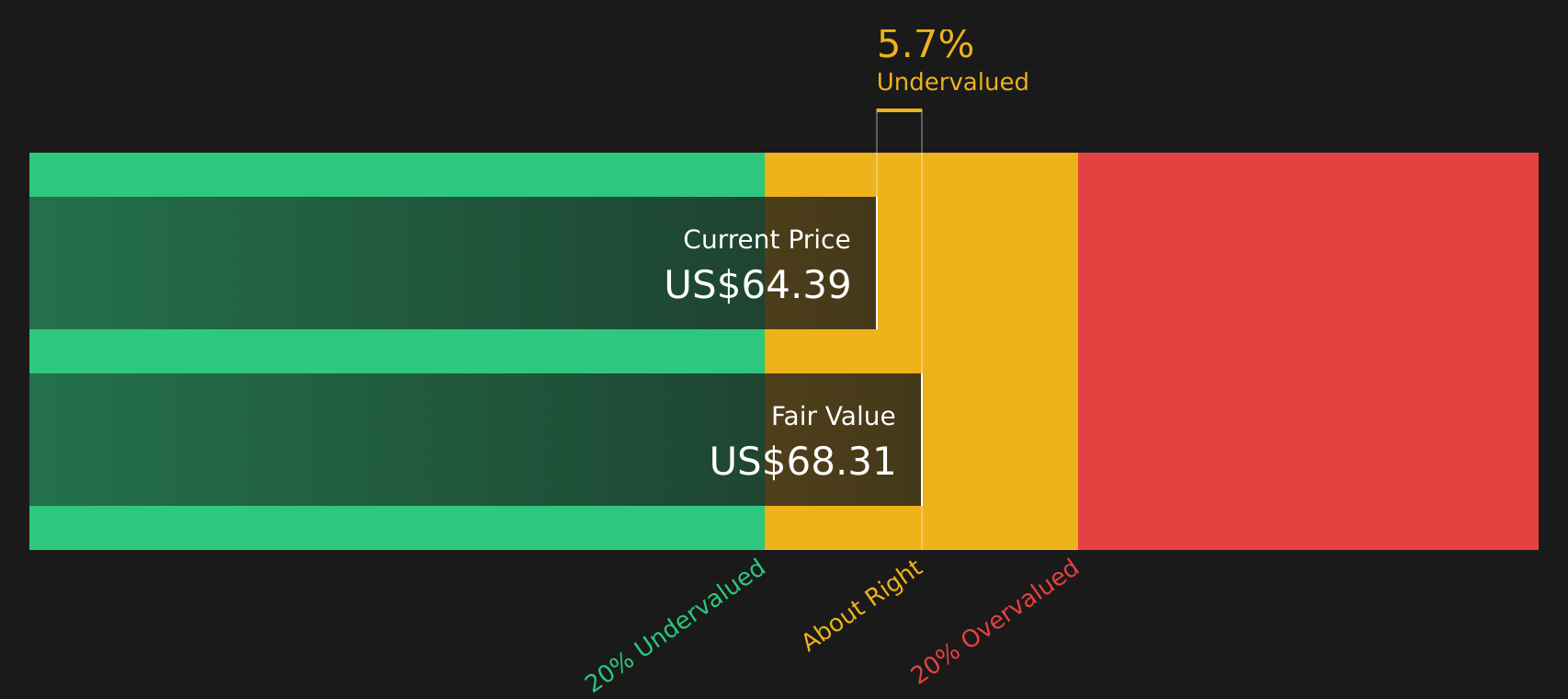
The Dividend Discount Model (DDM) starts with what Polaris pays out in dividends and what it can reasonably afford to grow those payments by over time. For Polaris, the model uses current dividends per share of about $2.73, a return on equity of roughly 8.2% and a payout ratio near 25%. Together, these inputs point to room for dividends to continue without stretching the balance sheet. Growth in those dividends is capped at 3.7% in the model, even though the broader expected growth input is higher, which keeps the valuation on the conservative side.
On these assumptions, the DDM points to an intrinsic value of about $68 per share. That sits close to the current market price, with the model indicating the stock is only about 5.5% undervalued. Because Polaris recently reported strong Q2 2026 results and guided to higher full year sales, it is possible the current price already reflects much of that positive news.
Overall, the Dividend Discount Model suggests Polaris appears roughly fairly valued at current levels.
Polaris is fairly valued according to our Dividend Discount Model (DDM), but this can change at a moment's notice. Track the value in your watchlist or portfolio and be alerted on when to act.
Is Polaris a Bargain on Sales?
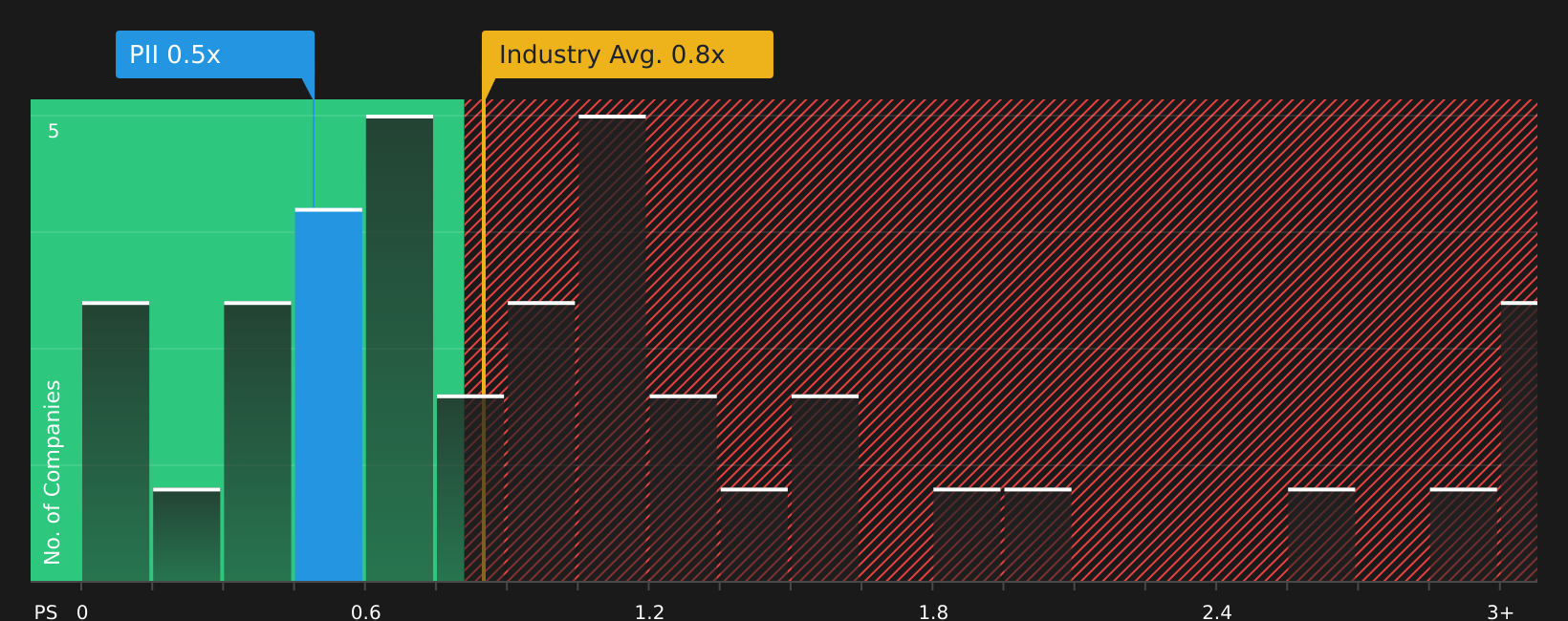
P/S can be a useful cross check for Polaris because revenue tends to move more steadily than earnings in a cyclical business. On this measure, Polaris trades on a P/S of about 0.5x, compared with a Leisure industry average of roughly 0.9x and a peer group average of about 1.1x. The company specific fair P/S that blends its growth profile, margins, size and risk comes out at around 0.6x.
That means the current P/S is below both the industry and peer benchmarks, and also below what the tailored fair ratio would suggest. For investors, it implies the market is pricing Polaris at a discount to the sales it generates, even after the recent share price recovery and positive guidance. This does not guarantee a positive outcome, but it does indicate that on sales alone the stock is not priced for aggressive expectations.
On a P/S basis, Polaris stock appears undervalued relative to both its industry and a reasonable fair multiple for its business profile.
See what the numbers say about this price — find out in our valuation breakdown.
The Polaris Narrative: What Would Justify Today's Price?
Simply Wall St Narratives pick up where the valuation puzzle for Polaris leaves off. They explain which combinations of future growth, margins and earnings would need to occur for Polaris' stock to be worth materially more or less than it is today, based on investor assumptions. Each narrative turns its view of fair value into a thesis about Polaris' business that you can revisit over time, rather than a one off snapshot. These narratives are available on the Community page.
Community views on Polaris are split, with one camp seeing meaningful upside while the other focuses on capped potential and tariff risk.
Bull case: 23% undervalued
"Polaris is unlocking a vast, untapped segment with the RANGER 500, which targets the 50% of the utility vehicle market previously out of reach for the company…"
Read the full Bull Case to see why Polaris could be undervalued
Bear case: 17% overvalued
"Heightened tariff exposure currently estimated at a $230 million annual impact even after mitigation, combined with the risk of further trade policy volatility, will continue to create cost uncertainty and pressure both gross margins and profitability…"
Read the full Bear Case to see why Polaris could be overvalued
Do you think there's more to the story for Polaris? Head over to our Community to see what others are saying!
The Bottom Line
Polaris now screens as roughly fairly valued on the Dividend Discount Model (DDM), with only a modest implied discount, while the sales based multiples still point to an undervalued stock relative to peers and its own tailored fair ratio. Together with the mixed broader valuation checks, that leaves Polaris looking neither like a clear bargain nor obviously expensive.
What matters from here is whether the company can sustain cash generation to support its dividend profile and whether the market gains confidence in demand, margins and tariff risk. The key debate is whether the current discount on sales is an opportunity or a sign that investors are correctly pricing those uncertainties.
This article by Simply Wall St is general in nature. We provide commentary based on historical data and analyst forecasts only using an unbiased methodology and our articles are not intended to be financial advice. It does not constitute a recommendation to buy or sell any stock, and does not take account of your objectives, or your financial situation. We aim to bring you long-term focused analysis driven by fundamental data. Note that our analysis may not factor in the latest price-sensitive company announcements or qualitative material. Simply Wall St has no position in any stocks mentioned.
Have feedback on this article? Concerned about the content? Get in touch with us directly. Alternatively, email editorial-team@simplywallst.com