


Microsoft stock has delivered a 68.0% gain over the past 5 years, yet current checks suggest it now trades close to what a Discounted Cash Flow (DCF) estimate would call its intrinsic value, while earnings-based multiples still screen it as undervalued. This mix leaves investors weighing a solid long-term share price record against signals that the valuation is no longer clearly cheap.
- Over 5 years, Microsoft has returned 68.0%, which shows long-term shareholders have already captured a substantial move in the stock.
- Ongoing investment in AI infrastructure and partnerships can support expectations for future cash flows, while rising costs for data centers, energy and custom chips may affect how much of that eventually reaches the bottom line.
- On Simply Wall St's checks, Microsoft scores 3 out of 6 on valuation, which suggests a mixed picture rather than a clear bargain or clear overvaluation.
The issue now is whether Microsoft at around US$483 per share offers enough valuation upside once those AI-driven opportunities and cost risks are weighed against its intrinsic value estimate.
Does Microsoft Look Fairly Valued on Cash Flow?
The Discounted Cash Flow model projects what Microsoft could earn for shareholders in the future and then brings those cash flows back to today. On this basis, Microsoft is modeled on a growing cash flow profile, with latest twelve month free cash flow of about $96.0b and analyst projections that remain firmly in positive territory over the coming decade.
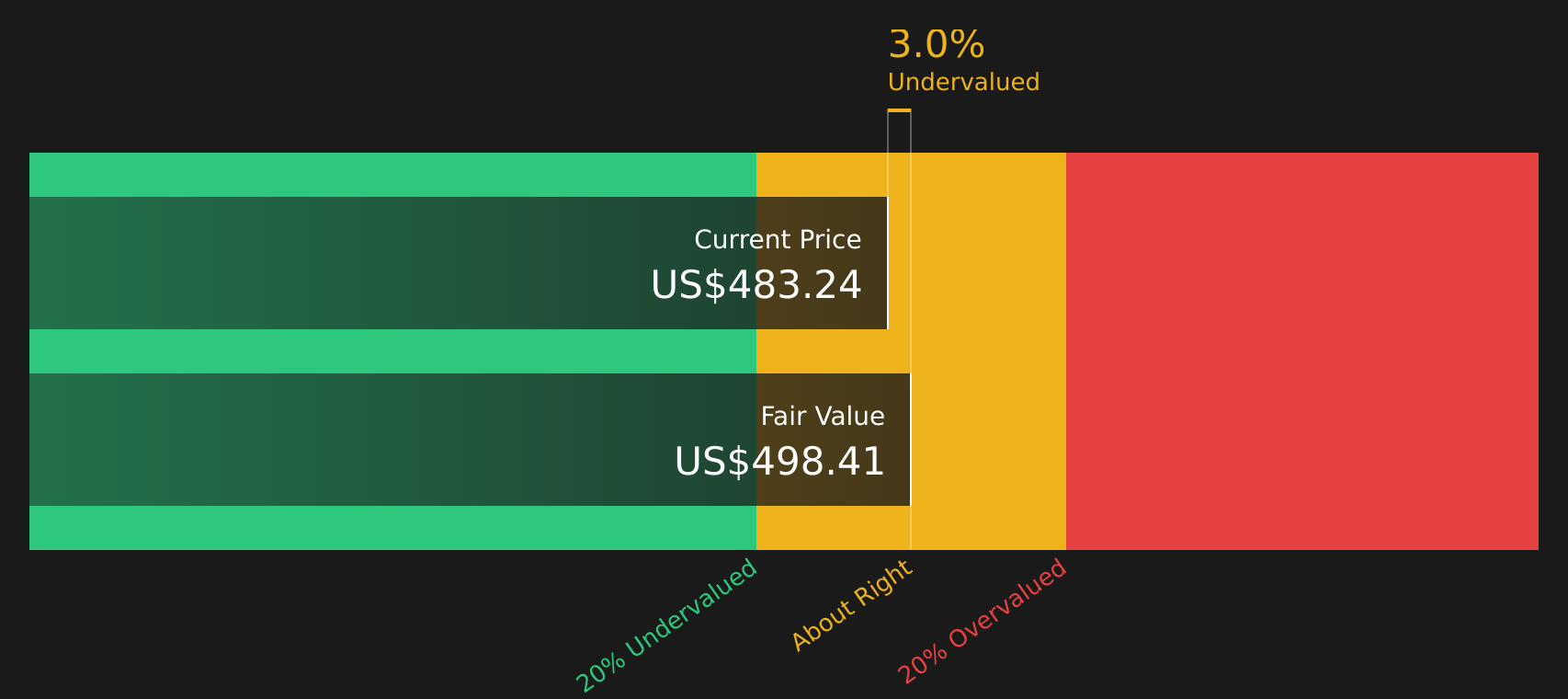
Those cash flows translate into an estimated intrinsic value of about $499 per share, compared with the current share price around $483. That implies Microsoft stock screens roughly 3.1% undervalued on this DCF view, which is a relatively tight gap for such a large company. Because Microsoft is pouring substantial capital into AI data centers and custom chips, the DCF outcome suggests the market is already pricing in a good portion of those investments, but not fully closing the gap to the modeled cash flows.
Overall, the DCF work up indicates Microsoft looks about fairly valued, with only a small discount between the share price and the modeled intrinsic value.
Microsoft is fairly valued according to our Discounted Cash Flow (DCF), but this can change at a moment's notice. Track the value in your watchlist or portfolio and be alerted on when to act.
Is Microsoft Still Cheap on Earnings?
P/E is a useful metric for Microsoft because earnings remain a central factor in how investors evaluate the stock. Based on current data, Microsoft trades on a P/E of about 26.8x. That is below the Software industry average P/E of about 30.9x and modestly above the peer average of roughly 24.4x, so the stock does not appear to be at the most expensive end of its group on this earnings measure.
The fair P/E that reflects Microsoft’s size, margins, sector and risk profile is modeled at about 48.7x. That is well above the current 26.8x multiple, which suggests the market is applying a sizable discount relative to what this framework implies might be reasonable for the company’s earnings power.
Taken together, this P/E analysis indicates Microsoft may be undervalued on this earnings multiple.

See what the numbers say about this price — find out in our valuation breakdown.
The Microsoft Narrative: What Would Justify Today's Price?
Narratives on Simply Wall St’s Community page pick up where this Microsoft valuation puzzle leaves off and spell out the specific future paths for growth, margins and earnings that would need to hold for the stock to be worth materially more or materially less than today’s price. Each narrative ties its number to a clear view of how Microsoft’s growth, profitability and risk profile might evolve, which you can revisit as fresh results and new information emerge.
Community views on Microsoft spread across a wide range, from AI driven upside to concerns that the price already bakes in too much optimism.
Bull case: 14% undervalued
"The accelerated adoption and integration of AI capabilities across Microsoft's infrastructure and application stack, including Azure AI, Copilot, Dynamics 365, GitHub and Fabric, are driving new revenue streams and usage intensity..."
Read the full Bull Case to see why Microsoft could be undervalued
Bear case: 22% overvalued
"Free cash flow fell in the same twelve months that operating profit went up $26.7 billion, and capital spending has stopped behaving like software..."
Read the full Bear Case to see why Microsoft could be overvalued
Do you think there's more to the story for Microsoft? Head over to our Community to see what others are saying!
The Bottom Line
For Microsoft, the Discounted Cash Flow (DCF) work points to an intrinsic value only slightly above the current share price, which suggests the stock is close to fully priced on that cash flow view. The earnings multiple tells a different story and screens the stock as undervalued relative to what its modeled P/E might support. The tension between these approaches comes down to how much future AI driven cash generation offsets heavy capital needs for data centers and chips. The crux for investors is whether Microsoft can convert its AI spend into durable, high quality earnings without eroding returns through sustained cost intensity.
This article by Simply Wall St is general in nature. We provide commentary based on historical data and analyst forecasts only using an unbiased methodology and our articles are not intended to be financial advice. It does not constitute a recommendation to buy or sell any stock, and does not take account of your objectives, or your financial situation. We aim to bring you long-term focused analysis driven by fundamental data. Note that our analysis may not factor in the latest price-sensitive company announcements or qualitative material. Simply Wall St has no position in any stocks mentioned.
Have feedback on this article? Concerned about the content? Get in touch with us directly. Alternatively, email editorial-team@simplywallst.com