


- In August 2026, Commvault announced past advancements to its Cloud Rewind add-on within Commvault Cloud, tripling Microsoft Azure coverage to protect 62% of enterprise-relevant Azure resource types while enabling automated dependency mapping, configuration protection, and orchestrated cloud application recovery from a single platform.
- A particularly interesting element is Cloud Rewind’s ability to run application recovery simulations in isolated, air-gapped environments, allowing organizations to test cloud recovery readiness and refine incident response before an outage or cyber event occurs.
- We’ll now examine how Cloud Rewind’s expanded Azure coverage and app-centric recovery capabilities influence Commvault’s broader investment narrative and growth drivers.
The best AI stocks today may lie beyond giants like Nvidia and Microsoft. Find the next big opportunity with these 17 smaller AI-focused companies with strong growth potential through early-stage innovation in machine learning, automation, and data intelligence that could fund your retirement.
Commvault Systems Investment Narrative Recap
To own Commvault, you need to believe its pivot to SaaS-based cyber resilience and multi cloud data protection can offset slower growth in legacy on premises software. The Cloud Rewind Azure expansion strengthens the near term catalyst around cloud based recovery and cyber readiness, but does not materially change the key risk that growth is still heavily driven by existing customers expanding spend rather than a broadening base of new enterprise logos.
Among recent updates, the launch of Commvault Cloud on Google Cloud in January 2026 is especially relevant here, since it extends similar cloud native protection across another hyperscaler. Taken together with the Azure enhancements in Cloud Rewind, Commvault is building a more uniform multi cloud story, which could support its catalyst around higher quality recurring SaaS revenues while still leaving execution and integration risks firmly in view.
Yet beneath this stronger cloud recovery story, investors should still watch for signs that reliance on large, lumpy deals could...
Read the full narrative on Commvault Systems (it's free!)
Commvault Systems’ narrative projects $1.6 billion revenue and $161.8 million earnings by 2029.
Uncover how Commvault Systems' forecasts yield a $161.15 fair value, a 20% upside to its current price.
Exploring Other Perspectives
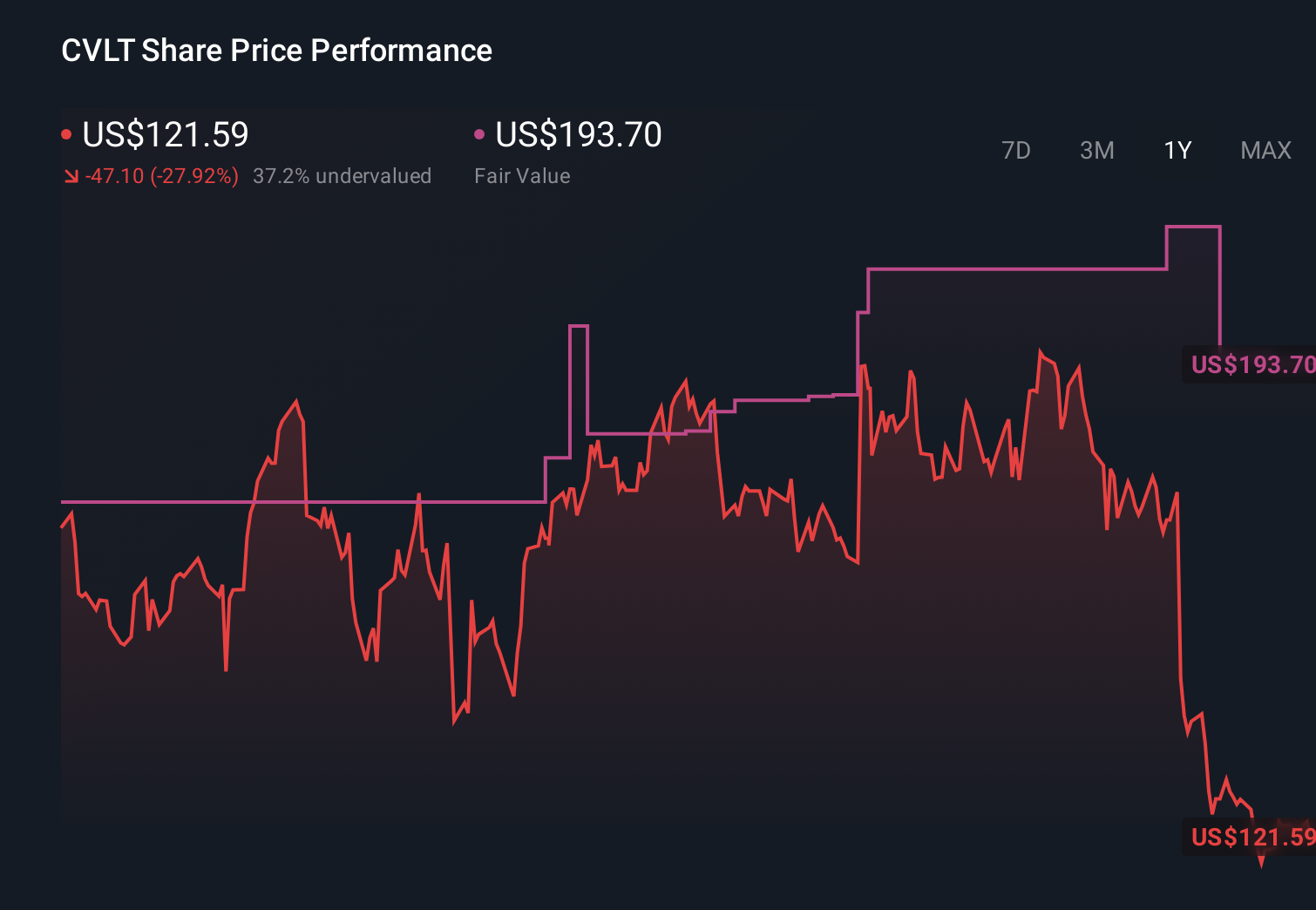
Some of the most optimistic analysts were already assuming Commvault could reach about US$1.7 billion of revenue and US$166 million of earnings by 2029, so this kind of Azure focused recovery upgrade may either support that bullish view on cloud and AI driven workloads or highlight how dependent that upside case is on continued partner led growth that could easily look different once fresh data is in.
Explore 4 other fair value estimates on Commvault Systems - why the stock might be worth as much as 60% more than the current price!
Reach Your Own Conclusion
Disagree with existing narratives? Extraordinary investment returns rarely come from following the herd, so go with your instincts.
- A great starting point for your Commvault Systems research is our analysis highlighting 3 key rewards and 1 important warning sign that could impact your investment decision.
- Our free Commvault Systems research report provides a comprehensive fundamental analysis summarized in a single visual - the Snowflake - making it easy to evaluate Commvault Systems' overall financial health at a glance.
Ready For A Different Approach?
Markets shift fast. These stocks won't stay hidden for long. Get the list while it matters:
- Rare earth metals are an input to most high-tech devices, military and defence systems and electric vehicles. The global race is on to secure supply of these critical minerals. Beat the pack to uncover the 28 best rare earth metal stocks of the very few that mine this essential strategic resource.
- Invest in the nuclear renaissance through our list of 92 elite nuclear energy infrastructure plays powering the global AI revolution.
- We've uncovered the 12 dividend fortresses yielding 5%+ that don't just survive market storms, but thrive in them.
This article by Simply Wall St is general in nature. We provide commentary based on historical data and analyst forecasts only using an unbiased methodology and our articles are not intended to be financial advice. It does not constitute a recommendation to buy or sell any stock, and does not take account of your objectives, or your financial situation. We aim to bring you long-term focused analysis driven by fundamental data. Note that our analysis may not factor in the latest price-sensitive company announcements or qualitative material. Simply Wall St has no position in any stocks mentioned.
Have feedback on this article? Concerned about the content? Get in touch with us directly. Alternatively, email editorial-team@simplywallst.com