


Autodesk stock has bounced strongly in the past month, yet the valuation checks send a mixed message, with the Discounted Cash Flow (DCF) intrinsic value estimate suggesting meaningful upside while the broader signals look closer to fair.
- Autodesk is up 21.3% over the past month, which puts more pressure on the current price to line up with the cash flows implied by that move.
- Expectations for continued revenue and earnings growth across design and construction software can support the valuation. However, any disappointment in margins or subscription uptake may weigh on how much investors are willing to pay.
- The stock screens as undervalued on 4 of 6 checks, so the overall picture is mixed rather than a clear bargain or clear overvaluation. You can see the breakdown in the value score of 4.
The issue now is whether Autodesk's recent rebound still offers a margin of safety relative to its DCF based intrinsic value estimate and its current market multiples.
Find out why Autodesk's -10.8% return over the last year is lagging behind its peers.
Is Autodesk a Bargain on Cash Flow?
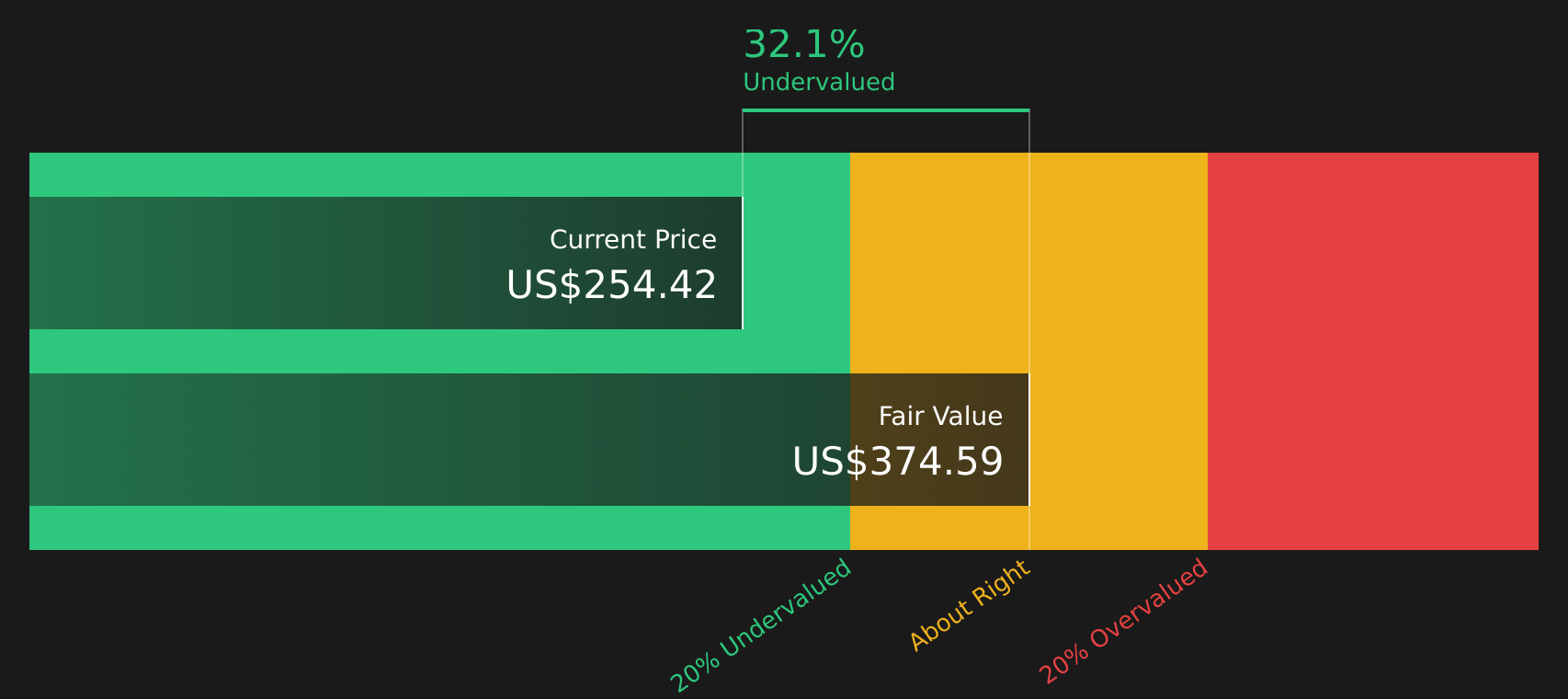
The Discounted Cash Flow (DCF) method estimates what Autodesk could be worth based on the cash it is expected to generate for shareholders. Autodesk is already producing substantial free cash flow, with the latest twelve month figure at about $2.68b, and the model assumes those cash flows keep growing rather than shrinking. On that basis, the DCF using a 2 Stage Free Cash Flow to Equity approach points to an intrinsic value of about $375 per share.
Compared with the current share price, that intrinsic value suggests Autodesk screens as around 32.1% undervalued. The upcoming Q2 2027 earnings report, where analysts are focused on margins and subscription progress, helps explain why the market may be cautious despite the higher DCF estimate.
On this cash flow view, Autodesk stock appears undervalued relative to what its projected cash generation supports.
Our Discounted Cash Flow (DCF) analysis suggests Autodesk is undervalued by 32.1%. Track this in your watchlist or portfolio, or discover 49 more high quality undervalued stocks.
Is Autodesk Fairly Priced on Earnings?
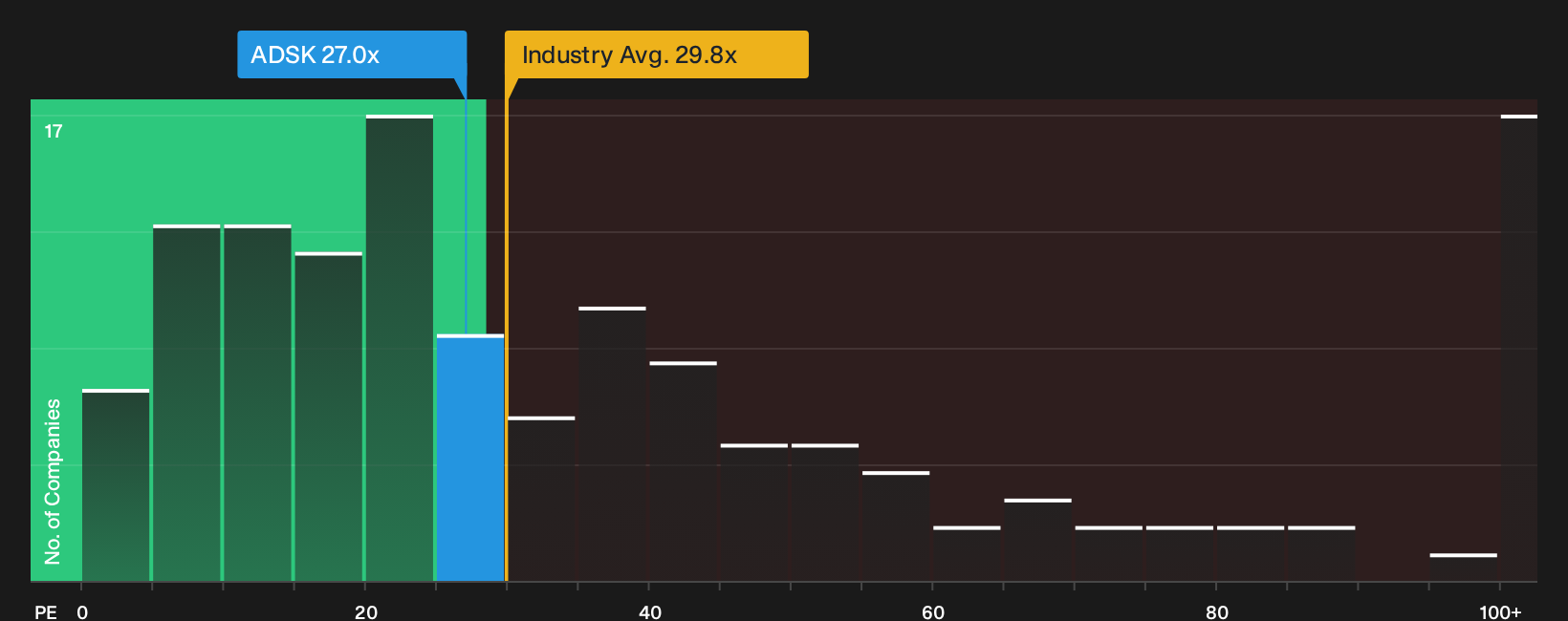
The P/E ratio is a useful lens for Autodesk because earnings are a key focus for a mature, cash generative software business. Autodesk trades on a P/E of about 36.7x, which is higher than the broader software industry average of roughly 30.9x. Compared with closer peers, which cluster nearer 58.8x, the stock sits below that group on earnings.
The model based fair P/E for Autodesk is around 33.5x. That is only slightly below the current multiple, so the gap is limited and does not point to a clear discount or premium on this measure. The P/E suggests the market is applying a valuation that is broadly in line with what its earnings profile and risk level support, rather than stretching to an aggressive premium or offering a clear-cut bargain.
On the P/E multiple, Autodesk appears roughly fairly valued compared with both its tailored fair ratio and the wider software sector.
See what the numbers say about this price — find out in our valuation breakdown.
The Autodesk Narrative: What Would Justify Today's Price?
Simply Wall St Narratives take Autodesk's valuation puzzle and turn it into a set of clear future paths that would justify a higher or lower share price based on growth, margins and earnings. Instead of giving you just one number from a ratio or model, they outline the future that number relies on so you can watch how Autodesk's actual progress lines up with those assumptions on the Community page.
The community is split on Autodesk, with one camp leaning into the industrial AI opportunity and another worried that execution risks and deal costs could cap the upside.
Bull case: 37% undervalued
"Autodesk's proprietary 2D and 3D AI models trained on geometry rich, real world project data, combined with an agentic AI layer that can be priced through subscription, consumption and outcome based models, create multiple monetization paths that can support revenue and earnings over time..."
Read the full Bull Case to see why Autodesk could be undervalued
Bear case: 12% overvalued
"The US$3.6b MaintainX deal is a recurring concern for bearish analysts, who point to potential margin dilution, the high acquisition multiple and the long path needed for the asset to fully support Autodesk''s FY27 and FY29 operating margin ambitions..."
Read the full Bear Case to see why Autodesk could be overvalued
Do you think there's more to the story for Autodesk? Head over to our Community to see what others are saying!
The Bottom Line
For Autodesk, the Discounted Cash Flow (DCF) intrinsic value estimate points to meaningful undervaluation, while the market based P/E view looks closer to about right. That split reflects a DCF that leans heavily on the durability of future cash flows, compared with a multiple that already prices in solid earnings power and peer comparisons. With broader checks landing in a mixed range, the key question is whether Autodesk can deliver on its margin and subscription ambitions without acquisition related drag. How that plays out will likely decide whether the current discount to intrinsic value is an opportunity or a signal that risks deserve a lasting mark down.
This article by Simply Wall St is general in nature. We provide commentary based on historical data and analyst forecasts only using an unbiased methodology and our articles are not intended to be financial advice. It does not constitute a recommendation to buy or sell any stock, and does not take account of your objectives, or your financial situation. We aim to bring you long-term focused analysis driven by fundamental data. Note that our analysis may not factor in the latest price-sensitive company announcements or qualitative material. Simply Wall St has no position in any stocks mentioned.
Have feedback on this article? Concerned about the content? Get in touch with us directly. Alternatively, email editorial-team@simplywallst.com