


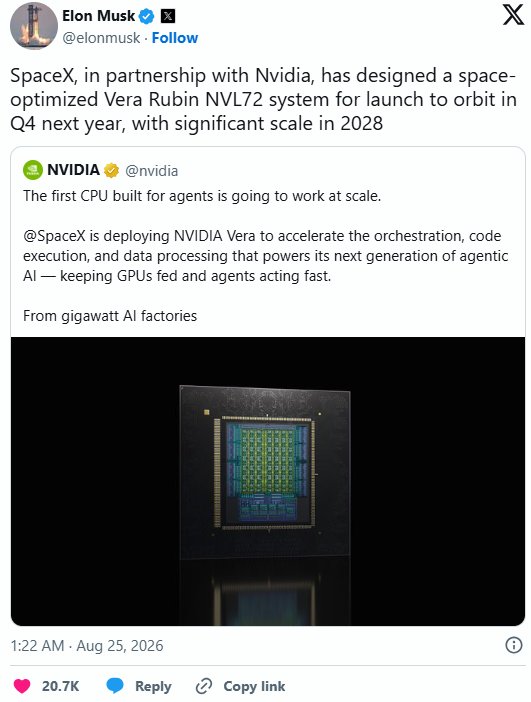
The Zhitong Finance App learned that Elon Musk is taking the AI race from Earth to space. On Monday, SpaceX (SPCX.US) CEO Musk announced on the X platform that the company's first Starmind AI satellites equipped with Nvidia (NVDA.US) chips will be launched for the first time in the fourth quarter of 2027 and will reach a “significant scale” in 2028. This schedule is ahead of the 2028 plan previously disclosed in the prospectus.
On the same day, Nvidia officially announced that SpaceXAI will deploy its next-generation Vera CPU to accelerate agent-based AI (Agentic AI) workloads and launch an optimized version of the Vera Rubin NVL72 rack-scale system into orbit as the computing power core of the first-generation Starmind satellite. This collaboration marks a critical turning point from concept to engineering implementation for the world's first space AI data center project.
From a “ground-based AI factory” to an “orbital data center”: Vera Rubin's space debut
Nvidia Vera is the first CPU specially designed for AI agents. It is equipped with 88 Nvidia-designed Olympus cores, and is equipped with LPDDR5x memory with a bandwidth of up to 1.2TB/s. In workloads such as proxy AI, reinforcement learning, and data processing, the task completion speed can be up to 1.8 times faster than x86 CPUs.
Ian Buck, vice president of hyperscale and high-performance computing at Nvidia, said, “Proxy AI requires a new type of computing system — one that can not only generate answers, but also act. Vera empowers AI agents to act in real-time — execute code, process data, and coordinate complex tasks. SpaceXAI is extending this architecture from ground-based AI factories to the next frontier of orbital computing.”
Mike Nicolls, president of SpaceXAI, stated, “Vera provides us with the CPU performance and memory bandwidth we need to handle a large amount of coordinated scheduling, code, and data processing tasks, while allowing the GPU to focus on the tasks it does best. That means higher performance AI agents, and more valuable work per watt of computing.”
Starmind: a “space supercomputer” with 1 million satellites
StarMind is an orbital AI data center constellation project planned by SpaceX. In January 2026, SpaceX submitted an application to the US Federal Communications Commission (FCC) to launch up to 1 million computing satellites to expand AI computing power on the ground through deployment in low-Earth orbit.
Each Starmind satellite is essentially an optimized Vera Rubin NVL72 rack-scale system, equipped with Nvidia Rubin GPUs and Vera CPUs. According to SpaceX's earlier disclosure, the computing power of a single satellite reached 120 kW (peak 150 kW), and the hardware code was AI1. High-speed data transmission between satellites is achieved through laser links, forming a distributed space AI supercomputer. The first Starmind AI1 satellites will launch Nvidia's accelerated computing platform into space for the first time, based on the optimized Vera Rubin NVL72 rack-scale system.
Musk wrote on X that this kind of data center, which exists in the form of a satellite, is “simpler, lower in cost, higher in density, and lighter than traditional racks.” Compared with ground-based facilities, space deployment does not require a large amount of land, and the cooling pressure is relatively low.
Computing power scale: 2GW→10GW→20GW aggressive expansion
Musk also gave more ambitious computing power expansion goals: Musk revealed during an earnings call in early August that SpaceX plans to have more than 2 gigawatts of AI computing power by the end of 2026, and “closer to 10 gigawatts rather than 5 gigawatts” by the end of 2027. SpaceXAI will also expand terrestrial AI infrastructure in Tennessee and Mississippi. The company plans to accumulate computing power through multiple projects and is expected to reach 20GW by the end of next year.
At the same time, Musk admits that some projects may not be fully implemented on time, but it is expected that the online computing power scale of about 15 GW will be achieved by the end of 2027. He also revealed that SpaceX is expected to receive a “very large percentage” of Nvidia GPUs in 2027.
The trillion-dollar capital expenditure and the “non-mainstream” path disputes
The cost ledger for space data centers is being closely scrutinized by Wall Street. Wood Mackenzie estimates that it costs about $170 billion to build a 1 gigawatt orbital data center, which is more than three times that of a traditional terrestrial data center. Morgan Stanley analyst Adam Jonas predicts that SpaceX's AI-related capital expenditure will reach 53 billion US dollars in 2026, and an increase of 130 billion US dollars in 2027.
Proponents, however, believe that space data centers can circumvent regulatory hurdles and community backlash from terrestrial data centers. SpaceX is reducing launch costs through the reuse of Starship (Starship) rockets and promoting economic improvements in orbital computation. Musk previously explained that before choosing the Nvidia system, he evaluated various chip solutions and finally decided that the Nvidia system was the best choice.
From exclusive collaboration to deep binding: SpaceX “All in” Nvidia
This partnership is a complete upgrade of SpaceX's relationship with Nvidia. On August 4, during the first quarterly results conference call since SpaceX went public, Musk announced that the company had decided to exclusively use Nvidia technology in AI computing power construction. Musk made it clear at the time: “We have established close cooperation and partnership with Nvidia on many levels, and we chose to use Nvidia exclusively.”
SpaceX believes Nvidia's Vera Rubin architecture is “the best AI computer available.” The two companies announced on August 4 that they will jointly develop the computing power payload for the Starmind AI1 satellite. Each satellite will be equipped with an Nvidia Vera CPU and Rubin GPU. SpaceX has indicated to investors that the chips for its space servers will exclusively use Nvidia.
According to the 13F documents previously disclosed by Nvidia on August 14, the company holds about 21 billion US dollars of shares in SpaceX. This deep binding relationship is extending from the capital level to the technical level.
Nvidia's earnings report on Wednesday is imminent: the space narrative becomes the latest catalyst
The announcement of this partnership coincided with the eve of Nvidia's quarterly earnings release on Wednesday (August 26). The space AI data center narrative is adding a new dimension to Nvidia's AI infrastructure story.
Nvidia said that the Vera Rubin platform integrates computing, networking and software into an integrated architecture to reduce the cost per token. As SpaceXAI advances to gigawatt-scale computing capacity, Vera Rubin provides a unified architectural foundation from ground-based AI factories to orbital computing.
In a rail environment, the constraints brought about by power consumption, cooling management, bandwidth, reliability, and physical integration are far more stringent than traditional data centers. The collaboration between Nvidia and SpaceX means that its AI accelerated computing system is being extended from Earth to near-Earth orbit.