


As intelligence penetrates deep into mine production systems, new energy technology is finding new implementation paths.
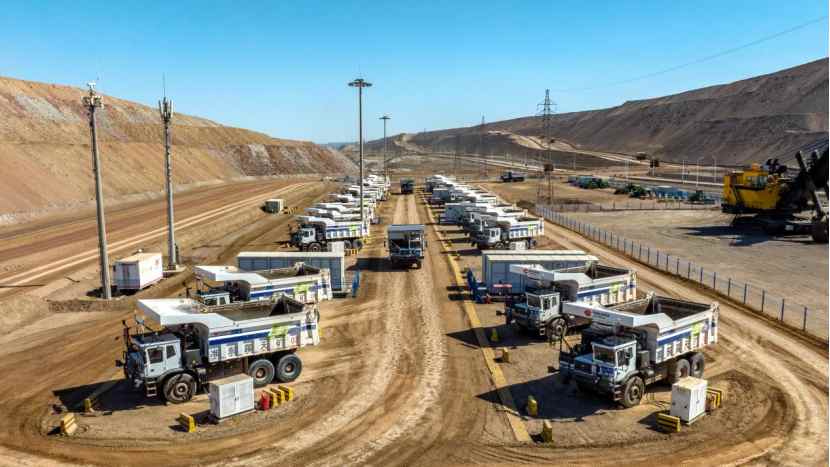
The Zhitong Finance App learned that as of August 24, Easy-Control Smart Driving (07687) has surpassed 1,480 pure electric unmanned mining cards, ranking first in the industry. For the first time, pure electric has jumped to the highest power type among unmanned mining trucks deployed by the company — in a fleet of over 3,500 unmanned mining trucks, clean energy models such as pure electric and methanol extenders account for nearly 60%. There are more than 1,400 fuel-range models, while traditional pure fuel models have already left the main engine sequence.
For a long time, heavy load, high frequency, and continuous operation have been the labels of mine transportation, and the pressure of batteries and energy supplementation systems has also made mines one of the most difficult scenarios for pure electrification to be implemented. However, the introduction of driverless cars has opened up new space for the evolution of mining equipment to pure electrification — when driverless cars take over the entire set of decisions on “how to charge electricity, when to charge, and who decides to charge”, pure electric mining cards in the past have begun to change from “human experience” to “system calculation.”
The “pure electric inflection point” in unmanned vehicle fleets
In the past few years, the scale of unmanned mining cards operated by Easy Control and Intelligent Driving has climbed to more than 3,500 units, covering more than 40 mines at home and abroad. Among them, the growth of pure electric unmanned mining cards is particularly obvious.
As early as the end of 2022, Easy Control and Intelligent Driving pioneered the landing of 20 pure electric unmanned mining cards in the Fushan mine in Honghe, Shandong. It has been in continuous and stable operation for more than 1,200 days. It is the first batch of large-scale “pure electricity” and “unmanned” projects to be implemented in China; at Guoneng's Xinjiang Zhundong Open Pit Coal Mine, 120 pure electric unmanned mining cards are equipped with 28 charging stations, relying on intelligent scheduling to achieve efficient energy replenishment and ensure operation continuity; while the alpine and high-altitude Zijin Mining Tibet Julong Copper Mine has more than 60 pure unmanned radio cards Normalized operation has been achieved, and pure operation has been further expanded Application boundaries of electric solutions under extreme operating conditions.
From reliability and scheduling efficiency to adaptability to extreme operating conditions, from coal mines to metallic and non-metallic mines, these practices together show that the pure electric solution is already tenable in heavy mining scenarios.
Why were unmanned mining cards the first to achieve “freedom of use of electricity”?
The passenger car industry often uses “the first half of electrification and the second half of intelligence” to summarize the evolution of the industry, while in mines, driverless driving is not only a beneficiary of pure electrification, but also an “accelerator” of pure electrification.
The ESG transformation of mines has never been able to bypass the three accounts of safety, cost, and low carbon. In complex working conditions, personnel safety is always a core requirement in mine production; at the same time, fuel consumption is directly related to transportation costs and carbon emissions. As a result, pure electricity and driverless driving complement each other: the former changes the energy structure and reduces fuel dependency; the latter reduces the dependence of high-risk driving jobs on people. The two technologies are not simply superimposed, but form a more complete closed loop of value between safety, economy, and low carbon.
Pure electric platforms are more suitable for unmanned driving in terms of control coordination. Compared with fuel mining cards, pure electric mining trucks do not have an engine or AT gearbox. The power system configuration is simpler, the motor response is faster, the control accuracy is higher, and it is more suitable for driverless systems to accurately control the vehicle's power output. At the same time, the simplification of the mechanical structure also helps reduce the failure rate and improve the operational reliability of driverless vehicles.
The rich operating data brought by unmanned vehicles makes energy management more evidence-based. Driven by people, driving habits are different, and energy consumption performance often “varies from person to person”; driverless driving allows vehicle operation and energy consumption performance to be continuously quantified, and energy recovery under heavy load downhill conditions can also be more fully utilized — 27 pure electric unmanned mine cards at the Shougang Water Plant Iron Mine have an annual renewable charge capacity of 386,000 kWh, reducing overall energy consumption by 8% to 10%.
Digital management further solves the problem of charging efficiency. Through the smart mining digital intelligence solution 'Kureno', 'how to charge electricity and when to charge' can shift from manual experience to system decision making. The system combines factors such as vehicle power, production tasks, charging load, and tiered electricity prices to dynamically coordinate the fleet and charging resources, rationally arrange the timing of refueling, and reduce queuing congestion caused by centralized charging of multiple vehicles. Based on typical project estimates, the solution can reduce charging volume by about 13% during peak hours and help the mining area reduce on-site manpower investment by about 30%.
From bicycle intelligence to cloud scheduling, driverless driving has built a complete architecture for the implementation of pure electric mining cards: the vehicle side is responsible for sensing, decision-making and control, and the cloud is responsible for energy scheduling, which together provides strong support for large-scale implementation of pure electrification in mines.
Policy, Economy and Industry: The “Window Period” Has Arrived
Pure electricity has accelerated to become the main driving force in mines, not only thanks to the development of driverless technology, but is also inseparable from the joint promotion of policies, economy, and industrial conditions.
In July 2026, the National Energy Administration proposed in the “Energy Saving and Carbon Reduction Action Plan (2026-2028)” to strengthen the research and promotion of energy saving and carbon reduction technology and equipment, promote the replacement of transportation equipment in mining areas with new energy sources, and set the goal of “building a number of zero-carbon low-carbon coal mines”. A month later, the National Development and Reform Commission and the National Energy Administration made further arrangements in the “15th Five-Year Plan for the Development of the Coal Industry” to carry out large-scale replacement of electric heavy trucks and hydrogen energy mining trucks in an orderly manner in the open pit mine transportation process, and simultaneously promote the integration of mining area source network load storage — the transformation of new energy sources in mining areas from single equipment replacement to full-link reconstruction of power generation, energy storage, and scheduling. The policy signal was further clarified. For mining companies, a pure electric mining card is no longer just an energy choice, but has begun to become an operating account that requires careful calculation.
The financial accounts of pure electric mining cards have also become clear with the support of driverless cars. Actual application data shows that a single pure electric unmanned mining card can save about 150 tons of standard coal consumption per year; when combined with standardized driving brought about by driverless driving, energy recovery efficiency is improved, the use of mechanical brakes is reduced, and vehicle maintenance costs and the frequency of replacement of consumables are also reduced. The economy of pure electric mining cards is more than just “electricity is cheaper than oil” — driverless driving turns energy consumption, maintenance, and loss into variables that can be optimized by the system. The larger the fleet size, the more economical this account is.
Behind this transformation is an industrial chain that is being redefined. Easy Control Smart Driving relies on cooperation with industry partners such as Ningde Times to jointly explore an integrated energy supply model of “green electricity generation - local consumption - intelligent scheduling”, from the battery itself to the mining energy system. At the same time, we continue to deepen collaboration with various OEMs, and jointly explore pure electric vehicle architectures that are more suitable for mining scenarios based on over 150 million kilometers of actual operation experience. Green power generation, pure electric mining cards, and driverless systems are forming a closer synergy, and moving “zero-carbon mines” from single-point technology exploration to systematic practice.
For mine operators, personnel safety and low-carbon transformation are becoming common must-answer questions, and the business logic of “pure electricity+unmanned” is becoming more and more clear and replicable. Up to now, the Easy-Control Smart Driving unmanned mining card has reduced carbon by more than 190,000 tons, which is equivalent to planting trees and reforestation of more than 9,400 hectares. This is a natural result of improved system energy efficiency.
Changes in the energy structure of more than 3,500 unmanned mine cards with easy control and smart driving are becoming a window for observing the new energy process in mines. From new energy becoming mainstream to the further rise of pure electricity, the reason behind this is the continuous reshaping of the way mine transportation is organized by driverless cars. Intelligence and decarbonization are also gradually moving from two parallel paths to the same production system.