


The Zhitong Finance App learned that at a time when the scale of credit market debt issuance linked to AI computing power infrastructure construction is surging, and concerns about the “AI credit bubble bursting” are rapidly heating up, and the yield on US bonds with a 10-year term or more rapidly rising and suppressing the NASDAQ 100 index, the seasonal statistics shown in a research report prepared by Wall Street financial giant Bank of America further suggest: September, the second year of the US presidency, is generally not conducive to high-risk equity assets such as stocks, especially those that rely on large forward cash flows, long capital return cycles, and are highly sensitive to changes in risk-free returns on the divider side Technology stocks fared better in September, but in September they were more favorable to the US dollar and commodity assets such as crude oil, gold, and silver.
The Bank of America strategist team emphasized in the research report that institutional and retail investors should prevent “rising interest/long-term US bond yields+credit market risk revaluation+weak seasonal equity assets”, but the historical win rate is not a definitive prediction. The final trend still depends on the profit cashout trajectory of important technology companies related to AI applications, inflation, and the expected path of the Federal Reserve's monetary policy.
Bank of America's top ten September trends forecast: the stock market may lose blood, and commodities such as gold are expected to lead the September asset allocation
As September approaches, a recent Bank of America report highlights important seasonal trends investors need to pay attention to, particularly as the market enters the second year of the US presidential four-year term cycle and faces critical midterm elections.
Mike Zacardi, a well-known US financial writer and investment analyst, quoted this Bank of America research report in a social media post and pointed out that global stock assets may face resistance, while commodities and the US dollar may unexpectedly release bullish signals.
Historical data charts compiled by Bank of America show that major stock indexes in the US stock market generally did not perform well during this period in September. The Nasdaq 100 Index (NDX) showed a clear bearish trend: historically, in September, the second year of the US presidential cycle, the index fell 70% for a long time, with an average return of − 0.66%.
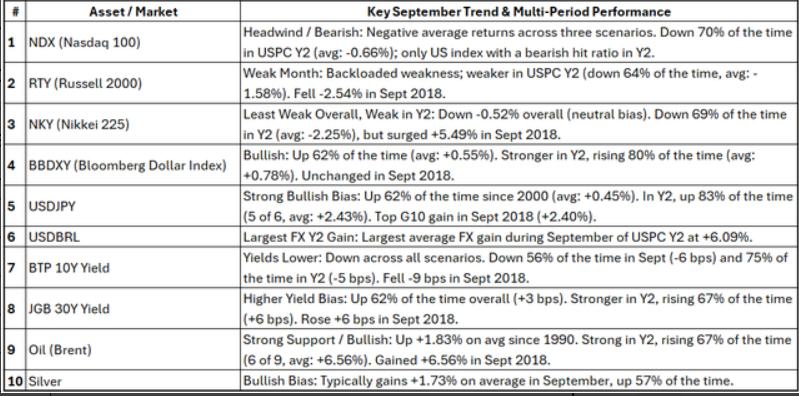
Similarly, the Russell 2000 Index (RTY), the benchmark index for small-cap stocks in the US stock market, also faced a historically weak month during this cycle, with a decline probability of about 64%.
In contrast, historical data compiled by Bank of America shows a strong bullish trend for the US dollar. In September, the second year of the US presidential cycle, the Bloomberg dollar index rose 80% of the time. Furthermore, since 2000, in the second year of these six recent presidential cycles, the dollar has risen five times against the yen, showing a clear bullish trend.
Commodities also performed more favourably. Among them, Brent crude oil also showed strong support — rising about 67% of the time in September of the second year of the presidential cycle; silver, which has always fluctuated sharply, usually had an average increase of about 1.73% in September of the second year of the presidential cycle over the years.
Another precious metal, gold, performed similarly strong during the same period in history. Wall Street's recent bullish sentiment on gold has intensified as the US Treasury unexpectedly increases its repurchases of long-term treasury bonds and global financial market concerns about the US government's repeated record high debt burdens have intensified. As US Treasury Secretary Bessentley strengthened the trading logic of weak dollar and currency depreciation, gold rose sharply. Over the past three weeks, the gold futures market has poured into record buying orders of more than 22 billion US dollars on a large scale, and positions have quickly turned crowded.
Citibank strategist Dirk Willer sees gold at 5,000 to 6000 US dollars per ounce in the next year, the core basis is intervention by the Ministry of Finance, the risk of losing control of the US bond maturity premium, weakening of the US dollar, and the restart of “de-dollarization” transactions; Deutsche Bank's year-end benchmark target is 4700-5100 US dollars, relying on the central bank's gold purchases and the return of ETFs to non-price-sensitive demand — the net inflow of gold ETFs over the past 30 days, with a cumulative increase of about 4 million ounces during the year, and the central bank's purchase amount reached 38.888 billion US dollars in the first quarter of 2026 .
Dalio, founder of the Bridgewater Fund, recently issued another warning about the US financial situation. He believes that US Treasury Secretary Bessent announced an expansion of long-term treasury bond repurchases this week, combined with phenomena such as the sharp rise in long-term US bond yields and Japan's reduction in exposure to the US bond market, which may mean that the US treasury is nearing a critical turning point; if the debt problem is not addressed in a timely manner, the US may face a more serious debt crisis in the next few years, and Dalio suggests investors increase their gold holdings.
Commodities take over, 5% long-term debt red line tortures fiscal deficits and AI financing feast
In September, the second year of the US presidential cycle, the NASDAQ 100 index had a historical decline probability of about 70%, an average return of -0.66%, and the probability of the Russell 2000 falling was about 64%; in contrast, the probability of the Bloomberg dollar index rising was about 80%. The dollar strengthened five times against the yen in the six samples since 2000, and the probability that Brent crude oil would rise was about 67%. Therefore, the Bank of America's benchmark investment strategy for September is to reduce the directional beta for high-term technology stocks and small-cap stocks, moderately increase the US dollar, and commodity assets such as traditional energy and precious metals.
The strategy team led by Bank of America's senior strategist Michael Hartnett, who has the title of “Wall Street's Most Promising Strategist,” proposed “going long on gold is the best solution right now”, along with Deutsche Bank's view that “gold is in an explosive upward phase” and the underlying logic of other Wall Street banks bullish on gold essentially points to the same main structural investment line: the US government's increasingly huge debt, 1.4 trillion US dollars of interest expenses and the wave of AI companies' debt issuance to push up the maturity price, and gold will benefit as a result; And once the yield rises, it jeopardizes the finances Sustainability and risk assets, and policy departments must also try to reduce financing costs, so gold becomes an asset to hedge against the cycle of “damage to bond values — policy intervention — decline in the real purchasing power of the US dollar.”
The reason Michael Hartnett listed “going long on gold” as the best current deal is that it is the best tool to hedge against the depreciation of the US dollar, debt disorder, and asset inflation. The underlying judgment is that US debt may approach 50 trillion US dollars around 2029, and the AI financing frenzy is further competing for institutional capital originally belonging to long-term treasury bonds.
Hartnett further viewed the 30-year US Treasury yield of 5% as a systemic risk watershed — this is its strategic threshold, not an official target set publicly by the Treasury Department. If Bezent successfully reduces long-term yields below 5%, interest rate sensitive assets may receive phased valuation repairs; if the intervention fails, the market may interpret “high yield+weak dollar” as fiscal credit rather than a strong economy, which in turn will cause a chain reaction of falling US dollars, deleveraging risk assets, and widening credit spreads.
The “Bull & Bear Indicator” (Bull & Bear Indicator), compiled exclusively by Bank of America, has risen to 9.5 and is in the “sell” range. Therefore, the Bank of America strategy team framework led by Hartnett advocates using gold to hedge against dollar credit dilution, increase the commodities and natural resources required for AI construction, while shorting AI bonds, and be wary of highly leveraged hyperscale cloud vendors, private credit, and cyclical financial assets. The Bank of America strategist team said that if long-term yields continue to rise and the dollar weakens at the same time, exposure to highly leveraged AI infrastructure, low-rated data center bonds, and private credit should be reduced, and shift to gold, energy, resource stocks, and short-term high-quality credit.