


The Zhitong Finance App learned that the latest data released by the German Federal Statistical Office on Tuesday showed that the economic growth rate of Europe's largest economy in the second quarter was higher than previous preliminary estimates. Against the backdrop of soaring energy prices and turbulence in the global supply chain caused by the war in Iran, the German economy showed resilience beyond expectations with strong export performance, achieving a third consecutive quarter of month-on-month growth.
According to revised data from the German Federal Statistical Office, Germany's gross domestic product (GDP) grew 0.3% month-on-month in the second quarter of 2026, up 0.1 percentage points from the initial value of 0.2% announced at the end of July. Previously, the growth rate in the first quarter was also raised to 0.4%, which means that the German economy achieved three consecutive quarters of positive growth for the first time since the end of the pandemic.
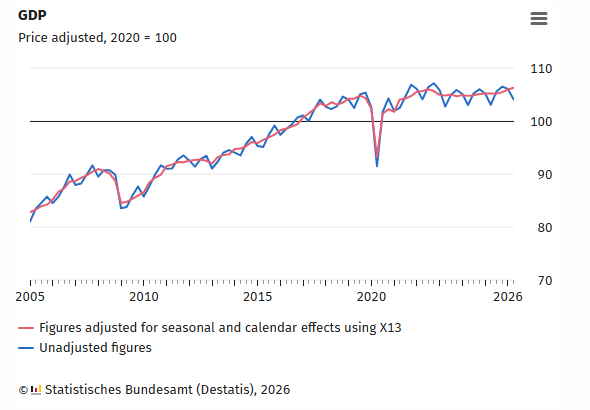
Federal Statistical Office Director Lute Brand said in a press release: “The German economy has continued its growth momentum since the beginning of the year, similar to the first quarter. Growth is mainly due to strong export performance.”
The revised data revealed that commodity exports surged 2.6% month-on-month in the second quarter, which was significantly higher than the initial value. Analysts pointed out that this increase was partly due to overseas companies fearing that the war with Iran would drive up prices and disrupt the supply chain, thus hoarding German goods ahead of schedule. Furthermore, the turnover performance of wholesale and retail trade was also better than expected, further supporting the overall improvement.
Judging from the GDP structure, net exports contributed 0.2 percentage points of growth. Private consumption and government spending each increased slightly by 0.1%, while capital investment unexpectedly fell by 0.2%, mainly dragged down by a sharp decline in investment in the machinery and equipment sector. There was also a significant increase in imports, reflecting a certain recovery in domestic demand and the behavior of enterprises to replenish inventories.
“Moving forward against the wind” in the shadow of war
The reason why this data is remarkable is that at the point in which it was announced — the US and Israel military action against Iran has continued for several months, and the global energy market has been severely impacted, with Europe bearing the brunt of the impact. As a major manufacturing country that is highly dependent on energy imports, Germany was once regarded as one of the most severely affected developed economies.
However, the facts show that the German economy is performing better than market concerns under the clouds of war. In recent months, factory output and export data have shown a gradual upward trend. Revised data from the German Federal Statistical Office confirmed that despite facing high energy costs and geopolitical uncertainty, the core competitiveness and external demand of the German manufacturing industry did not collapse.
However, this resilience doesn't mean peace of mind. The Bundesbank issued an early warning last week, and GDP growth in the third quarter is expected to be minimal at best.
The central bank pointed out that the water level of the Rhine River has dropped to a record low and is seriously interfering with the logistics transportation of German industry — Europe's most important inland waterway carries a large amount of raw materials and manufactured goods. Too low water levels have led to a drastic reduction in barge cargo volume and a surge in transportation costs. Meanwhile, the export growth momentum previously accumulated is fading, and overseas companies' “preventive hoarding” behavior is difficult to sustain, and the export growth rate is facing downward pressure in the coming months.
Mertz's New Deal coexists with structural challenges
The German economy has stagnated for a long time over the past few years. The difficulties stem from a combination of structural factors: structural rise in energy costs after the Russia-Ukraine conflict, competitive pressure brought about by the rise of the Chinese manufacturing industry, and continued suppression of Germany's export sector by imposing tariffs during US President Trump's tenure.
At the beginning of 2026, the market had high hopes for a strong rebound in the German economy. The new Chancellor Friedrich Mertz launched a large-scale fiscal expansion plan, focusing on defense and infrastructure construction, which is viewed by outsiders as a key measure to break Germany's long-term fiscal conservatism and restart the engine of growth. The coalition government also simultaneously announced reform plans involving taxation, pensions, and administrative bureaucracy, aimed at attracting private capital by improving the investment climate.
However, the outbreak of the Middle East war greatly reduced these optimistic expectations. Energy-intensive manufacturing is once again being hit by costs, and the German government has lowered its GDP growth forecast for the full year 2026 to 0.5% from 1% previously. Although this figure avoided a recession, it was far from sufficient to fix the output gap accumulated over many years of stagnation.