


The Zhitong Finance App learned that European infrastructure-type stocks, which have long been underrated by institutional investors in recent years, are increasingly rewarding investors by providing huge risk exposure to two key regional themes: European defense, military and defense system autonomy, and stock market safe havens against America's cutting-edge artificial intelligence technology-driven shocks and AI disruptions.
The excess alpha investment income from European infrastructure stocks is not simply a fall and rebound in European cyclical stocks; it is a common intersection of the three main lines of capital expenditure: when high-valued US technology stocks face a double revaluation of AI investment returns and the risk of “AI disrupting everything”, European power grid systems, energy, transportation, defense, and semiconductor equipment infrastructure construction companies such as large-scale industrial equipment and lithography machines rely on physical assets and extremely high infrastructure entry barriers and pricing rights, becoming a resilient income combination for global capital seeking profitability An important vehicle for diversification of investment risks, in particular defense and military, semiconductor equipment, steel, and power grids, can be said to have jointly ignited this round of European bull markets.
The investment implication for investors is that priority should be given to leading infrastructure construction stocks that can receive real orders, have strong cash flow all year round, and are expected to receive priority policy funding, rather than betting on all steel, chemical, military, and traditional large industrial equipment companies in general.
National defense and military autonomy, energy security and financial expansion resonate
A basket of infrastructure stocks, including European steel producer ArcelorMittal SA (ArcelorMittal SA), Swedish truck manufacturer Volvo, and French construction group Vinci SA, has accumulated a sharp rise of 57% since the end of 2024, an increase close to double the European Stoxx 600 benchmark index. The US-Iran war pushed up oil prices, the risk of energy channels between Russia and Europe, and large-scale expansion of defense and infrastructure construction spending by European economies such as Germany, and jointly promoted the strong rise of European infrastructure stocks dominated by military, semiconductor equipment, steel, and power system construction companies.
Meanwhile, geopolitical turmoil in the Middle East caused by the US-Iran war drove the international benchmark crude oil price to rise sharply by 30%, and the ongoing conflict between Russia and Ukraine continues to threaten core energy infrastructure such as the key gas pipelines connecting Russia and Europe. The German government has confirmed that it plans to invest hundreds of billions of euros in defense, military industry, and infrastructure construction.
Recently, this European infrastructure stock group has also attracted a global investor base focusing on so-called “HALO stocks,” because it has important physical assets that cannot be replaced by large factories, power grid systems, and other AI models/AI agents at all, and is thought to be less affected by the disruptive effects of artificial intelligence dominated by Anthropic, a large-scale AI application laboratory.
Wall Street analysts have recently released research reports saying that the stock prices of asset-heavy companies with tangible production assets are significantly outperforming the global stock market. This is also the core logic that European stocks have slightly outperformed US stocks since this year. Global investors, including hedge funds and retail investors, are actively seeking safe havens to escape the “artificial intelligence disrupts everything” sell-off storm, they have tacitly turned their investment attention to asset-intensive HALO (Heavy Assets, Low Obsolescence, that is, focused on heavy assets and low risk of AI elimination), and these HALO stocks, which include lithography giant Asmack and hybrid bonding advanced packaging equipment BE Semiconductor NV The European stock market has a high weight, while the US stock market's weight is biased towards “lightweight capital” stocks.
Mark Hafer, chief investment officer at UBS Global Wealth Management, said: “As the scope of financial support for large European economies expands and structural demand for transportation, energy, digital construction and climate-related assets continues to grow, European infrastructure stocks may provide investors with an attractive combination of resilience, returns and diversified value.”
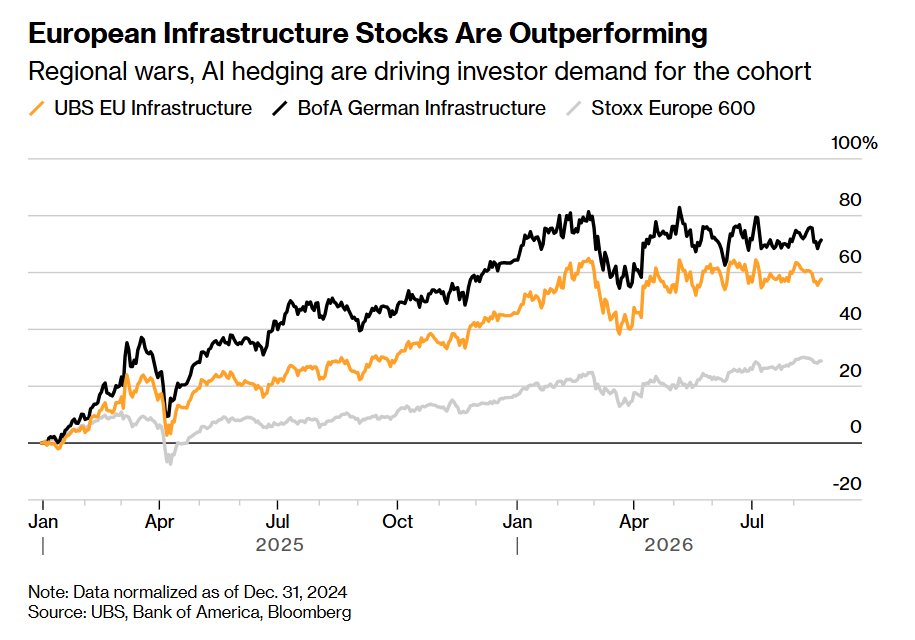
European infrastructure stocks are leading the way — as shown in the chart above, hedging demand for regional defense and military construction and artificial intelligence is driving investors to buy this stock group. Note: The data is standardized based on December 31, 2024.
According to information, Germany's draft 2027 budget shows that Europe's largest economy will raise defense and security spending to more than 200 billion euros (about 233 billion US dollars) by the end of this decade, which is equivalent to one-third of the federal budget. Although overall spending is still below the benchmark target, relevant departments are seeking to expedite disbursement of funds this year.
Heffer pointed out that important infrastructure construction industries such as transportation, communications, water supply, and energy systems in the European stock market will be the main winners, and emphasized the barriers these fields pose to new entrants. “Existing infrastructure construction companies often have strong pricing power,” he said.
A sub-report prepared by Bloomberg Intelligence shows that as Europe actively seeks alternatives to cheap traditional Russian energy, low-cost Asian goods, and security guarantees provided by the US, it will need to invest around 14 trillion euros by 2035. The report shows that power, national defense, and high-end chip/semiconductor equipment infrastructure stocks such as Rheinland Group, Saab, and Asmack are in an advantageous position, while automotive, chemical and steel producers are facing higher performance growth thresholds.
The rise of HALO trading - a “physical asset moat” under the wave of artificial intelligence disruption
The changing market narrative around artificial intelligence is another attraction. After initially rewarding major AI capital expenditure companies in the US and the computing power industry chain that benefited from the AI computing infrastructure frenzy, capital is now flocking to stocks unlikely to be disrupted by artificial intelligence due to investors' concerns that the valuation of US technology stocks will rise and AI may have a disruptive impact on the highly weighted software industry. On Wall Street, this has given birth to “heavy assets and low risk of obsolescence” HALO sector stocks.
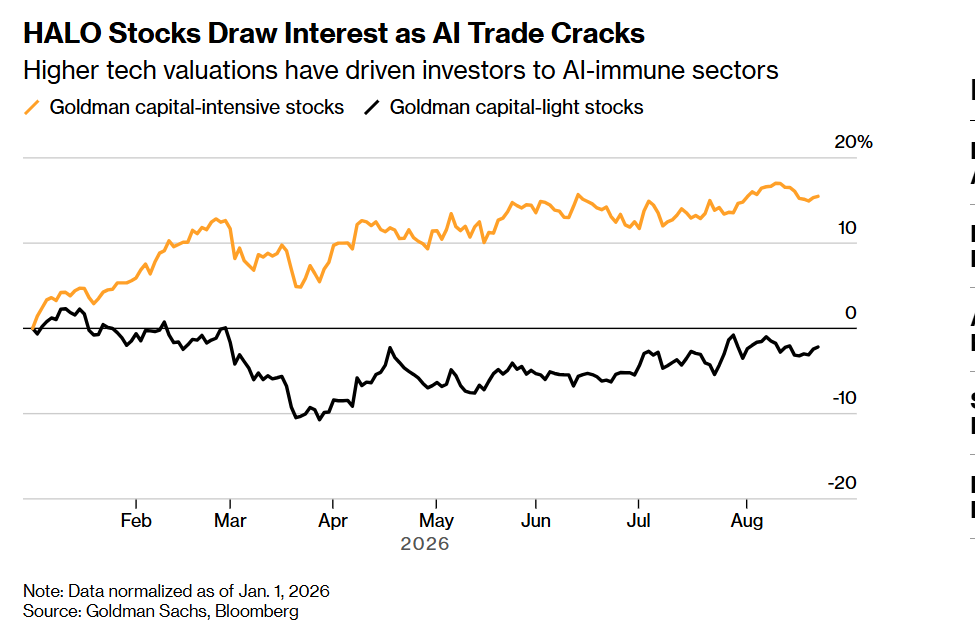
As shown in the chart above, as AI trading cracks, HALO stocks are attracting investors' interest — rising tech stock valuations are driving investors to an industry almost immune to the impact of artificial intelligence. Note: The data is standardized based on January 1, 2026.
The “halo effect” is not a “halo effect” commonly referred to in psychology, but rather refers to companies whose value mainly comes from physical assets/core high-end production/manufacturing networks/infrastructure with high replicable costs and a long lifespan. Therefore, investors think they are not easy to be quickly replaced or “technically eliminated” by AI, and are more likely to obtain a “safe haven premium” when AI anxiety heats up. Goldman Sachs defines these HALO themed stocks as stock assets that are less susceptible to AI technical elimination, while Bank of America's sales and trading desk has recently guided high-net-worth customers to actively allocate such HALO stocks, which have premium attributes under the impact of AI.
Such stocks enable investors to bet on assets that cannot be completely replaced by digital algorithms, such as large infrastructure plants such as traditional steel manufacturing, transmission lines, and large manufacturing plants. A basket of capital-intensive HALO stocks compiled by Goldman Sachs has risen 15% since this year, outperforming the 2% decline in its asset-light counterpart portfolio.
Sharon Bell, senior European stock strategist at Goldman Sachs, said, “Europe has many capital-type companies. They have huge physical capital, and their business is unlikely to be affected by artificial intelligence. In fact, the opposite is likely to be the case; they are receiving increasing market attention in the AI era.”
Citigroup colleagues also said that investors are seeing European stocks as an ideal tool to spread the risk of artificial intelligence. According to the bank's analysis report, lithography giant Asmack, large mining company Fresnillo, Swiss specialty chemicals company Sika, and the British utility company National Grid Corporation were all selected for the HALO stock screening list with positive profit momentum and relatively attractive valuations.
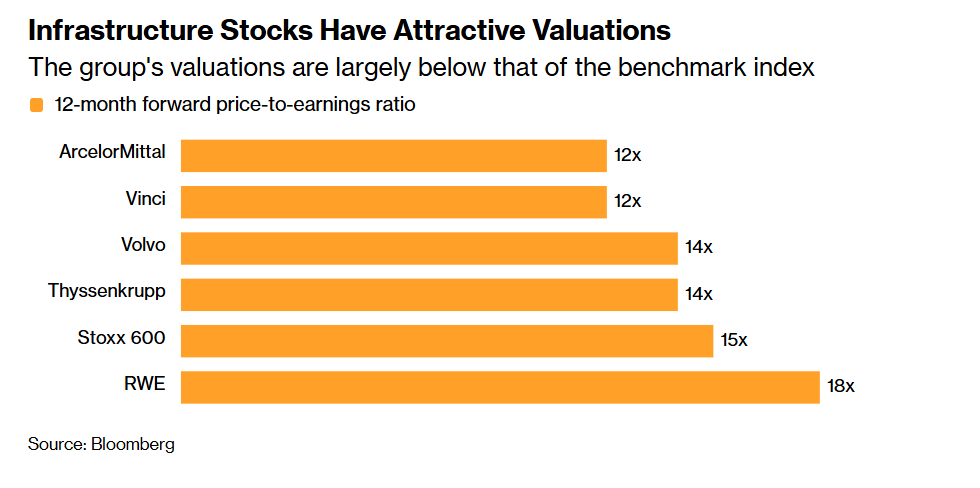
As shown in the chart above, European infrastructure stock valuations have strong investment appeal — the valuation of this group of stocks is generally lower than the benchmark index.
Some investors are more skeptical about the effects of increased infrastructure spending on corporate profits. Preksha Shah, an investment expert from St James's Place, said, “Stimulus measures take time to transfer, and spending doesn't always translate into benefits. Would a typical European Stoxx 50 index component benefit from this? So far, we haven't seen this impact reflected in profits.”
However, a recent Bank of America survey found that about 29% of fund managers expect fiscal expansion in the Eurozone to become the second-largest driver of economic growth in Europe, after the easing of the geopolitical situation. Coupled with ongoing US trade pressure and more intense competition from China, these factors are creating important investment opportunities based on fiscal expansion in various European industries.
Mislav Matejka, strategist at J.P. Morgan Chase, said, “What this means for the market is that a longer-lasting capital expenditure cycle is being formed in the European market, which is strongly supported by policies, covering infrastructure sectors co-dominated by defense, energy systems, power grids, industrial capacity, digital infrastructure, and some key supply chains.”