


The Zhitong Finance App learned that just as NVDA.US (NVDA.US) was about to release its high-profile quarterly report after Wednesday, Bank of America securities analyst Vivek Arya's team threw a “contradictory” bombshell into the market — the Philadelphia Semiconductor Index (SOX) still has about 10% downside in the short term, but the SOX index still has about 10% downside in the short term, but this correction is exactly the layout window for “enhanced buying” (enhanced buy).
In her report to clients, Arya stated bluntly: “Although this downside risk is unreasonable from a fundamental point of view, SOX still has a downside risk of about 10%, which will bring its valuation back to the discount level of the S&P 500 index before the release of ChatGPT (November 2022).” However, “on the other side of the ledger, the situation is very attractive.”
Short-term pressure quadruples: why are chip stocks likely to fall another 10%?
Bank of America has listed four major short-term headwinds that are suppressing the semiconductor sector:
First, interest rates are rising. US 30-year Treasury yields hit a new high of 5.33% since 2007 this month, and rising long-term interest rates are putting a systemic strain on highly valued growth stocks.
Second, the “neighborhood avoidance effect” of data centers. Community boycotts against AI data center projects across the US are heating up. New York State has suspended approval for large data centers above 50 megawatts, Pennsylvania has introduced the “strictest” regulatory rules in the US, and Texas has carried out a comprehensive audit of data center grid access.
Third, “revolving financing” concerns. The market is questioning the model of giants such as Nvidia providing open financing to customers and suppliers, fearing that this may dilute the quality of profits and boost venture capital.
Fourth, the warehouses are crowded. Institutional investors' holdings in semiconductor stocks exceeded the S&P 500 index by 13%, creating additional supply-side pressure.
If SOX falls another 10%, its forward price-earnings ratio will fall back to about 20 times — the same as the S&P 500 index, which had previously been pushed by the AI boom from a discount of about 9% against the S&P 500 to a 15% premium.
Eight “enhanced buy” targets: from Nvidia to Intel's all-star lineup
Despite short-term pressure, Bank of America clearly listed the following eight semiconductor stocks as “enhanced buying opportunities”:
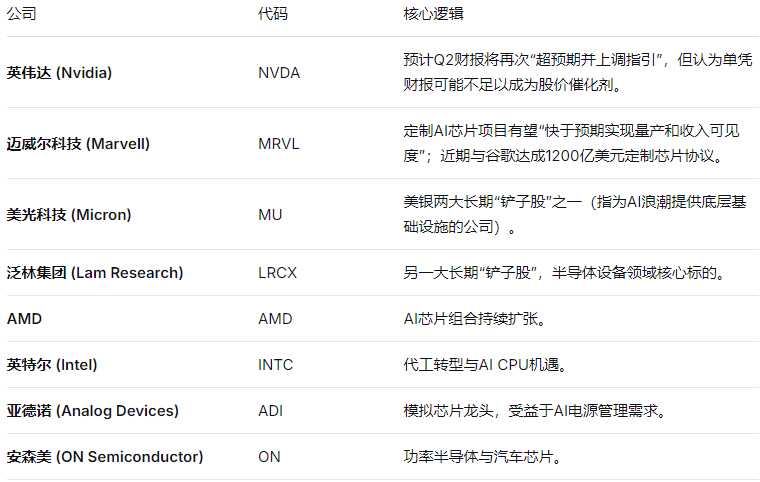
Arya emphasized that seasonal strength in the fourth quarter and the first quarter of 2027 will provide a strong upward catalyst for these stocks.
Nvidia's “Crucial Battle”: A Buyback Narrative Beyond Earnings
Bank of America gave a more detailed analysis of Nvidia, which is about to release financial reports. Arya pointed out that Nvidia faces two major downside risks: “return on capital may slow down” and “there are unstable and unpredictable sales in new businesses in the corporate market.”
Bank of America believes that Nvidia can draw on Apple's post-2012 model — increasing the return on cash from the current level of about 50% of free cash flow to over 75%, which is the “next catalyst” for its stock price revaluation. Bank of America estimates that Nvidia will generate a total free cash flow of more than 400 billion US dollars from 2026 to 2027, which is about equal to the sum of Apple and Microsoft during the same period. Larger share buybacks will “create more potential buyers and reduce market concerns about investment risks in the AI ecosystem.”
The long-term narrative remains the same: AI data centers will reach $1.8 trillion by 2030
Bank of America's long-term outlook remains firm and bullish. The bank's latest forecast shows that the global AI data center system market will grow from about US$564 billion in 2026 to about US$1.8 trillion in 2030. Among them, AI servers will account for 1.4 trillion US dollars, network devices will account for 310 billion US dollars, and storage will account for 85 billion US dollars. The compound annual growth rate (CAGR) from 2025 to 2030 was as high as 45%.
Against the backdrop of SOX index constituent stocks expanding at a compound annual earnings per share growth rate of about 70%, Arya believes that the current forward price-earnings ratio of about 20 times is still in the underestimated range.