


The Zhitong Finance App learned that the French stock market is about to face multiple political risks, and these uncertainties may further continue its weak performance compared to other European markets.
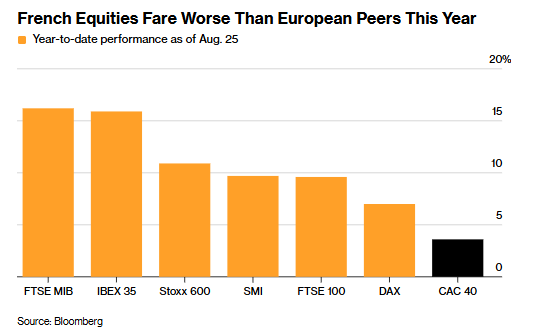
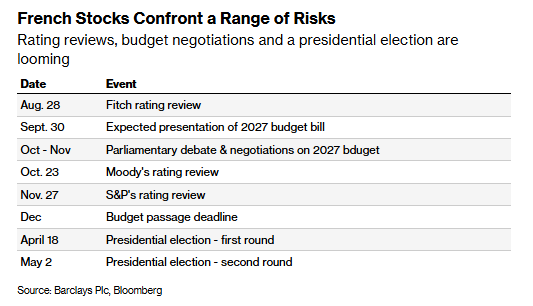
Since this year, the CAC 40 benchmark index has risen 3.6% and reached a record high in early August. However, this increase is far less than the 11% rebound of the Pan-European Stoxx 600 Index over the same period. Investors are now preparing for this weekend's Fitch Ratings review, and the next few months will also usher in budget negotiations and presidential elections.
Although less than one-fifth of CAC's 40 revenue comes from mainland France, which has helped the index to withstand domestic headwinds to a certain extent, bond investors have been demanding a risk premium for holding French government bonds since President Emmanuel Macron announced early parliamentary elections in June 2024.
Marina Zavolok, Europe's chief equity strategist at Morgan Stanley, said: “Investors are becoming increasingly aware of the fluctuations French political risks may cause.” She pointed out that investors who focus on a long-term layout are particularly likely to be discouraged by the uncertain prospects of the French market.
Since 2024, France has successively replaced five prime ministers. Long-term economic growth has been weak, and the debt burden is heavy. According to a recent Bank of America survey, 56% of net fund managers ranked France as Europe's least favored stock market, a record high.
The minority government led by Prime Minister Sébastien Le Cornoux plans to submit a full draft budget in late September. However, the government's fiscal plan is shrouded in great uncertainty, as opposition parties are focusing more and more attention on the contentious presidential election to begin in April.
Marina Le Pen of the far-right political party, the National League, is currently leading the investigation of voter intentions. According to estimates by the French National Financial Audit Agency, if the budget cannot be passed before the election due to political differences, France's fiscal deficit will expand by at least 0.5% of economic output.
According to Goldman Sachs data, industries such as finance, utilities, telecommunications, and industry have the greatest exposure to political risk. Those individual stocks that account for relatively high domestic sales include companies such as BNP Paribas, Orange, Engie, and Wanxi.
Thanks to steady banking performance, the indicator has risen 7.3% this year, better than its 1.1% increase compared to the international benchmark. However, this excessive performance also made it face greater pressure to recover in the face of heightened political concerns.
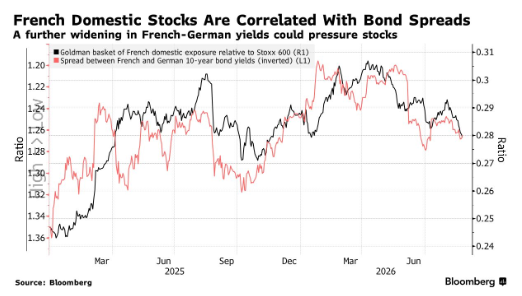
The index's relative performance is closely related to the difference in French and German 10-year treasury bond yields. Interest spreads have recently widened and are close to the highest level in the past two years. Widening interest spreads not only weaken the attractiveness of French stocks, but also curtail companies' ability to invest, and ultimately damage their competitiveness.
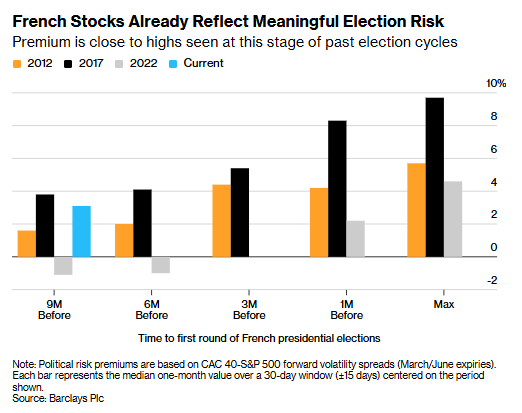
Other indicators also show that French assets have begun to price political risk. An analysis by Barclays Bank found that the risk premium currently implied by blue-chip stocks is close to the high point at the same stage in the previous election cycle. The bank's strategists calculated based on the March/June forward volatility spread between CAC 40 and S&P 500.
The strategy team, which includes Stefano Pascale and Anshul Gupta, stated in the report: “This shows that while election premiums may continue to accumulate, a significant portion of political uncertainty is reflected in current pricing.”
They further stated that Air Liquide Group, AXA Insurance, and Renault are historically most sensitive to changes in interest spreads on French-German bonds, which means that if France's sovereign risk premium expands further, these individual stocks may be particularly vulnerable.
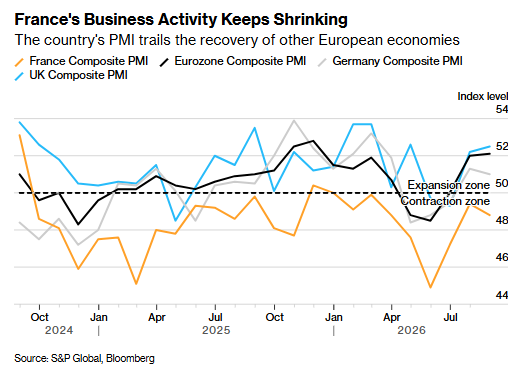
A weak economy has also dragged down market sentiment. Affected by the slump in the service sector, commercial activity in France contracted further in August. Although GDP rebounded after a flat start in the second quarter, the overall growth rate still lagged behind the overall level of the Eurozone. Meanwhile, the unemployment rate is hovering at a high level not seen since 2020.
Some investors believe that large industrial stocks such as Schneider Electric or Legrand may have some defensive value because most of their sales come from overseas. Banque Piguet Galland senior fund manager Christina Karlsten pointed out that in the current context of artificial intelligence (AI) development driving data center demand and energy transformation, the sector is also showing some appeal.
However, other stocks with highly international businesses lagged behind in 2026. Luxury goods giants LVMH and Hermès plummeted 30% and 27%, respectively, due to the war in Iran and weak consumption in key markets, making them one of the worst performing constituent stocks in the CAC 40.
Karlsten said that the overall failure of the French index means that “a lot of bad news” has been digested by the market. “But I think investors will remain on the sidelines until the elections are clear,” she added.