


The Zhitong Finance App learned that high inflation in Australia prompted economists from Goldman Sachs to the Commonwealth Bank of Australia (CBA) to predict that interest rates will rise again as early as next month, abandoning expectations that interest rates will remain the same for the rest of the year. This shift occurred after the inflation report released on Wednesday showed that price pressure was still high. The minutes of the Reserve Bank of Australia's August meeting showed that the interest rate setting committee was less tolerant of rising consumer prices.
Australia's largest bank, the Commonwealth Bank of Australia, said on Thursday that the inflation data would cause the RBA to “lose patience” and predicted a 25 basis point rate hike to 4.6% in November, while pointing out that there may also be changes at the September 28-29 meeting. “The Australian economy needs to tighten monetary policy,” said the bank's Belinda Allen.
Economists at ANZ and Goldman Sachs also expect the Reserve Bank of Australia to raise interest rates in November. Among them, Goldman Sachs also believes that there is a risk of interest rate hikes in September. Deutsche Bank's Phil Donaghoe was the first to change previous predictions after releasing CPI data on Wednesday. He further predicted that the Reserve Bank of Australia would raise interest rates at the September meeting, and said potential inflation was “unbearably high.”
National Australia Bank's Sally Auld also predicted interest rate hikes in September. She believes “the risk of raising interest rates again in November is high, especially if economic activity data shows that the economy will be resilient in the next few months.”
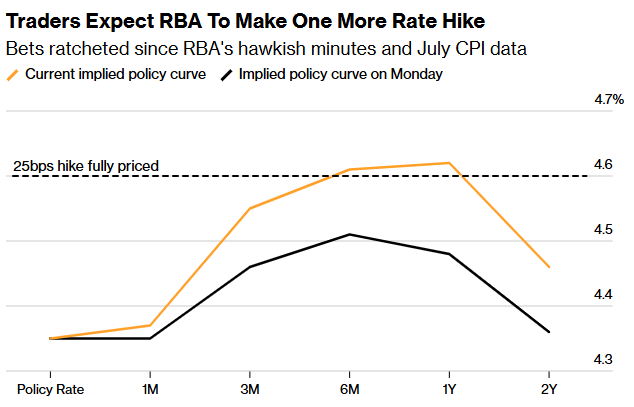
Australian bond prices fell for three consecutive days due to hawkish meeting minutes and inflation data. The yield on three-year government bonds, which are more sensitive to policy, rose 7 basis points to 4.67% in early trading, hitting a new high in more than a month, and market expectations for the November rate hike were further strengthened.
Traders have fully absorbed expectations of a 25 basis point rate hike at the November meeting, which is higher than the probability of about 48% earlier this week. They think the chance of a rate hike next month is around 50%.
The Reserve Bank of Australia raised interest rates at the first three meetings of this year, completely ending the short easing policy previously implemented in 2025 and restoring the cash rate to 4.35%. The move was to cope with the recovery in inflation, which occurred even before the US-Iran war brought an energy shock to the global economy and increased pressure on prices.
The potential growth rate of the Australian economy has declined due to low productivity for over a decade, making the country more vulnerable to inflation.
Other economists maintained expectations that interest rates would remain unchanged, including Westpac Banking Corp. (Westpac Banking Corp.). “Although the November rate hike is still risky, we don't think this is our basic expectation,” the bank said in a report.
Paul Bloxham of HSBC Holdings also said that further interest rate hikes by the Reserve Bank of Australia may be risky. He pointed out, “It is important to note that the Reserve Bank of Australia still regards monthly CPI data as part of the signal indicators,” and stated that the Reserve Bank of Australia believes that it will take several years for the monthly data to be completely reliable. He also added, “Weak economic growth and falling housing prices are expected to put downward pressure on inflation during the forecast period.”
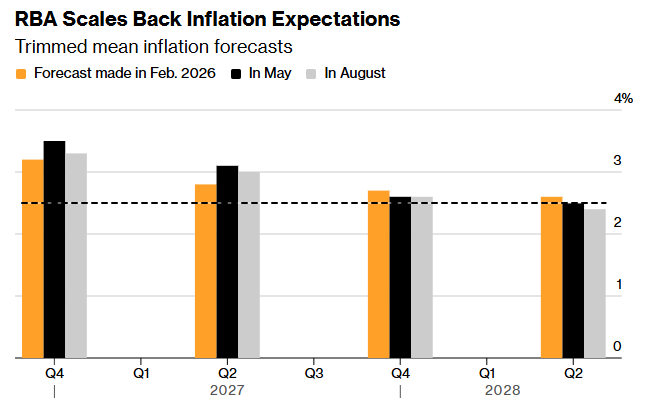
The RBA's inflation target is to reach the midpoint of its 2-3% target range, a level it has not reached in nearly five years. There are no other official inflation figures until the September decision is announced, and traders and economists will keep a close eye on second-quarter GDP and labor market data to be released next week for more clues.