


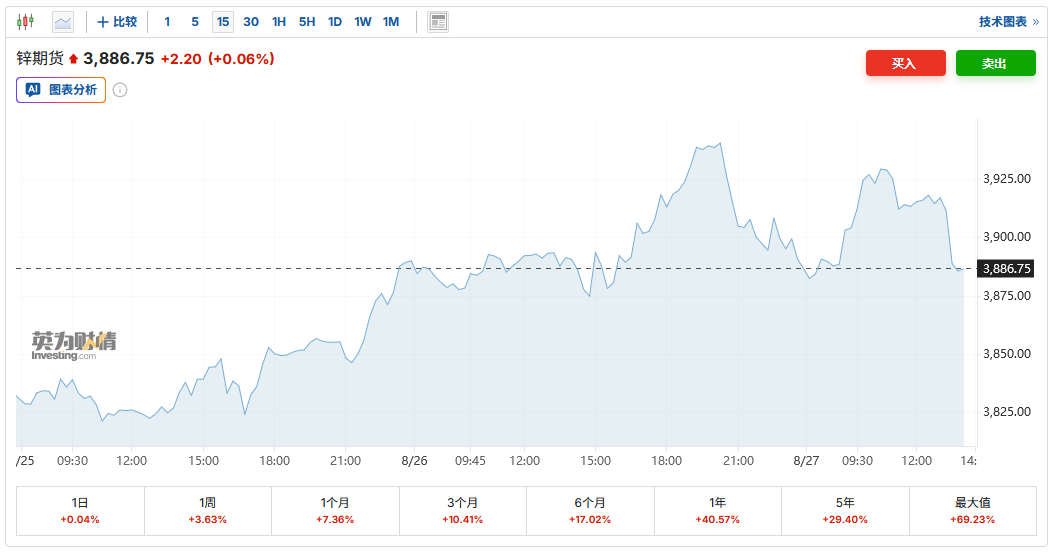
The Zhitong Finance App learned that due to widespread concerns in the market due to tight supply, zinc prices continued to rise for the 7th consecutive trading day, and remained near their highest level in more than four years. As of press release, London Metal Exchange (LME) zinc futures rose slightly to 3886.75 US dollars/ton, rising 1% during the day.
According to the data, spot zinc was nearly 200 US dollars/ton higher than the 3-month futures price on Wednesday, the biggest price difference since December last year. At the same time, processing fees charged by the smelter fell sharply to a negative value due to a shortage of ore supply. Processing fees paid by miners to smelters to process ore into metallic zinc have fallen to minus $110 per ton, according to Fastmarkets data. Although smelters can offset some of the losses by selling by-products, processing fees have been negative for a long time, which will increase the risk of production cuts and further lead to a tightening of supply.
An agency wrote in a report: “The liquidity of tradable physical zinc in the LME market is already at a very low level.” “Until there is a substantial recovery in mine production, smelting costs will provide strong bottom support for zinc prices.”
It is worth mentioning that copper prices are also showing similar trends to zinc prices in the context of tightening supply, including relatively low inventories, expanding spot premiums, and negative processing costs. Previously, due to traders planning for the possibility that the US Trump administration might announce import tariffs on refined copper, large amounts of copper resources flowed to the US, and copper stocks in other regions of the world were continuously drawn out. Although the June 30 deadline for US Secretary of Commerce Lutnick to submit tariff proposals has passed, the White House has yet to announce the final policy. Producers, consumers, and traders are closely watching whether Trump will further extend current trade protection measures for semi-finished copper products to refined raw materials such as copper.
According to reports, zinc prices have been rising at an accelerated pace since entering May. The global zinc supply side was generally stable in 2025, which is rare in the past ten years, and is regarded as a major global zinc supply year. However, after entering 2026, there were frequent supply disruptions, including: an earthquake occurred at Boliden's Garpenberg zinc mine in Sweden in early March, then the company announced that it would affect about 70,000 tons of zinc for the whole year; in early April, Australia was affected by the hurricane and compounded the subsequent diesel crisis, causing the transit and shipment of core minerals such as lithium ore and zinc ore to stagnate.
The HSBC Global Commodities Team has previously issued a warning that the zinc market is currently showing signs of extreme supply shortages. The team expects global zinc production to drop 2.1% year-on-year to 12.5 million tons in 2026, mainly due to production cuts in Latin America. At the same time, production will also be interrupted at the smelting side. As demand in Europe and North America recovers moderately, market supply and demand will tend to be tight.