


The Zhitong Finance App learned that in the context of the rapid expansion of AI infrastructure financing, rising concerns about the “AI credit bubble”, and rising long-term treasury bond yields, suppressing the rise and valuation of technology stocks related to the AI computing power theme, BNP Paribas (BNP Paribas, “Bank France and Pakistan” for short) analysts released the latest research report saying that the Hot Chips conference, which has the title of the “Semiconductor Industry Olympics”, released a positive signal about the AI computing power industry chain: customized AI inference chips Jalapeño and Nvidia from OpenOpen The BlueField-4 network architecture, to the introduction of optical interconnection in the AMD MI500, to Samsung Electronics and SK Hynix's promotion of new high-bandwidth storage, industrial innovation continues to accelerate simultaneously along the four spindles of AI core computing, storage, networking, and advanced packaging.
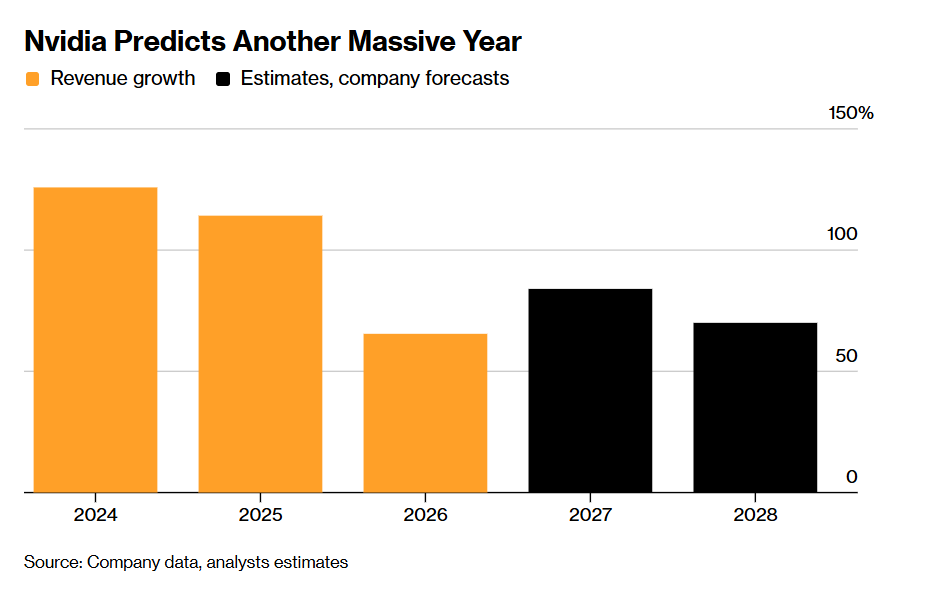
Nvidia just announced revenue for the second fiscal quarter of fiscal year 2027 reached US$96.221 billion, up 106% year on year. Adjusted earnings per share of US$2.22 per share were more than 5% higher than analysts' already strict expectations, and data center business revenue increased 117% year over year to US$89 billion. What is even more shocking is the powerful forecast given by Nvidia's management, led by Hwang In-hoon — the 2028 fiscal year ending January 2028 revenue is expected to increase sharply by about 70%, significantly higher than Wall Street's expectations of about 50% based on Blackwell and Rubin's order visibility before the earnings report, and set the revenue guide for the third fiscal quarter at $108 billion and fluctuate 2% up and down. It can be described as a joint proof that global AI computing power demand is still far from peaking .
Bank France and Pakistan's analyst team led by Karl Ackerman said that the unstoppable trend of AI intelligence (Agentic AI) penetration into various industries is shifting the system bottleneck from simply pursuing GPU computing throughput to memory bandwidth, KV cache, low latency interconnection, real-time task orchestration and data processing in the inference stage. This means that the main line of AI computing power investment is spreading from “GPU and TPU computing power alone” to “customized XPU/AI ASIC+ high bandwidth storage+optical interconnection and network card+DPU and CPU” A complete and extensive AI computing power infrastructure stack.
Wall Street financial giants Goldman Sachs, Morgan Stanley, and Bank of America, which are optimistic about the long-term investment prospects of the AI computing power industry chain, have recently generally stated that the AI super bull market is far from over, but will move from the “AI chip purchase frenzy” to the second stage of “large-scale construction of AI factories” — that is, the next round of excess alpha revenue will no longer only belong to the list of the strongest leaders in the AI GPU/AI ASIC field, but will spread systematically to data center high-performance CPUs, DRAM/NAND/HBM storage, AI PCB/liquid cooling systems, and data center optical connection/ An “AI factory” level full-stack AI computing power infrastructure layer such as optical communication systems, ABF carriers/glass substrates, MLCC, data center grade electronic distribution, and extensive wafer foundry other than advanced manufacturing processes.
As Nvidia once again announces strong performance that has surpassed expectations and an unusually explosive performance outlook, the AI computing power-themed trading hotspot is likely to not only revolve around the Nvidia GPU computing power cluster, but also further accelerate its spread to the entire AI computing power industry chain, such as HBM/DRAM/NAND, COWS/3D advanced packaging, data center CPUs, high-performance network infrastructure, optical interconnection, and data center power chain infrastructure, forming a new round of “main rise” super market at the industrial chain level.
The risk of AI credit financing cannot suppress the revolution of reasoning! OpenAI's self-developed chips shine, Nvidia Scale In accelerates, and AI computing power infrastructure ushered in a “full-stack bull market”
The BNP Paribas analyst team said that OpenAI's Jalapeño and Nvidia network architecture were among the key highlights of the Hot Chips conference. The analyst team led by Ackerman highlighted the key outputs and research findings obtained from the Hot Chips conference and pointed out that AI agents focusing on agent-based fully automated AI workflows are catalysts for innovation, which further highlights the huge potential value of artificial intelligence infrastructure as an investable topic.
The team of analysts led by Karl Ackerman outlined the following highlights. First, they said that the customized self-developed AI inference chip jointly created by OpenAI and Broadcom (belonging to the AI ASIC technology route, similar to TPU) — the performance of the chip called “Jalapeño” is an important benefit for Broadcom (AVGO.US) and Celestica (CLS.US); second, Google's parent company Alphabet (GOOGL.US) strongly promises to launch two cutting-edge advanced process chips for each generation of products every year; third, AMD (AMD.US) plans to launch artificial intelligence chips soon High-speed optical components are introduced in the vertical expansion interconnect (scale-up) of the MI500 smart chip, that is, so-called silicon photonic technology using the CPO technology route.
Fourth, analysts pointed out that the artificial intelligence network architecture “Scale In” led by Nvidia (NVDA.US) is supported by the company's key accelerated infrastructure chip BlueField-4 data processor (DPU); fifth, Facebook's parent company Meta (META.US) uses Broadcom's Tomahawk Ultra to expand vertically (i.e. scale-up); sixth, Samsung Electronics, the dominant Korean memory chip leader, innovates in high-bandwidth memory (HBM) basic chips, and another SK Hynix (SKHY.US), the Korean memory chip leader, is willing to use Intel (INTC.US)'s advanced packaging technology — embedded multi-chip interconnect bridging (EMIB) — an advanced packaging system for SK Hynix's HBM product line; finally, analysts said that the network interface card (NIC) load rate/connection rate of each AMD Helios server is significantly higher than Nvidia's Vera Rubin, which is an important benefit to the data center optical interconnection segment — the high-speed optical transceiver ecosystem.
Analysts also pointed out that the popularity of AI inference super applications is driving accelerated innovation at the memory level. Ackerman and his team said, “The current memory hierarchy is mainly aimed at training workloads, but inference is essentially limited by overall memory performance, and demand for KV caches continues to grow as context length and number of users increase. Therefore, we believe that static random access memory (SRAM), three-dimensional dynamic random access memory (3D-DRAM), vertical high-bandwidth memory (HBM), and high-bandwidth flash memory (HBF) are all seeking to meet the memory bandwidth, latency, and strong power consumption requirements closer to the AI computing core processor — or directly integrated on top of the most core computing processor.”
Additionally, analysts pointed out that they are seeing more iterations of self-developed and customized AI accelerator computing power systems, including Google TPU, Meta MTIA, Microsoft Maia, OpenAI Jalapeño, Cerebras WSE, and GroQ LPX. The analysts added, “We attribute the proliferation of new XPU/AI ASICs to the diversity of AI inference side workloads and the very attractive economics of computing power infrastructure tokens.”
Ackerman and his team also said that central processing units (i.e. Agentic CPUs) focused on AI agents are becoming the center of the stage. Analysts pointed out that as workloads moved to multi-step workflows, system bottlenecks turned into real-time task orchestration and data processing. Different CPUs have taken different routes: Nvidia Vera is positioned to achieve the highest level of AI single-threaded performance; AMD EPYC Venice takes a product portfolio technology route to meet diverse workloads; and Intel's exclusive Diamond Rapids differentiates itself with its fan-out fabric (Fan-out Fabric) design.
The BNP Paribas analyst team expects Broadcom's target price to be as high as 675 US dollars, which means that in the agency's opinion, Broadcom's potential increase in the next 12 months is as high as 90%; for Celestica, the target price is as high as 500 US dollars, a significant increase from the previous 450 US dollars, which means that in the agency's opinion, the potential price increase is as high as 60% in the next 12 months; for the “AI chip superpower” Nvidia, the target price is as high as 285 dollars, which means that the potential increase is close to 40%.
70% growth guidelines break through the “AI computing power expansion peaked theory”! Is Vera Rubin detonating a new round of AI computing power industry chain bull market?
The median revenue guidance for the third fiscal quarter given by Nvidia management was as high as US$108 billion, and the company even rarer expected revenue growth of about 70% for the 2028 fiscal year, which was significantly higher than the market's expectations of about 44% before earnings, and emphasized that this figure was limited by supply capacity rather than demand. The signals released at the Hot Chips conference and Nvidia's strong performance and outlook are driving the global AI computing power infrastructure investment theme to accelerate into the “second round of industrial chain boom” co-driven by the large-scale transformation of AI agents (Agentic AI) and Vera Rubin.
Vera Rubin has begun mass production and shipping, and is expected to contribute about 20% of data center business revenue this fiscal season, adding Anthropic to spend 45 billion US dollars to sign a six-year computing power deal with Nscale — using Nvidia's latest Vera Rubin computing power. In addition, Amazon's cloud computing business division AWS also plans to deploy 2 million additional Nvidia GPUs from 2027 to 2028 — this indicates that demand has expanded from traditional hyperscale cloud vendors to cutting-edge model laboratories, NeoCloud (NeoCloud), and sovereign artificial intelligence With a wider range of corporate customers around the world, order visibility did not “peak computing power.”
Hot Chips are further strengthened, and this AI superbull market is being upgraded from “GPU solo dance” to full-stack AI computing power infrastructure expansion: OpenAI's Jalapeño combines custom inference chips (Inference ASIC), Broadcom network technology with Celestica cabinet systems; AMD is preparing to introduce optical technology into the MI500 vertical expansion interconnect (scale-up); Nvidia strengthens the Scale-In high-performance network with a BlueField-4 data processor (DPU); Meta uses Tomahawk Ultra, while Samsung Electronics, SK Hynix, and Intel EMIB Advanced Packaging are competing for HBM upgrade dividends.
The underlying logic behind these cutting-edge technology iteration trends is that the computational volume generated by intelligent execution reasoning, planning, and multiple rounds of tool calls is far higher than traditional Q&A, and the system bottleneck is shifting from single GPU computing power to KV cache, memory bandwidth, low latency networks, optical interconnection, and real-time CPU orchestration; therefore, OpenAI self-developed chips are not a sign of weakening AI computing power requirements, but the result is that a single supplier can no longer cover all workloads at the best cost. There is partial competition for Nvidia's share, yet at the same time expanding the AI computing industry leaders such as Broadcom and Celestica guys , and the overall serviceable market for HBM, optical modules/optical communications, AI PCBs, liquid cooling systems, data center CPUs, and 3D advanced packaging.
Anthropic's deal with Nscale transforms this need to upgrade from a “GPU solo dance” to full-stack infrastructure expansion from a technology roadmap into a long-term capital commitment. Anthropic's six-year computing power lease contract locked in approximately 460 megawatts of capacity in West Virginia, and Nscale deployed the Vera Rubin system; it replaced the campus space released after Microsoft withdrew from the letter of intent. The Single Model Laboratory signed a long-term contract for nearly half a gigawatt of computing power, which greatly strengthened order certainty for a complete set of rack-level computing power clusters led by Vera Rubin, data center power, and high-performance network infrastructure equipment led by Nvidia.
Furthermore, A16z, a top venture capital firm in Silicon Valley, recently observed that the hourly rental price of Nvidia B200 AI GPU computing power modules has bucked the trend, the model is becoming more specialized, and the willingness to pay for consumer-grade artificial intelligence applications has largely meant that computing power demand is shifting from one-time training capital expenses to continuous inference operating expenses (Inference Opex), making the AI computing power infrastructure cycle more durable.
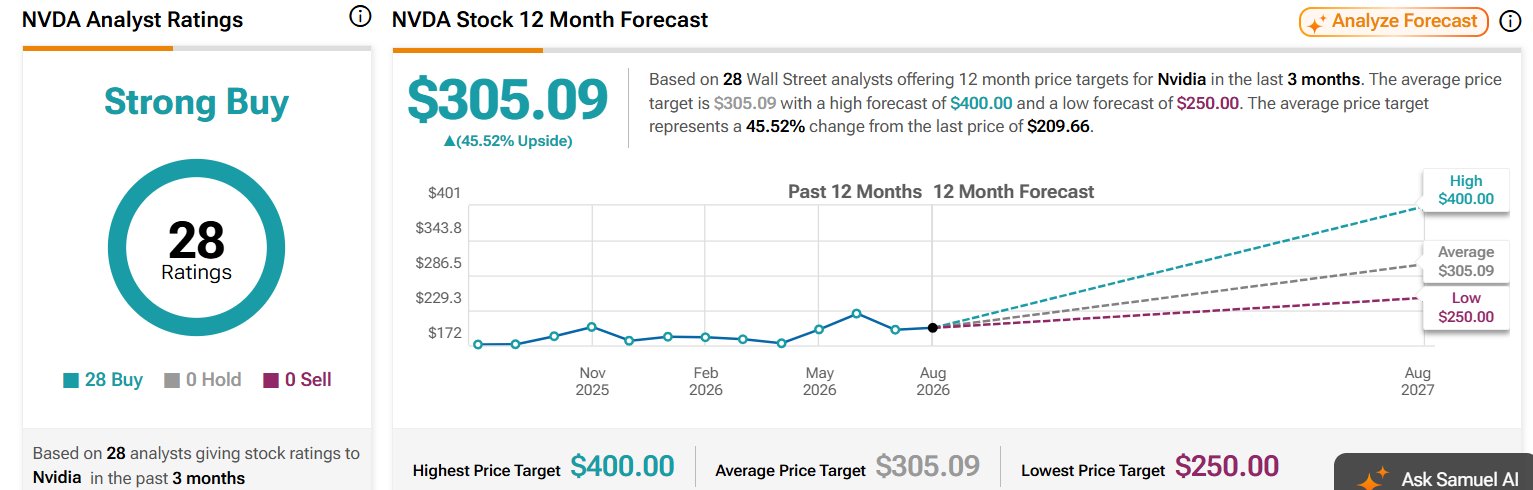
Wall Street analysts mean a potential increase of up to 45% for Nvidia's average price; currently, Wall Street's most optimistic public target price for Nvidia is $500 given by Baird senior analyst Tristan Gerra, which is rated as “outperforming the market”, which means that the potential stock price will rise by about 132.9%, corresponding to a market value of about 12.2 trillion US dollars, or an increase of 7 trillion US dollars over the current potential price. The above market capitalization estimates assume that the total share capital remains essentially unchanged.
Baird is so aggressive about Nvidia's core logic: first, Nvidia is further expanding its share among inference computing and hyperscale cloud customers, and the number of reasoning, planning, and tool calls required for an intelligent AI task is significantly higher than that of traditional chatbots; second, Vera Rubin's adoption speed and deployment scale is expected to surpass Blackwell, continuing to increase the value of GPUs, NVLink, networks, and entire cabinet systems; third, independent Vera CPUs are expected to use bandwidth and energy efficiency advantages to break into traditional x86 services In the device market, Baird estimates that this may open up an incremental potential market of about 200 billion US dollars for Nvidia; fourth, global AI infrastructure spending may exceed 1 trillion US dollars in 2027 and reach 3 trillion to 4 trillion US dollars per year by 2030. Nvidia's CUDA ecosystem, chip-network-system full-stack capabilities, and annual product iterations form the most difficult moat to replicate.