


On August 27, Baidu Group-SW (09888, hereinafter referred to as Baidu) issued an announcement on the Hong Kong Stock Exchange stating that it will voluntarily change its secondary listing status to a major listing on the Hong Kong Stock Exchange, which will take effect on September 1, 2026. From the effective date, Baidu will have dual major listings on the Hong Kong Stock Exchange and NASDAQ. As soon as the news was announced, the market quickly responded positively — the Hong Kong stock Baidu surged 6.82% to HK$97.1 in early trading, and the US stock rose nearly 4% to 96.9 US dollars at night. Investors had clear expectations for the revaluation of “the first full-stack AI stock.”
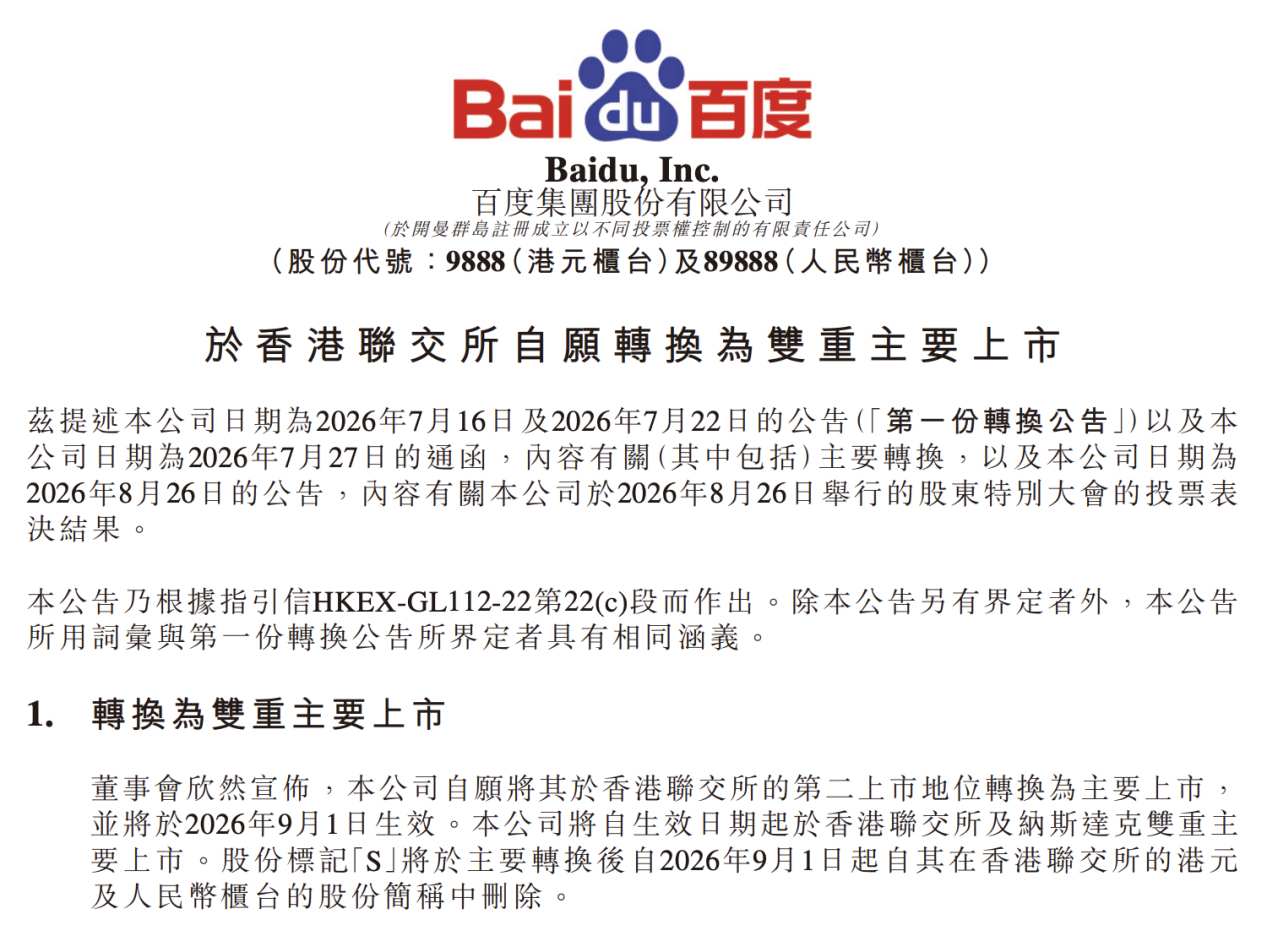
According to reports, this conversion does not involve the company issuing new shares or carrying out any financing activities. By the end of June this year, Baidu's total cash and investment had reached 283.1 billion yuan, and operating cash flow had been positive for four consecutive quarters, further indicating that this conversion was not a financing supplement. Baidu will use its dual major listing and Hong Kong Stock Exchange to obtain new investors and new valuations and pricing as the “first full-stack AI share”.
Market participants analyzed that after the dual major listing transition, Baidu will become the first dual major listed company to achieve a full-stack AI layout in the Hong Kong and NASDAQ markets. According to the current rules and inspection cycle, Baidu is expected to be included in the Hong Kong Stock Connect as soon as September 7. At that time, mainland investors can directly trade Baidu Hong Kong stocks through the Shanghai-Shenzhen-Hong Kong Stock Connect mechanism.
Zou Chengfeng, senior vice president of Dongxing Securities Investment Bank headquarters, said that from an investment bank valuation perspective, one notable change after Baidu's dual listing is that AI assets may receive more independent pricing. Currently, many institutions in the market have used segmented valuation methods to evaluate Baidu. If businesses such as Kunlun Core, Smart Cloud, and Radish Express are valued separately, and the AI business growth space is considered, some estimates show that Baidu's potential growth potential is close to three times, and a change in the valuation system is worth looking forward to.
The Hong Kong Stock Connect window is approaching, and the influx of southbound capital amplifies Baidu's AI value
Baidu's change from a “secondary listing” to a “dual major listing” of the Hong Kong stock listing will not only establish the new coordinates of Baidu's “first full-stack AI share”, but will also trigger the triple positive resonance of improving liquidity, improving the investor structure, and changing the valuation system.
In recent years, southbound capital has become an important source of incremental capital for the Hong Kong market. In particular, for industries that mainland investors are familiar with, such as the Internet, semiconductors, artificial intelligence, etc., Hong Kong Stock Connect has strengthened the connection between mainland capital and Hong Kong stock technology assets to a certain extent.
According to public data, the net flow of capital from the Hong Kong Stock Exchange to the south has continued in recent years, and its role in supporting the pricing power and liquidity of large technology leaders is becoming more and more prominent.
Since 2022, Chinese Internet companies that have switched from secondary listing to dual major listings include Bilibili, Alibaba, and NetEase. Their first trading day to be included in Hong Kong Stock Connect achieved average daily gains, with the highest increase of 10.66%. Some companies received an average 15% to 20% increase in southbound capital within 30 days after being included in the Hong Kong Stock Connect.
For Baidu, on the one hand, the dual main listing retains the main NASDAQ listing site to cover global investors; on the other hand, it strengthens the attributes of Hong Kong's main listing site. The influx of southbound capital will be a powerful catalyst for its AI value to be fully discovered by the market. According to current rules and past precedents, Baidu is expected to officially join the Hong Kong Stock Connect on September 7 as soon as possible. At that time, mainland institutions and individual investors familiar with China's AI industry chain will directly participate in pricing, bringing plenty of incremental liquidity to Baidu.
Full-stack AI has entered the cashout period, and capital market revaluation has new coordinates
With the finalization of the two main listing dates, Baidu's inclusion in the Hong Kong Stock Connect is clear. The addition of Southbound Funding will also bring about a fundamental correction in Baidu's valuation logic.
Compared to overseas markets, mainland investors have a sharper perception and deep understanding of Baidu's “core—cloud-model-body” full-stack layout from chips, cloud infrastructure, models to smart applications. When mainland capital has pricing power, the market will no longer simply measure Baidu using the old “search advertising” scale, but will quickly switch to a new coordinate system of “AI technology enterprises,” thus giving it higher valuation tolerance and growth expectations.
The motivation behind this valuation reshaping stems from Baidu's global scarce full-stack AI business closed loop. Unlike AI companies that broke through at a single point, Baidu has built a complete commercial transmission chain from lower-level computing power to higher-level applications: Kunlun Core is the cornerstone of computing power, and is currently promoting a Hong Kong stock IPO, with an external valuation of 50 billion US dollars; AI cloud infrastructure revenue in the second quarter reached 7.3 billion yuan, up 50% year on year; GPU cloud revenue increased 283% year over year, further accelerating the growth rate of 184% in the previous quarter; Radish Express established a leading position in the world with an unmanned mileage of 250 million kilometers.
Financial reports show that Baidu's AI business revenue has accounted for more than 50% of general business revenue for two consecutive quarters. This structural change indicates that Baidu's AI business has become a core growth driver.
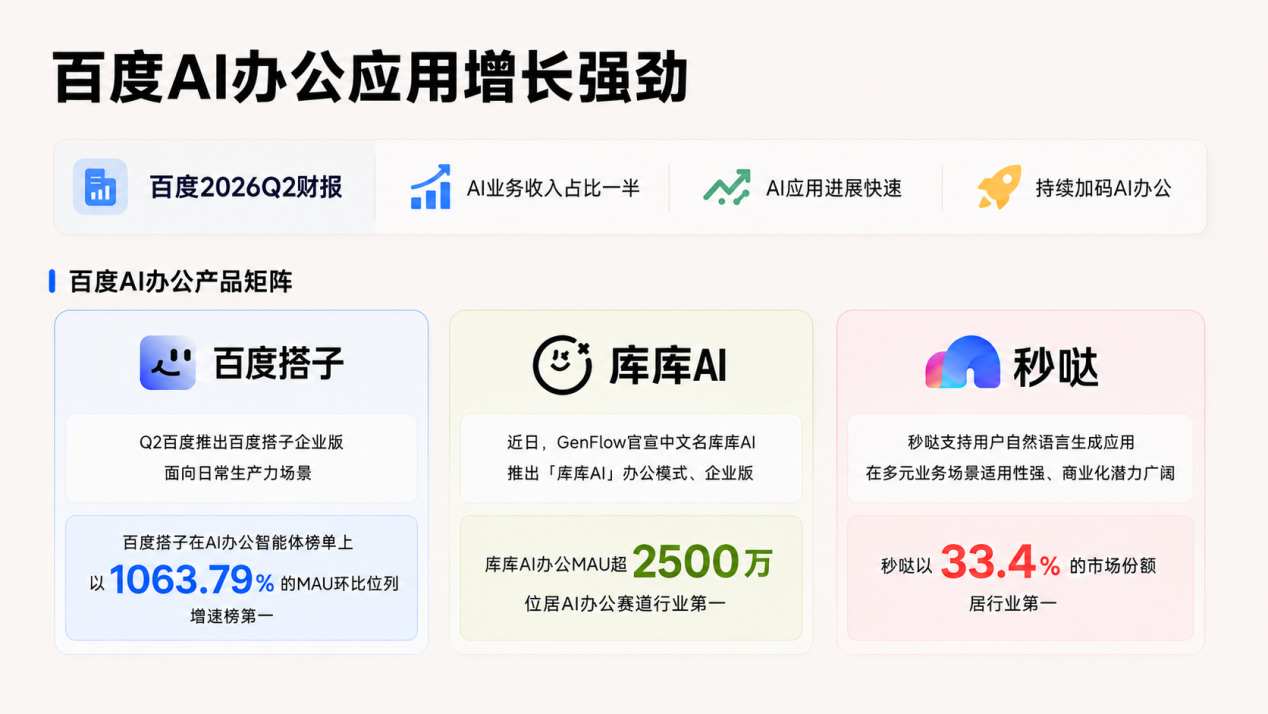
At the same time, Baidu's AI application business continues to make progress, with the AI office sector developing rapidly. According to July data from the AI product list, Baidu's monthly active users increased by 1063.79% month-on-month, ranking first in the AI office smart device growth rate list; Kuku has more than 25 million monthly active AI office users, ranking first in the AI office circuit industry. Both user size and growth rate occupy the leading position in the industry, showing that Baidu's AI applications are continuing to be implemented and are maintaining a growth trend.
“As the AI business becomes Baidu's core development direction, we are laying the foundation for the next phase of AI-driven growth.” Li Yanhong, founder of Baidu, said that the continued growth of the AI business has further confirmed Baidu's transformation from an Internet-centered company to an AI-first company, and has further strengthened Baidu's confidence in long-term growth potential.
In June of this year, Citi stated in Baidu's research report, “We believe that Li Yanhong has excellent foresight and can always anticipate major technological breakthroughs long before they become mainstream. Baidu's investment results in the field of artificial intelligence are obvious to all, including the Kunlun Core AI accelerator, Baidu's intelligent cloud infrastructure, ERNIE basic model, and a series of artificial intelligence applications; more importantly, Baidu has succeeded in driverless technology and Robotaxi services.”
As southbound capital continues to be injected through Hong Kong Stock Connect, the value of Baidu's “full-stack AI” asset package will be dismantled and re-evaluated one by one, ushering in a pricing moment for China's AI core assets.
The valuation logic was completely changed, and the market value of HKD trillion anchors the first share of “full-stack AI”
When Southbound Capital entered the market with a deep understanding of “full-stack AI,” Baidu's true value, which had long been covered up by a single PE valuation model, ushered in the best opportunity for systematic reevaluation.
For a long time, the US stock market has been accustomed to using the traditional framework of “China's Internet” or “search ads” to define Baidu, causing its complex AI business portfolio to be folded into the comprehensive income statement, causing significant value discounts. The launch of the dual major listing and Hong Kong Stock Connect just provided the institutional prerequisites for the market to adopt a more detailed SOTP (Segment Plus Total Valuation Method), and promoted a complete shift in Baidu's valuation logic
From the perspective of SOTP, Baidu's six core business segments will each receive independent pricing anchors, and the value of the folded AI assets will be made explicit. According to the calculation logic of a number of top investment banks, Baidu Smart Cloud and Kunlun Core alone have valuation potential of about 26 billion US dollars and 28.8 billion US dollars respectively; while Radish Fast, which is the first tier of driverless cars in the world, with reference to Waymo's valuation system, its potential value can also reach 25.2 billion US dollars. Combined with AI applications, search services and abundant net cash reserves, Baidu's overall potential value is expected to exceed US$129.4 billion, equivalent to approximately HK$1.01 trillion.
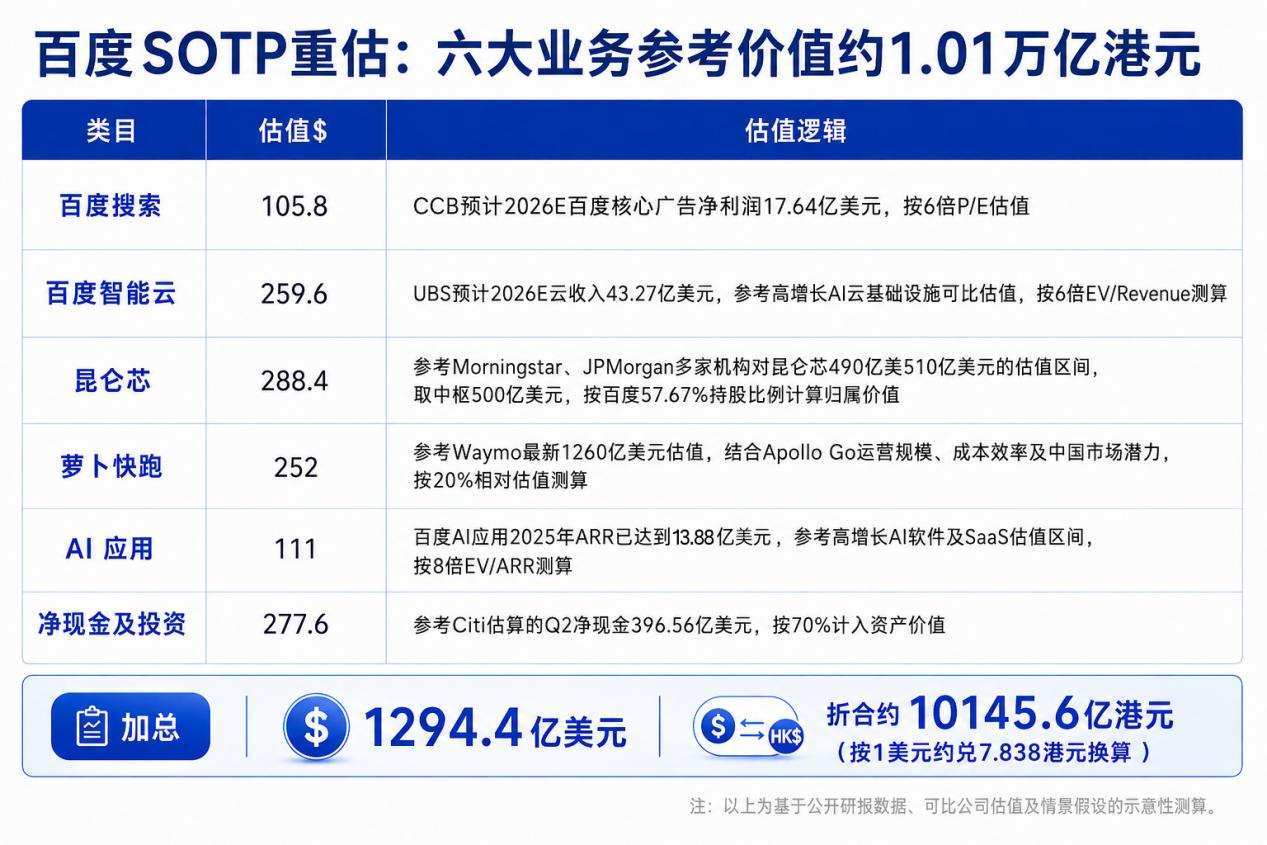
This trillion-dollar market capitalization anchor means that Baidu has nearly three times as much room for growth compared to the current market capitalization. This is not just a digital game; it is an in-depth value discovery by the market of Baidu's “core - cloud - model - body” full-stack AI assets. With investors familiar with China's hard technology industry chain dominating the pricing power, Baidu's valuation system will complete a complete shift from “Internet stock” to “AI increment.” The trillion dollar market capitalization is not only Baidu's return to value, but also a proper name for China's AI core assets in the global capital market.