


Since 2026, the popularity of the domestic innovative drug circuit has continued to heat up. The policy side unleashed clear benefits one after another. For the first time, the government work report clearly identified biomedicine as an “emerging pillar industry”, and the “Fifteenth Five-Year Plan for National Health” also emphasized the need to “support the development and application of innovative drugs throughout the entire chain”; at the industrial level, enthusiasm for innovation continued to rise. In the first half of the year, China's innovative drug licensing transactions totaled about 110 billion US dollars, a record high for the same period. Of the 38 innovative drugs approved during this period, 11 were new targets, new mechanisms, and all were independently developed domestically.
Committed to becoming a “global birthplace of new drugs”, Baiosetu (688796.SH, 02315.HK) was the first to sense the warmth of the industry. In the first half of 2026, the company's performance achieved an overall jump, recording revenue of 941 million yuan, an increase of 51.6% over the previous year; net profit to mother was 241 million yuan, a sharp increase of 402.3% over the previous year, and has remained profitable for 5 consecutive quarters.
As the scale effect became more prominent, the net cash inflow from operating income rose to 262 million yuan, surpassing the net profit scale. Domestic business revenue reached 380 million yuan, and strong domestic industry demand has become an important engine driving the company's rapid growth.
With self-developed gene editing technology as the core, Baiosetu has built integrated new drug development capabilities covering target verification, antibody discovery, pre-clinical pharmacological efficacy evaluation, and gene editing model development through the “Whole-Human Antibody Molecular Library + Target Humanized Mouse Bank” dual platform.
During the reporting period, the company's two major business lines went hand in hand, and the revenue structure continued to be optimized.
The innovative animal model sales business had revenue of 446 million yuan in the first half of the year, an increase of 62.4% over the previous year, and the leading position in the market continued to consolidate. The share of sales of high-cost products such as dual-antagonist/multi-antibody animal models increased, and gross margin maintained a high level of 82.3%, further demonstrating the company's technical strength and competitive advantage in the industry in the field of innovative animal models.
In order to meet the demand for continued growth in orders, the company's new 100,000-cage facility in Haimen was gradually put into operation, freeing up sufficient space for subsequent production capacity.
The antibody development business had revenue of 218 million yuan in the first half of the year, an increase of 33.8% over the previous year, and the “antibody shelf” entered the accelerated monetization channel. Relying on the “Thousand Mouse Antibodies” program, the company has built a library of more than 1 million real whole-human antibody sequences around 1000+ potential drugable targets. With AI and automation collaboration, the antibody library will rapidly expand to hundreds of millions of levels. New drug companies can directly select experimentally verified candidate molecules from the “antibody shelf”. As a result, antibody discovery has changed from “finding a needle in a haystack” to “supermarket purchase”, significantly reducing the time and capital costs of new drug development.
As of June 30, 2026, the company's antibody business has signed more than 455 cooperation/licensing agreements, adding more than 105 in the first half of the year alone. Partners include multinational giants such as Merck, Gilead, and Johnson & Johnson, as well as leading domestic pharmaceutical companies, and the cooperation landscape continues to expand.
In the first half of the year, the company's preclinical product and service revenue growth rate reached 57.9%, and R&D expenses increased by about 27.8% year-on-year during the same period. The revenue growth rate clearly outperformed the expenditure growth rate, indicating that operational efficiency continued to improve.
During the reporting period, the company officially launched RenSuper Workstation, a next-generation AI-driven antibody discovery platform. The platform relies on the large-scale in vivo immunity and real verification data system accumulated over a long period of time by the renMice® whole-human antibody mouse platform, and integrates AI and high-throughput automation capabilities to form a closed loop of “intelligent screening+rapid verification”.
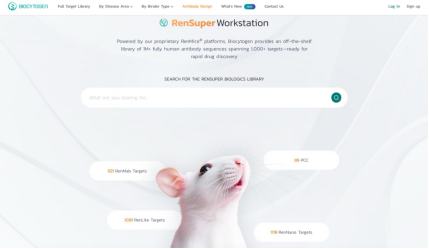
Welcome to RenSuper Workstation: https://www.rensuperbio.com/
Take the Rennano all-human heavy chain antibody (HCaB) platform as an example. The platform has a maximum screening hit rate of 98%, and data verification has been obtained on multiple difficult targets; its automation capabilities cover the entire life cycle of antibody protein production, and antibody protein production is stable at an average of 50-100 mg, and the throughput reaches 800 samples/day, which can stably support large-scale antibody sample preparation and rapid verification requirements.
The platform is expected to promote the evolution of antibody discovery from a “customized project” to a new model of “retrievable, scalable, and more efficient”, and further strengthen Baiosetu's competitive moat on the antibody discovery circuit.
Along with the overall improvement of the innovative drug sector, Baiosetu has entered a period of achieving results. Looking forward to the future, the accelerated empowerment of AI and the subsequent orderly release of high-throughput automated production capacity will provide more definitive support for the company's long-term growth.