


Pre-market market trends
1. Before the US stock market on August 27 (Thursday), futures for the three major US stock indexes had mixed ups and downs. As of press release, Dow futures were down 0.03%, S&P 500 futures were up 0.42%, and NASDAQ futures were up 0.94%.

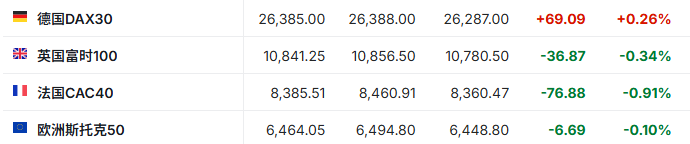
2. As of press release, the German DAX index rose 0.26%, the UK FTSE 100 index fell 0.34%, the French CAC40 index fell 0.91%, and the European Stoxx 50 index fell 0.10%.
3. As of press release, WTI crude oil rose 0.26% to $82.44 per barrel. Brent crude oil rose 0.47 percent to $87.35 per barrel.

Market news
Are you afraid to lose the AI competition? The Trump administration is preparing new tariffs on semiconductors. According to people familiar with the matter, the Trump administration is still considering imposing a new round of comprehensive tariffs on semiconductors, despite tech companies' warnings that this move could sever hopes of a dominant position in the field of artificial intelligence. According to reports, a tariff plan currently being considered will greatly expand the scope of taxable technology products, not only including chips, but may also affect many products manufactured using chips. US Secretary of Commerce Lutnick is inclined to link foreign companies' tariff relief with investment in the US chip manufacturing industry to stimulate domestic chip production. The government is also considering formulating a phased implementation plan for the new tariffs. They emphasized that the framework is still likely to be substantially revised in the coming weeks or months.
Trump signed an executive order prohibiting some foreign energy equipment from being connected to the US grid. US President Trump signed an emergency executive order prohibiting some foreign-made transformers and other key energy equipment from entering the US grid on national security grounds. The executive order prohibits the US from purchasing or installing specific foreign-made power equipment that poses cybersecurity risks or operational risks. The executive order requires the US Department of Energy to introduce supporting regulations within 120 days, and authorizes the Secretary of Energy to impose restrictions on equipment already in use to resolve related safety hazards.
Kuwait and Qatar joined “shuttle transportation,” and oil flow in the Strait of Hormuz rebounded to about three-quarters before the war. The Persian Gulf oil producers Kuwait and Qatar are increasing crude oil shipments through the Strait of Hormuz, and the combined export volume of the two countries has recovered to 70% of the level of about 2 million b/d before Iran's war. Traders said that currently about 7 million to 8 million barrels of oil are being shipped through the Strait of Hormuz every day, which is higher than the level of about 4 million barrels in mid-July, which is equivalent to about three-quarters of the pre-war level. Vortexa's Monday data showed close to 10 million barrels per day.
Samsung Electric took the lead in increasing MLCC prices, with consumer products rising 25%-30% and high-end products by 10%-20%. According to the latest research from TrendForce Jibang Consulting, South Korea's Samsung Electric recently took the lead in increasing MLCC prices for OEM and ODM customers in the fourth quarter of 2026. Specific price increase: Samsung Electric expects an average increase of 25% to 30% for consumer-grade X5R products to curb the desire to place orders and free up production capacity for high-end production line expansion; high-end X6S products used in AI servers are priced according to customer negotiations, with an average increase of 10% to 20%. Major Japanese manufacturers Murata, Taiyo Yuden, and Kyocera are currently holding a wait-and-see attitude and prices are flat. Whether to follow up on price adjustments in the future will be the key to observing whether this round of price increases can continue to expand.
The semiconductor boom increased the risk of inflation, and the Bank of Korea rarely raised interest rates twice in a row. The Bank of Korea raised the benchmark interest rate for the second time in a row to deal with the risk of inflation caused by the unprecedented boom in the semiconductor industry driving the economy to grow beyond expectations. On Thursday, South Korea raised the seven-day repurchase interest rate by 25 basis points to 3% with a 6-1 vote. The only dissenting member supported staying on hold. According to an earlier survey of 22 economists, 14 economists predicted interest rate hikes of 25 basis points, while 8 predicted that interest rates would remain unchanged. The Bank of Korea raised interest rates by 25 basis points in July, the first rate hike since January 2023.
Bank of Japan Deputy Governor: I agree with Kazuo Ueda's view that the pace of interest rate hikes will be accelerated if necessary. Bank of Japan Deputy Governor Ryozo Himino said that he did not comment on the market's expectations regarding the Bank of Japan's interest rate hike. When deciding the pace and timing of future interest rate hikes, the Bank of Japan will assess the possibility of achieving its benchmark scenario and associated risks, including the situation in the Middle East, the demand for artificial intelligence, and exchange rate impacts. It is believed that by adopting appropriate policy measures, the Bank of Japan can stabilize overall inflation at 2%. Ryozo Himino also stated that he agreed with Kazuo Ueda's view that the pace of interest rate hikes would be accelerated if necessary. No central bank will adjust the extent of financial easing in a way that surprises or shocks the market. The weak GDP data is somewhat worrisome, but it is likely influenced by technical factors and is not enough to change their views on the economic outlook.
On the eve of the sprint IPO, Anthropic spent 45 billion dollars to lock in Nscale's computing power. According to reports, Anthropic will pay 45 billion US dollars (about 302.5 billion yuan) to the British AI infrastructure service provider NScale over the next 6 years to rent cloud computing capacity at its West Virginia data center campus in the US. The company locked in about 460 megawatts of power capacity, and also made extensive use of Nvidia (NVDA.US)'s latest Vera Rubin architecture chips.
Individual stock news
Nvidia's revenue surpassed expectations and doubled significantly last quarter. It is expected to break the 100 billion mark for the first time this quarter, and the 70% growth rate guide for the next fiscal year will crush expectations. In the second fiscal quarter, Nvidia's revenue recorded the highest year-on-year growth rate in two years. Data center revenue increased 117% year over year, gross margin remained flat at 75% of the previous quarter, and recorded a net income of nearly 7.8 billion US dollars in equity securities during the quarter. The median revenue guide growth for the third fiscal quarter slowed to nearly 90%. Excluding computing revenue from data centers in China, it did not exceed the most optimistic expectations of institutions. The median gross margin guide fell to 74%, slightly lower than expected. Nvidia claims Rubin has accelerated its entry into full mass production, and Hwang In-hoon claims that AI has reached an inflection point, and now computing power is revenue. After the financial report was announced, the stock price fell for a while, but the phone call revealed a 70% increase in revenue for the next fiscal year and Amazon (AMZN.US) promised to drastically increase the use of Nvidia products. As of press release, the stock had surged more than 6% before the market.
Kioxia SanDisk (SNDK.US) teamed up to increase Japan's NAND production capacity by investing 5 trillion yen over six years to target the AI storage gap. Japan's NAND flash memory manufacturer Kioxia Holdings and its manufacturing partner SanDisk plan to invest more than 5 trillion yen (about US$31.4 billion) in Japan to drastically increase production capacity to ease the tight supply of key storage components in AI data centers. Kioxia CEO Hiroo Ota said on Thursday that the Tokyo-based flash memory giant plans to complete this scale of investment within the next six years, including 1.8 trillion yen for the new Kitakami (Kitakami) plant alone. The plant will produce the latest generation of high-density 3D flash memory chips optimized for massive workloads generated by AI services.
Amazon will buy 2 million Nvidia chips for data center expansion. Amazon will deploy around 2 million Nvidia's high-end chips in 2027 and 2028, which are specifically designed to train and run artificial intelligence models. Additionally, Amazon said in March of this year that it will install 1 million Nvidia chips in Amazon Web Services (AWS) data centers starting this year. Chips involved in this latest deal include Nvidia's Blackwell Ultra, Rubin, and Rubin Ultra graphics cards. The unit price of these products is expected to be at least tens of thousands of dollars, but big customers can enjoy discounts.
Nvidia reportedly plans to acquire Hugging Face for more than $13 billion. According to reports, Nvidia is in negotiations to acquire the well-known AI platform Hugging Face, which focuses on sharing and developing open source models. Sources revealed that the two sides have been in serious negotiations over a deal valued at more than 13 billion US dollars in the past few weeks. People familiar with the matter also revealed that Microsoft (MSFT.US) has also met with Hugging Face, but there has been no further contact between the two sides so far. According to previous reports, at the end of last year, Hugging Face rejected Nvidia's $500 million investment offer, which, if successful, would bring Hugging Face's valuation to $7 billion.
The European Union called out to Meta (META.US): The US settlement is only the beginning; European standards must not be discounted. A European Commission spokesperson stated on Meta's recent settlement agreement of about 18 billion US dollars in the US, saying that they have communicated with the company on this, and emphasized that Meta itself is in control of the follow-up action. The spokesperson clearly stated that the European side expects Meta to provide appropriate solutions that meet European standards in terms of screen usage time management and parental control functions, which means that adjustments in the US may not meet EU regulatory requirements. Compared to the US, which focuses on specific functional restrictions on youth protection, the EU is more concerned about the overall compliance framework and user rights protection, and Meta is likely to face stricter scrutiny in Europe than in its home country.
The US e-commerce company Coupang (CPNG.US) has become a new friction point between the US and South Korea, and US senators are urging taxes on South Korea. According to reports, US Republican Senator Bernie Moreno from Ohio urged US Trade Representative Greer to consider imposing tariffs on South Korea due to South Korea's treatment of the US e-commerce Coupang. “Seoul is currently engaged in open hostilities against foreign companies,” Moreno wrote in a letter to Greer on Thursday. The letter listed issues such as “burdensome compliance requirements, excessive fines, criminal lawsuits against corporate executives, and biased supervision and enforcement.” In his letter, Moreno asked Greer to consider initiating an investigation under section 301 of the 1974 Trade Act. South Korea denies discriminating between Coupang and local Korean companies.
CrowdStrike (CRWD.US) and Okta (OKTA.US) financial reports bombed the ground to protect AI as a “new money printer.” On August 26, CrowdStrike and OKTA's after-market earnings both exceeded expectations. Among them, CrowdStrike's revenue increased 26%, and the net increase in ARR reached a record high, and the AI inspection business surged nearly threefold. The company even defined this strong performance as the “Mythos moment”, believing that the threat environment of cutting-edge AI has greatly boosted demand for high-end cybersecurity tools. The AI cybersecurity wave is accelerating; Okta's revenue increased 11%, and the RPO reached 4.86 billion US dollars. The target range for the full year is estimated to be between US$3,216 billion and US$3.26 billion.
The CEO of CRM.US (CRM.US) Q2 results and guidelines exceeded expectations, rejects the “SaaS doomsday theory.” SAFTSE's second-fiscal quarter revenue of US$11.3 billion and adjusted earnings per share of US$5.90 per share surpassed expectations. The company raised its annual revenue guidelines and announced that the AI product AgentForce's annualized revenue is worth $1.5 billion, while expanding cooperation with Anthropic. Furthermore, the CEO also refuted the “SaaS apocalyptic theory,” saying that AI is driving the growth of platform value.
The amount of money in profit guidelines and the outlook for PC and printer demand raised concerns that HP (HPQ.US)'s Q3 results exceeded expectations but plummeted after the results. Hewlett-Packard's third-fiscal quarter revenue of US$15.7 billion and adjusted earnings per share of US$0.83, both exceeded expectations, but the stock price plummeted by more than 9% after the market. The market is concerned about the “gold content” of its earnings guide for the fourth fiscal quarter — it actually fell short of expectations after excluding tariff refunds. At the same time, PC shipments fell 16%, demand for printers was weak, and concerns about future price increases surfaced. Investors questioned whether core profitability could continue.
The AI wave is detonating the need for chip design! Synopsys (SNPS.US) Q3 results exceeded expectations and raised full-year guidance. Chip automation design (EDA) giant Synopsys's third-fiscal quarter revenue increased 42% year over year to US$2.48 billion, better than analysts' average forecast of US$2.44 billion; adjusted net profit was US$750 million, up 37% from US$550 million in the same period last year; and adjusted earnings per share were US$3.91, better than analysts' average expectation of US$3.67.
Demand for computers and mobile phones is driving growth, and Best Buy (BBY.US) raised its annual forecast. Best Buy's second-quarter results exceeded expectations and raised its full-year outlook. According to the data, the company's Q2 revenue reached 9.8 billion US dollars, and same-store sales increased 4.1% during the quarter, the strongest since 2022. The company said that demand for computers, mobile phones and TVs is driving growth, and sales of new categories such as AI glasses have doubled, and CEO Cory Barry also said that most categories have achieved growth. Looking ahead, same-store sales are expected to increase by 1.9% to 3% for the whole year, compared to a negative increase of 1%.
BILI.US Q2 net profit surged 55%, advertising became a growth engine, and gross margin improved for 16 consecutive quarters. Bilibili Q2's revenue was 7.94 billion yuan, up 8% year on year, and net profit was 339 million yuan, up 55% year on year. Advertising revenue was 3.13 billion yuan, up 28% year on year, becoming the number one engine for growth; game revenue fell 14% due to the high base. Gross margin improved to 37.2% for 16 consecutive quarters, and operating profit increased 48%. The DAU of users reached 116.5 million, and the average daily time was 113 minutes.
Key economic data and event forecasts
20:30 Beijing time: The number of jobless claims in the US for the week ending August 22, and the initial monthly rate of US wholesale inventory for July.
Thursday, Beijing time: The Jackson Hole Global Central Bank Annual Meeting will be held on August 27-29.
Performance Forecast
Friday morning: Mywell (MRVL.US), Autodesk (ADSK.US), Workday (WDAY.US), IREN (IREN.US), Shinya Technology (FINV.US)
Friday pre-market: Mingchuang Premium (MNSO.US), Jiayin Technology (JFIN.US)