


China's internet healthcare industry is at a critical crossroads.
In 2026, the size of China's Internet healthcare market is expected to break through the trillion yuan mark. The aging population is compounding the daily demand for home care released by the “silver hair economy”, and is forcing the entire medical service system to expand from in-hospital diagnosis and treatment to out-of-hospital management and transformation to full-cycle management. The chronic disease service segment is expanding at a high double-digit growth rate.
At present, the industry trend is clear: the construction of an online health management system is imminent, and chronic disease services have also been expanded to many disease fields. However, when almost all players are shouting “full cycle service,” what really tests a company's long-term value is whether its business model has a differentiated moat and verifiable sustainability.
On August 27, Ark Biker (06086) announced its 2026 interim results. Its revenue reached 1,824.5 billion yuan (RMB, same unit), up 22.2% year on year; adjusted net profit reached 18.708 million yuan, up 6.4% year on year, maintaining a good trend of continuous profit. More importantly, through financial statements, we can see that in the chronic disease service circuit, a new business model different from traditional logic is taking shape.
Track congestion and model fields, the mainstream path of the industry already has bottlenecks
To understand the uniqueness of the ARK Kenker business model, we must first clearly see the competitive landscape it is in.
Currently, chronic disease management is one of the most important areas in the Chinese healthcare market. The patient base is huge, and there is strong potential for growth. Frost & Sullivan predicts that from 2020 to 2030, China's medical expenses for chronic diseases will increase from 4.1 trillion yuan to 12.5 trillion yuan, with a compound annual growth rate of 11.8%.
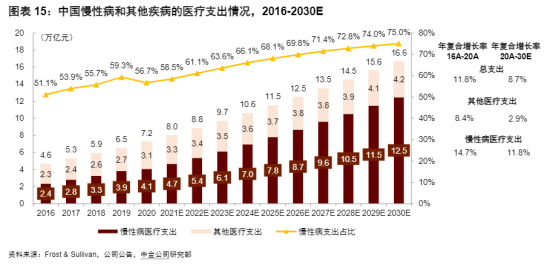
The water is big, the fish is big, but the dark current is raging. In the out-of-hospital scenario, the chronic disease service market has formed three major camps: comprehensive pharmaceutical e-commerce represented by JD Health and Ali Health, which relies on the parent company's traffic, logistics and supply chain scale advantages to penetrate the slow disease drug purchase market with pharmaceutical e-commerce as the core; offline pharmacy chains, represented by Yifeng Pharmacy and Dashenlin, rely on physical stores to achieve local implementation and scenario services; in addition, it is a vertical chronic disease service platform represented by Ark Kenke. Such participants often have a deep understanding of the chronic disease market and have established a certain reserve of expertise, expertise and language Higher authority to differentiate services Compete for users.
This pattern determines the field of business models for different companies. Pharmaceutical service providers covering multiple diseases are mainly driven by “scale effects” to attract users with massive SKUs and low-cost drugs, and operate drugs for chronic diseases as a high-frequency category in pharmaceutical retail. Its core lies in supply chain efficiency and traffic conversion, but the relationship between users and platforms essentially remains at the level of “transactions.” However, the logic of offline pharmacy chains is “scene reach”, using the physical scenario of the store network to complete immediate execution, but the depth of service is also limited by the “as soon as you arrive at the store” transaction boundary.
If the competitive barrier for comprehensive pharmaceutical e-commerce platforms is “scale,” and offline pharmacies are “touchpoints,” then the competitive barrier for Ark Kenke is “trust.” This is a deep trust relationship based on the AI+H2H (Hospital to Home) system and the familiar doctor-patient model throughout the entire course of a user's illness.
“Trust is a barrier”, looking into the differentiated core of Ark Riders
The Zhitong Finance App observes that the linear growth logic of traditional chronic disease management platforms is essentially a one-way cycle of “customer acquisition - transaction - loss”. The core variables of user decisions are drug prices and delivery speed. The platform and user are weakly connected shelf relationships. The single customer value ceiling is determined by the amount of a single drug purchase, and the upper limit of growth is determined by traffic volume and customer acquisition costs, which has now gradually peaked in fierce competition.
The core of what Ark Kenke is trying to build is to break out of the single supply logic of drug sales and position itself as an ecosystem that runs through the entire service cycle for chronic diseases. Prescription drugs account for 83.1% of the total GMV, which is a direct reflection of the service embedded in the core diagnosis and treatment scenario for chronic patients: chronic patients need to take prescription drugs regularly for a long period of time. This proportion indicates that users have formed a habit of using the whole process of prescription, drug delivery, and subsequent health management after the platform has completed diagnosis, which is the foundation for the long-term service model to run.
At the same time, the underlying support of this ecosystem is the scale of tens of millions of users and 10,000 doctor resources it has accumulated: patients with chronic diseases account for a relatively high proportion of 59.8 million registered users, and 14.7 million monthly active users increased 23.1% year over year, indicating that users' dependence on the platform has extended from “drug purchase” to high-frequency scenarios such as daily health consultation, doctor-patient communication, and follow-up management; 282,000 registered doctors have provided a professional resource base for service implementation.
Furthermore, the company's medical resources and supply chain network continue to be consolidated, creating competitive barriers that are difficult for peers to surpass. As of the latest disclosure date, it has built a medical service network covering multiple departments with extensive and specialized registered doctor resources; the supply chain network covers more than 1,800 suppliers and more than 1,000 pharmaceutical companies, and the scale effect is gradually showing.
In the field of chronic disease services, trust is the core currency in circulation. In the first half of 2026, Ark Biker's repurchase rate of paying users reached 89.2%, essentially a direct quantification of user trust. When patients establish approval of the platform's medical service quality and doctors' professionalism, they will naturally develop long-term usage habits. With the continuous penetration of active intervention services throughout the cycle, the platform has increased the service frequency and depth of interaction for individual customers, formed a positive cycle of “service trust-building - user retention and repurchase - value enhancement and feeding back service upgrades”, breaking the ceiling of traditional linear growth, and growth resilience will be significantly stronger than platforms that only profit from transactions.
From this perspective, compared to various competitors, Ark Jianke's differentiated strategy based on “familiar doctors and patients” will help the company reach the core of chronic disease service decision-making, and at the same time, its strong product capabilities will further enhance the company's competitiveness.
Establish a solid foundation for growth, and triple genes support the implementation of a full-cycle service ecosystem
Currently, the Internet medical industry is undergoing a transformation, and user demand has shifted from “simple drug delivery” to “demand for health intervention throughout the life cycle.” Earlier, the “Fifteenth Five-Year Plan for National Health” issued by the State Council also took “optimizing a comprehensive full-cycle integrated health service system” as the main line, raising full-cycle health management to the height of the national strategy. An industry consensus has been formed, but there are only a few companies that can actually transform “full-cycle services” into a sustainable business model.
According to the Zhitong Finance App, Ark Biker's full-cycle service model is expected to work. The core is that it has three irreplaceable growth genes, thus facing the three major pain points of trust, continuity, and cost that have existed in the industry for a long time.
First, Ark Kenke solved the core trust issue of medical services through a “familiar doctor-patient” relationship. Based on offline consultations between patients and doctors, patients' existing trust in doctors is continued and strengthened online through the platform. Through long-term service accumulation, it establishes connections between users and acquaintances of contracted doctors. Users will actively follow the doctors' service pace to complete health management, and the stickiness and repurchase rate are significantly higher than anonymous doctor-patient relationships.
Second, the service continuity of the H2H (from hospital to home) system breaks the pain point of “pre-hospital and post-hospital interruption” of traditional medical services: under the traditional model, patients' diagnosis and treatment services are concentrated within the hospital, and health management and follow-up services outside the hospital are not accepted. The full cycle of ARK Jianke's service opens up a full link from in-hospital diagnosis and treatment to out-of-hospital health management. The diagnosis and treatment plans completed by users within the hospital can be continuously followed up on the platform. Continuity of service not only greatly enhances users' health management effectiveness, but also strengthens the users' platform's dependence on health management.
What is most noteworthy is that at a time when technology is being rapidly iterated, Ark Jianke's forward-looking layout of AI technology is embedded into business processes and the development of an AI product matrix based on the Apricot Stone Model is expected to solve the cost problem of large-scale delivery of high-quality chronic disease services, and transform full-cycle services from small-scale project implementation to a commercial business that can be popularized by tens of millions of users.
In the specific implementation scenario, Ark Biker worked in both directions from both the doctor and patient to build a complete AI product matrix:
On the user side, the AI product matrix has been improved and upgraded. AI health managers and AI medication assistants have broken the constraints of time and space, superimposed AI intelligent follow-up tools on a large scale, and the closed loop of out-of-hospital health management services has been further completed. Relying on 7×24 hour online service capabilities, combined with dynamic personalized follow-up, the platform can not only implement differentiated health control for different users, but also provide medication reminders and health information services.
On the doctors' side, it integrates AI pre-diagnosis, AI auxiliary diagnosis, AI academic assistants, etc., freeing doctors from repetitive desk work. While improving their service efficiency, it also brings a better full-process management experience to online patients. At the same time, with the intervention of the follow-up system, doctors' post-diagnosis management efficiency has been greatly improved. Through AI “reducing the burden and increasing efficiency”, limited resources for high-quality doctors have been fully expanded, and professional services cover more patients.
Seen from this perspective, AI technology is by no means only the underlying technical support for Ark Riders, but also the core of leveraging the rise in commercial value. The path of value creation is clearly identifiable: first, AI technology has replaced standardized manual services such as basic consulting and data collation, achieving accurate pressure reduction in operating costs and directly broadening profit margins; second, AI technology drives user value to achieve a model change from “single service access” to “long-term health management consumption”, and is also expected to expand value-added service categories, and ultimately weave a full-life cycle health management ecosystem with a virtuous cycle of “user access - health management - medical services”.
epilogue
At this point, the future growth logic of Ark Riders is clearly audible. On the one hand, China's digital health market is still in the dividend period of increased penetration, and residents' demand for full-cycle health management continues to be released, providing a broad space for business expansion; on the other hand, the continuous iteration of its AI technology and the deep refinement of its closed ecological loop will further widen the gap with peers.
In the future, with the deepening application of AI technology in chronic disease services and medical decision-making scenarios, the professionalism and accuracy of its services will continue to improve. As far as the capital market is concerned, platforms that also have the triple genes of “barrier of trust+AI scaling capability+closed loop of full-cycle service” are extremely scarce. The long-term value of this chronic disease service platform that gradually improves business transformation and establishes strong technological barriers may be further verified and highlighted as industry dividends are released and its own ecology is improved.
Predictably, with 2026 as a starting point, Ark Biker will not only usher in a leap forward in growth, but will also provide a new sample for business model innovation in the chronic disease service and digital health industry, and accelerate the industry's progress in the direction of “technological empowerment, ecological collaboration, and closed loop of service”.