


The Zhitong Finance App learned that this Friday, Federal Reserve Chairman Kevin Walsh will deliver a keynote address at the Jackson Hole Global Central Bank Annual Meeting. As US bond yields continue to be high and US inflation is above the 2% target for five consecutive years, many Wall Street institutions, including J.P. Morgan Chase, Apollo Global Management, and Morgan Stanley, unanimously called for Walsh to clearly demonstrate the Fed's firm commitment to fighting inflation in this speech.
Market logic: Staying anti-inflationary can reduce long-term returns
Investors generally believe that if Walsh clearly conveys a tough stance on price stability in his speech on Friday, it may trigger the purchase of 30-year US bonds, thereby reducing long-term yields. Last week, the 30-year US Treasury yield rose to 5.34%, the highest level since 2007.
The move will also help US Treasury Secretary Scott Bessent. Bezent has previously taken a number of measures, including the repurchase of long-term bonds, in an attempt to curb the sell-off of long-term bonds and ease America's growing interest burden. However, despite the intervention of the US Treasury, the 30-year US Treasury yield has remained above the 5% mark for nearly two months. Continued high borrowing costs are putting pressure on the US real estate market, private equity firms, and small businesses.
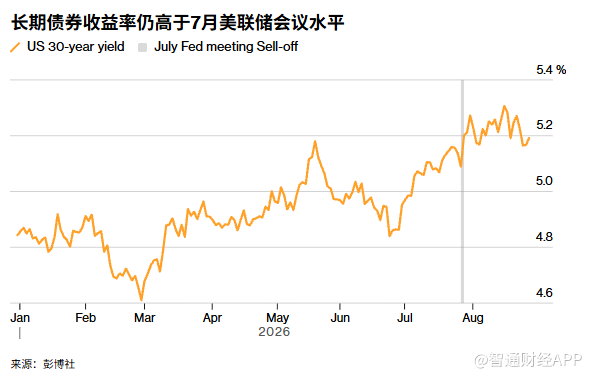
Since the interest rate meeting in July, Walsh's ambiguous communication style has puzzled investors and raised questions about whether the Fed's determination to control prices has wavered. At the press conference after the July meeting, Walsh declined to explain how policymakers would deal with different economic scenarios, and some remarks were even interpreted by some market participants as “the Federal Reserve may adjust its inflation target in January next year,” directly triggering the sell-off of long-term bonds.
Priya Misra, portfolio manager at J.P. Morgan Chase Investment Management, said that if Walsh can use this speech to clearly state that fighting inflation is a top priority, then “the market's anxiety about the Fed's reputation will ease.” Misra said that Walsh's tough stance on high inflation will depress the term premium.
Vishal Kanduja, head of broad market fixed income at Morgan Stanley Investment Management, also said, “If the Federal Reserve focuses on inflation, the term premium should drop drastically because the credibility of the Federal Reserve will now be greatly enhanced.” The term premium measures the additional compensation required by investors to take the risk of holding long-term US Treasury bonds. A term premium indicator tracked by the New York Federal Reserve is close to its highest level since 2014.
Agencies' collective appeal: Walsh must provide clear framework guidelines
Jay Barry, head of global interest rate strategy at J.P. Morgan Chase, said that if Walsh retracts some of the vague statements on Friday, “it may cause the US Treasury yield curve to flatten.” This happens when short-term interest rates rise faster than long-term interest rates.
Apollo Global Management Chief Economist Thorsten Slocke said that Walsh “must make a more clear statement than the July press conference.” Slock stressed that Walsh does not need to disclose the Fed's next interest rate action in advance, but he must express his views on the current inflation situation and the job market in order to clarify its policy priorities. “If he doesn't provide any framework guidance, the risk is that long-term interest rates will rise more sharply,” Slock warned.
Slock further pointed out that the US bond yield curve is facing multiple upward pressures: the long end is dragged down by the size of historic debt exceeding 40 trillion US dollars; the short end remains high due to stubborn inflation; and the middle end is pressured by large-scale borrowing by AI giants. “There is a risk that the entire yield curve will rise further,” he said.
Walsh's speech also provided the market with a window to observe the macroeconomic outlook — the August employment report will be released next week, and consumer price index data will be released a few days before the Federal Reserve's next policy decision on September 16. Currently, federal funds futures show that the probability that the market expects an interest rate hike of 25 basis points next month is about 35%.
Kevin Flanagan, head of investment strategy at WisdomTree, said: “The final arbiter is still the data itself, which is what the market will focus on after Walsh's speech. The two-year yield is still higher than the federal funds rate, which reflects the uncertainty premium surrounding Walsh and shows that even though the July employment and inflation data softened, the market has not completely ruled out the possibility of interest rate hikes.”