


The Zhitong Finance App notes that Broadcom (AVGO.US) is at a critical moment. The company will release its third fiscal quarter earnings report on September 2, 2026. Wall Street expects it to hand over an impressive report card. The driving force behind it comes from an unprecedented demand for artificial intelligence infrastructure. Analysts expect revenue of around $29.4 billion, up 84% year over year, highlighting the transformative impact of AI spending on the company's business model.
The semiconductor giant has positioned itself as a key enabler of the AI revolution, designing custom accelerator chips for major technology companies vying to expand data center capabilities.
The reason why this financial report is significant is Broadcom's unique position in the AI chip ecosystem. When Nvidia took the headlines with general-purpose GPUs, Broadcom pioneered a lucrative segment: tailor-made AI accelerators for customers. This strategy has attracted six large technology companies as core customers, creating recurring revenue streams, making them more predictable and stable than typical semiconductor cyclical fluctuations. According to company guidelines, AI-related semiconductor revenue for the year may exceed US$20 billion, an increase of more than 200% over the previous year.
For investors evaluating the semiconductor industry, Broadcom's earnings report will provide key insight into the sustainability of AI infrastructure spending. The results will help answer the question of whether large-scale capital expenditure for cloud service providers and enterprises is a temporary surge or the beginning of a multi-year construction cycle. Following the strong rise in August, Broadcom's stock price is close to an all-time high, and the market has absorbed a lot of optimism, which makes the execution risk of this financial report particularly prominent.
Q3 2026 Earnings Preview: What to Expect
Wall Street analysts have set ambitious expectations for Broadcom's third-quarter results, which reflect the company's guidance and trends observable in AI infrastructure spending. The revenue consensus forecast is approximately US$29.4 billion, an increase of 84% over US$16 billion in the same period last year. For a company of the size of Broadcom, this growth rate is almost unprecedented, highlighting the extraordinary demand environment in the current AI-related semiconductor market.
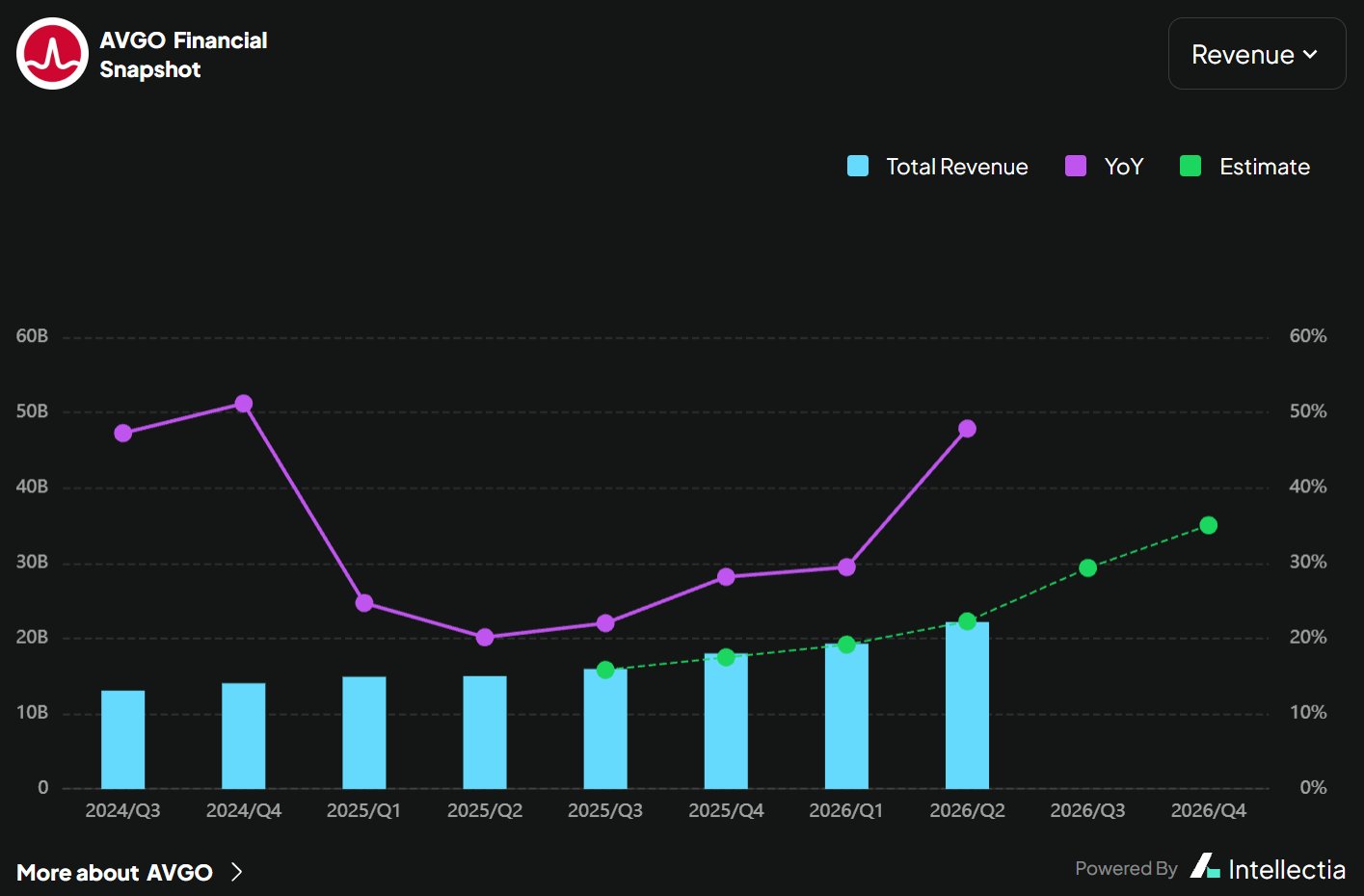
Earnings per share expectations are also bullish, with analysts expecting GAAP earnings of around $2.55 and non-GAAP earnings per share of $3.24. The latter will increase by 92% over the same period last year, indicating that revenue growth is effectively being translated into profit expansion. This operating leverage stems from the company's ability to maintain pricing power while expanding production, which indicates sustainable profitability even when the business grows exponentially.
The semiconductor solutions division, which includes AI accelerators, network chips, and other components, is expected to contribute most of the growth. Management said AI-related semiconductor revenue in the third quarter is likely to increase by more than 200% year over year, reaching about 4.5 billion US dollars. This figure accounts for a significant share of total semiconductor revenue, and highlights how AI is rapidly transforming from an emerging opportunity to a major growth engine. Although the infrastructure software business grew moderately, it provided important diversification and recurring revenue characteristics, enhancing overall business stability.
AI infrastructure construction: sustainable or bubble?
The most critical question facing Broadcom investors is whether the current surge in AI infrastructure spending represents an enduring trend or an unsustainable bubble destined to burst. Multiple factors suggest that this construction is characterized by real technological change rather than excessive speculation. The practical application of AI is rapidly expanding to all walks of life, from code generation and content creation to drug discovery and autonomous systems, creating real economic value that justifies continued investment.
As a cloud service provider with Broadcom's main customer base, it has demonstrated its continued commitment to AI infrastructure expansion through its capital expenditure guidelines. These companies are not only testing AI, but are also fundamentally restructuring their business around AI capabilities, embedding artificial intelligence into core products and services that generate billions of dollars in revenue. This structural shift shows that AI spending is becoming an operational necessity rather than a discretionary investment that can be easily cut.
However, risks that could dampen growth expectations remain. Competition in the AI chip market is intensifying, Nvidia continues to innovate rapidly, and new entrants are emerging with alternative architectures. Furthermore, questions about the scalability of AI models and the actual limitations of current methods may eventually slow the pace of infrastructure expansion. The shift from training large-scale models to large-scale deployment may change demand patterns in different ways, unevenly affecting different chip vendors. Broadcom's custom chip model resists commercialization to a certain extent, but it is unable to completely insulate the company from market dynamics.
Competitive position in the AI chip market
Broadcom has a unique position in the AI semiconductor competition landscape, bringing significant opportunities as well as unique challenges. Unlike Nvidia, which sells standardized GPUs to a wide range of markets, or AMD, which provides generic and semi-custom solutions, Broadcom focuses on fully customized designs developed in close collaboration with specific customers. This specialization creates deep relationships and huge conversion costs, but it also limits the potential market size compared to generic alternatives.
The moat surrounding Broadcom's custom chip business is multifaceted and quite impressive. The engineering expertise required to design cutting-edge AI accelerators represents years of accumulated knowledge and experience. Customer relationships are built on multiple product generations, and every successful partnership strengthens trust and consistency. The dependencies created by the integration of custom chips into a broader system architecture cannot be easily eliminated without significant disruptions and costs.
Looking ahead, Broadcom's competitive position seems solid, but it's not unshakable. As AI architectures evolve, companies must continue to invest heavily in R&D to maintain a leading position in technology. New competitors, including established semiconductor companies and well-funded startups, are targeting the customized AI chip market with innovative methods. The key to continued success is for Broadcom to expand its customer base to include new entrants in the AI infrastructure market while deepening existing customer relationships.
Market Background and Macro Factors
Broadcom's performance must be assessed against broader semiconductor market dynamics and macroeconomic conditions affecting technology spending. The Federal Reserve's monetary policy stance — interest rates remained between 3.50% and 3.75% as of August 2026 — created a relatively stable environment for capital-intensive investments such as data center expansions. However, continued inflation above the Federal Reserve's 2% target and the possibility of future interest rate adjustments introduced uncertainty and could affect clients' spending decisions.
The broader semiconductor industry is experiencing a fragmented recovery, with AI-related fields showing unusually strong performance, while traditional markets are even more sluggish. This differentiation benefits companies such as Broadcom that have significant AI exposure, while also posing challenges to companies that rely more on consumer electronics or industrial applications. Market gains concentrated on AI-related stocks raised concerns about radicalization of valuations and the risk of a sharp correction if growth expectations were not met.
For investors seeking increased exposure to AI infrastructure, Broadcom offers a differentiated option to complement rather than directly compete with more commonly mentioned companies such as Nvidia. The custom chip business model provides unique risk-reward characteristics and may appeal to investors who are concerned about the sustainability of GPU demand or competitive threats to standardized accelerator products. As the AI market matures and diversifies, Broadcom's specialized approach may become increasingly valuable.
conclusions
Broadcom's September 2 earnings report represents a key turning point and will provide important insights into the sustainability of AI infrastructure needs and the company's ability to derive value from this transformative trend. Against the backdrop of the market's expected revenue growth of 84% and profit growth of 92%, the execution threshold is extremely high, but the company's guidance and observable market trends indicate that these goals can be achieved. The custom AI chip business has evolved from a promising opportunity to become the main driver of Broadcom's financial performance, creating both huge upward potential and concentrated risks that investors must carefully consider.
Broadcom's long-term investment logic relies on the durability of AI infrastructure spending and the company's ability to maintain a competitive position in the field of custom silicon design. Current evidence shows that the adoption of AI in various industries is accelerating, creating a continuing demand for specialized chips that Broadcom excels at. While valuation levels require close attention, the company's profitability, customer relationships, and technical capabilities provide a solid foundation for continued growth.