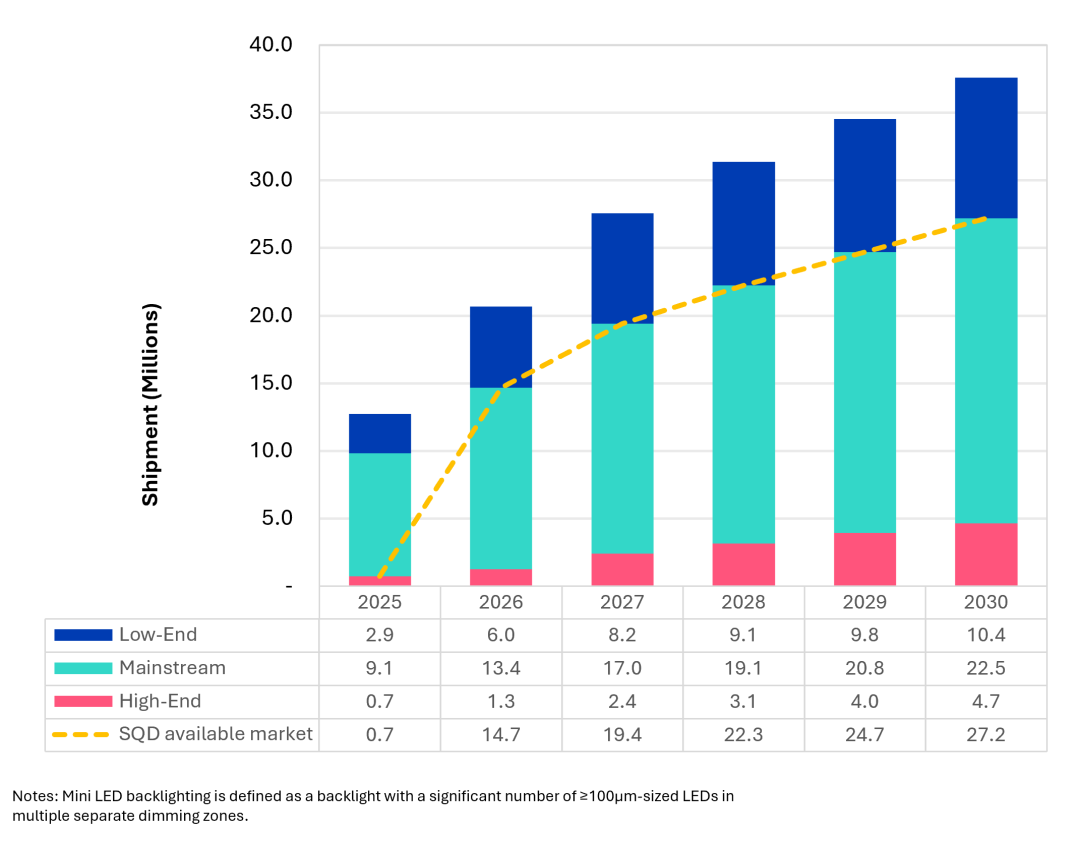
The Zhitong Finance App learned that Omdia's chief analyst Jimmy Kim wrote that TCL is consolidating its position in the high-end TV market with SQD Mini LED technology, while Hisense and Samsung continue to focus on lower cost solutions to drive shipment growth. SQD Mini LEDs can also provide leading color performance while maintaining a more competitive cost advantage over RGB Mini LEDs. By covering both the high-end and mainstream Mini LED TV markets, the technology is expected to respond to a potential market size of more than 27 million units by 2030.
Differentiation of backlight technology among the three major mini LED TV manufacturers
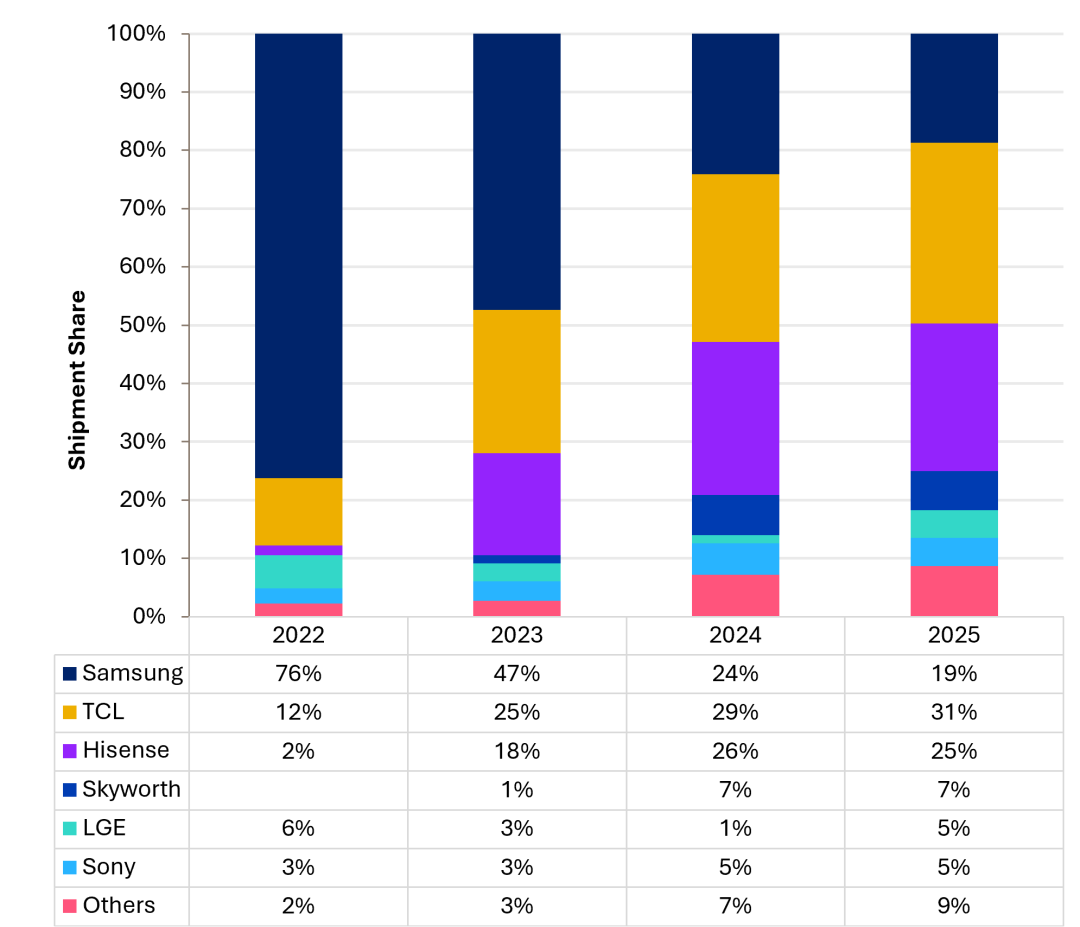
As of 2022, Samsung led the Mini LED TV market with about 75% of shipments. Since then, however, TCL and Hisense have gradually entered the Mini LED TV market with low-cost solutions, and eventually surpassed Samsung's market share in 2024. In response, Samsung also launched the first batch of TV models using edge-type (edge-type) mini LEDs in 2025, targeting the low-cost market.
Currently, TCL has the largest market share in the mini LED TV market, followed by Hisense and Samsung, as shown in Figure 1. Together, the three manufacturers account for about 75% of the market share.
Figure 1: Mini LED Backlit TV Market Share by Vendor
Currently, TCL, Hisense, and Samsung, as the top three TV manufacturers with the highest share of the Mini LED TV market, have adopted similar product strategies in the Mini LED TV market, mainly driving shipment growth through low-cost solutions. However, after entering 2026, the strategies of the three vendors began to diverge, as shown in Table 1.
Table 1: Backlight technology differentiation trends among the top three mini LED TV manufacturers in 2026
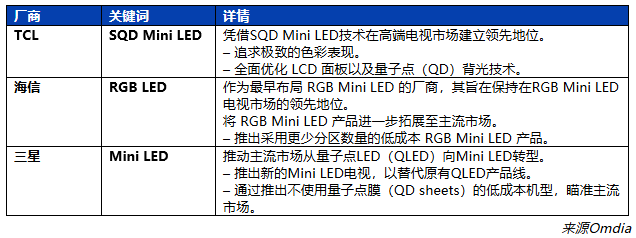
Both Hisense and Samsung continue to adopt a low-cost strategy in the mainstream TV market, but the two have taken different technology paths. Hisense has launched a new RGB Mini LED TV series to reduce costs by reducing the number of backlight partitions, and plans to expand the product line to mainstream markets to further strengthen its leading position in the RGB Mini LED market. At the same time, Samsung launched a new TV product line called “Mini LED” to reduce costs by eliminating quantum dot films (QD sheets) and using white mini LED packages. Samsung plans to gradually replace its mainstream QLED product line with this new Mini LED series.
TCL, on the other hand, focused on the high-end TV market and launched a new SQD Mini LED TV product line. Omdia research shows that TCL is pursuing extreme color performance with its unique SQD Mini LED technology to establish its leading position in the high-end TV market while continuing to maintain the complete layout of RGB Mini LED and QD Mini LED products.
SQD Mini LED: Extreme color performance and strong cost competitiveness
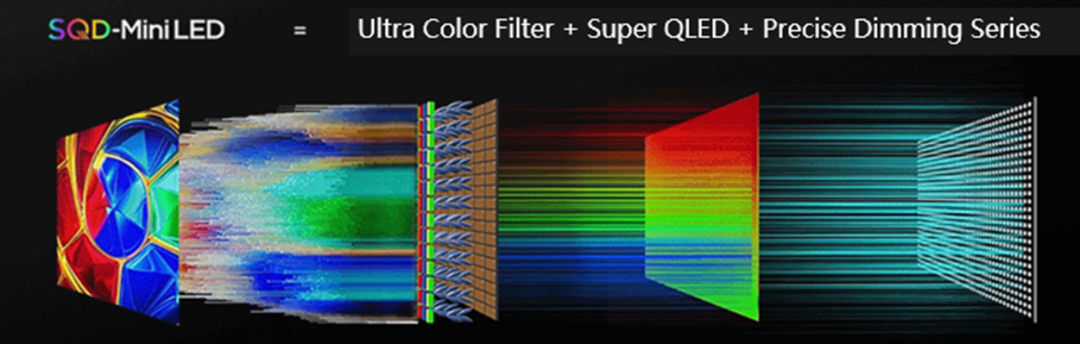
According to TCL, the SQD Mini LED is not a single quantum dot (QD) technology. Extreme color performance can only be achieved by combining multiple component technical innovations: using ultra-high color gamut panels, ultra-high color filters, SQD materials, ultra-thin backlighting, and precise dimming technology.
Figure 2: SQD Mini LED technical diagram
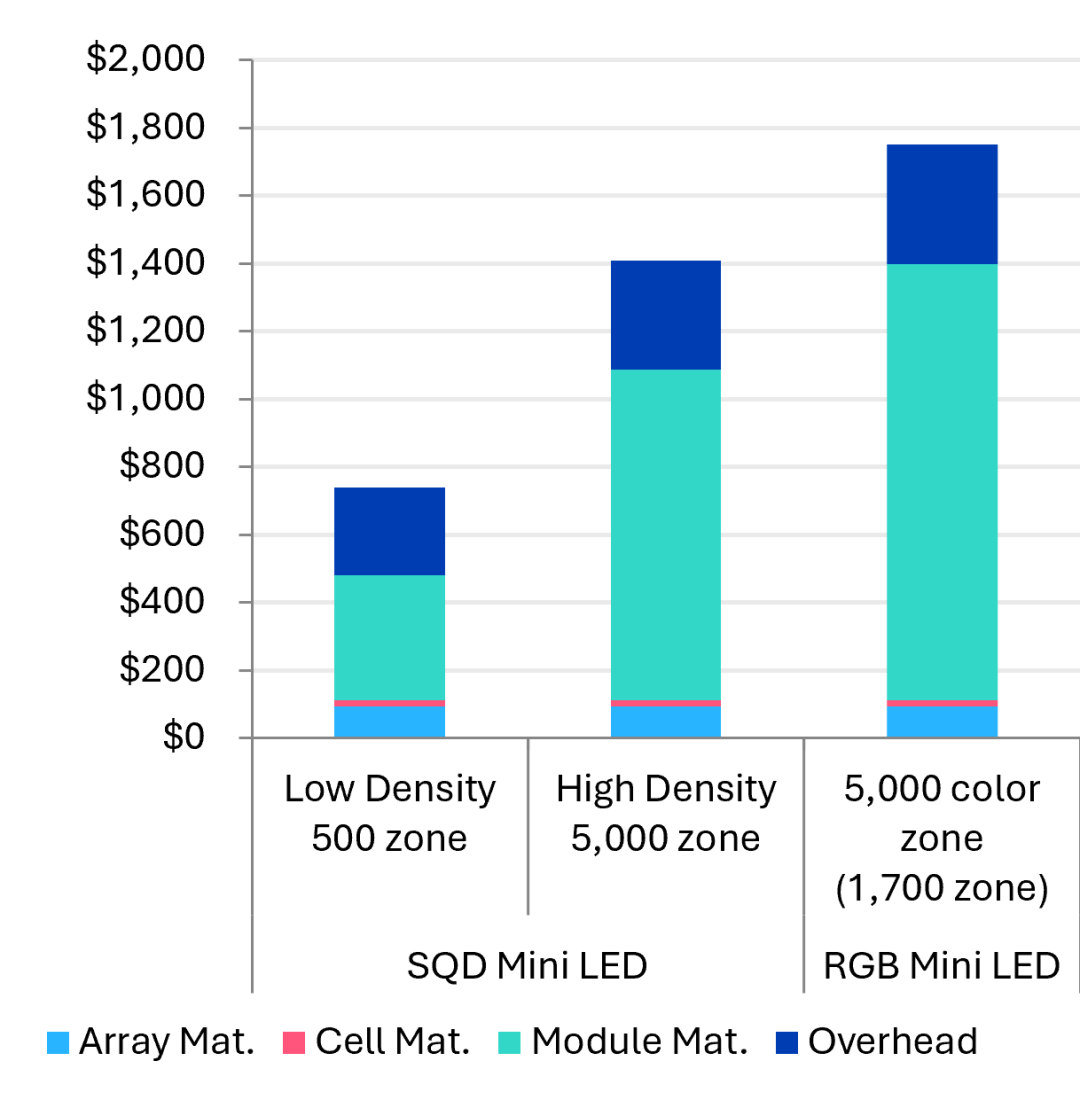
Compared to RGB Mini LEDs, SQD Mini LEDs are expected to be more cost competitive. Their cost structure is close to standard QD Mini LEDs, while maintaining extreme color performance. According to Omdia's analog estimates, the manufacturing cost of an SQD Mini LED backlit TV module with 5,000 dimming zones is estimated to be around $1,400, which is about 20% lower than an RGB Mini LED backlit TV module using the same number of color dimming partitions.
Normally, the number of dimming zones for RGB Mini LED TVs is calculated according to the three colors red, green, and blue. If calculated as an all-white dimming zone, 5,000 color dimming zones is only equivalent to about 1,700 white dimming zones. If the number of dimming zones is reduced to 500, close to the standard level of SQD, the manufacturing cost can be further reduced to less than $750. The strong cost competitiveness of the SQD Mini LED stems from the fact that its cost structure is highly flexible.
Figure 3: Manufacturing Costs for an 85-inch 4K TV Module
At CES 2026, the SQD Mini LED debuted and showed the ultimate color performance, with a color gamut coverage of 100% BT.2020. Therefore, the SQD Mini LED was initially thought to mainly target the high-end mini LED TV market and compete with RGB Mini LED TVs. However, considering its strong cost competitiveness, SQD Mini LED TVs are expected to penetrate both high-end and mainstream mini LED TV markets.
Under such circumstances, the demand in the mainstream Mini LED TV market can also be incorporated into SQD Mini LED TVs, and the overall potential demand scale may reach 14.7 million units in 2026. With the launch of the QM7L SQD Mini LED TV model in the US market, the market environment for SQD Mini LED TVs has further improved. Its aggressive pricing strategy has further enhanced the competitiveness of SQD Mini LED TVs, making them highly applicable even in mainstream markets.
By 2030, the total demand for high-end and mainstream Mini LED TV markets will exceed 27 million units. TCL is actively advancing the SQD Mini LED strategy and is willing to share its SQD platform with more TV vendors. If this strategy succeeds, the SQD Mini LED TV market could grow to more than 10 million units by then, accounting for more than 40% of the total potential market.
Figure 4: Mini LED-backlit TV demand forecast