


The Zhitong Finance App learned that when large model capabilities continue to be iterated and transfer costs continue to drop, what exactly are companies really willing to buy for a long time? Is it just another model interface, or a production system that can read its own business, call tools, abide by permissions, and be responsible for results? This question is becoming a proposition that industrial AI must answer from concept to delivery.
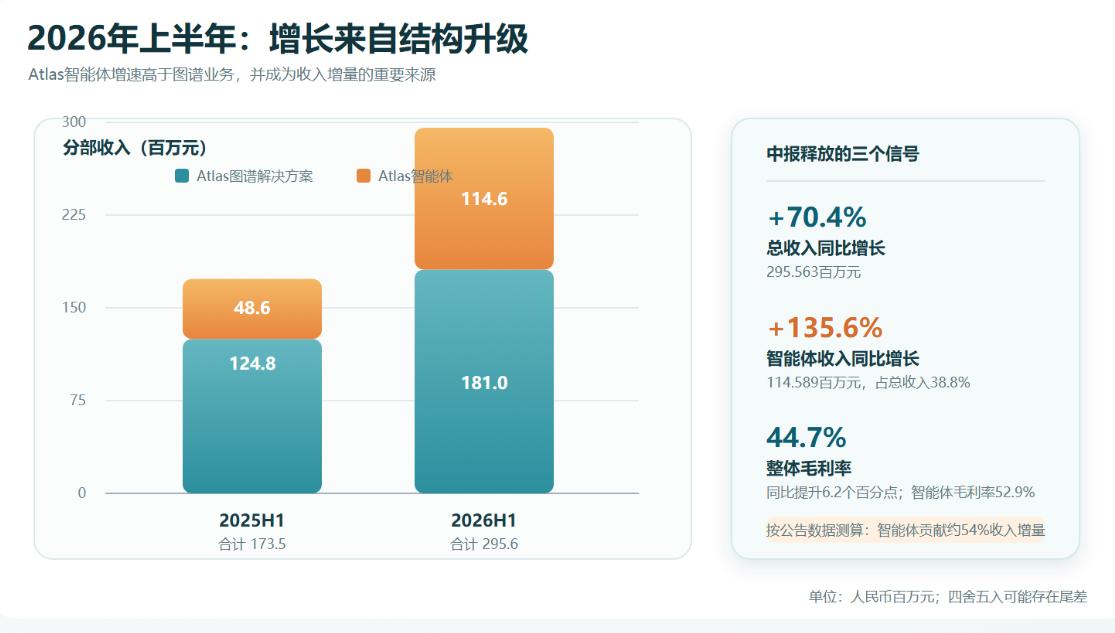
The 2026 interim report of Haizhi Technology (02706) provides a sample worth observing: during the reporting period, the company achieved revenue of 295.56 million yuan (RMB, same unit), up 70.4% year on year; gross profit of 132.08 million yuan, up 97.8% year on year; overall gross profit margin was 44.7%, up 6.2 percentage points year on year. More notably, the Atlas smart revenue reached 114.59 million yuan, up 135.6% year on year, accounting for 38.8% of total revenue, and the smart gross profit margin was 52.9%, higher than the company's overall level; loss during the period was 78.97 million yuan, down 38.1% year on year, and adjusted net loss was 19.60 million yuan, down 31.5% year on year.
According to the announcement segment data, the smart device business contributed about 54% of the revenue increase.
In other words, this interim report shows not simply the volume of projects, but a signal of simultaneous changes in the industry's AI demand, product structure, and management quality. Haizhi's value also needs to be understood by putting it back into the “basic model - enterprise data and semantics - executive governance - industry results” industrial chain.
(Data source: Haizhi Technology 2026 Interim Results Report Mapping: Zhitong Finance App)
1. From “being able to answer” to “being able to complete”: the procurement standards for enterprise AI are shifting gears
In the past period, when companies evaluated AI products, they often first looked at model parameters, response accuracy, and demonstration results. However, in scenarios where business rules are complicated and compliance requirements are high, such as government affairs, finance, and energy, the real threshold is not to generate a paragraph of text, but rather to let the system understand the enterprise's own objects, processes, and authority, and complete a traceable task within the boundaries.
This means that the evaluation criteria for industrial AI are shifting from “what will the model” to “what can the enterprise reliably complete”: whether data can be calculated uniformly, whether the business can be accurately understood, whether actions can be safely scheduled, and whether the results can be audited and reviewed. AI gradually evolved from a single-point question-and-answer tool to a system that participated in the operation of an enterprise.
Guosheng Securities proposed in a research report last month that the long-term space of industrial-grade AI can be understood from “enterprise knowledge-based labor cost restructuring”; an in-depth report published by Huachuang Securities at the same time summarized Harness as a control layer connecting models, enterprise data, rules, and process actions. The common point of view of the two organizations is that the enterprise operation system above the model is becoming a key part of implementing the value of industrial AI.
The changes in the business structure in the Haizhi Interim Report provide a quantitative footnote to this trend — the revenue of the Atlas solution increased 45.0% year over year, maintaining the basic market; the growth rate of smart revenue reached 135.6%, making it a more flexible incremental source.
The next question that arises from this is: after model capabilities tend to be inclusive, who can organize an enterprise's proprietary knowledge and business processes to form an execution capacity for sustainable use?
II. From “computable” to “actionable”: layers of control beyond the model are taking shape
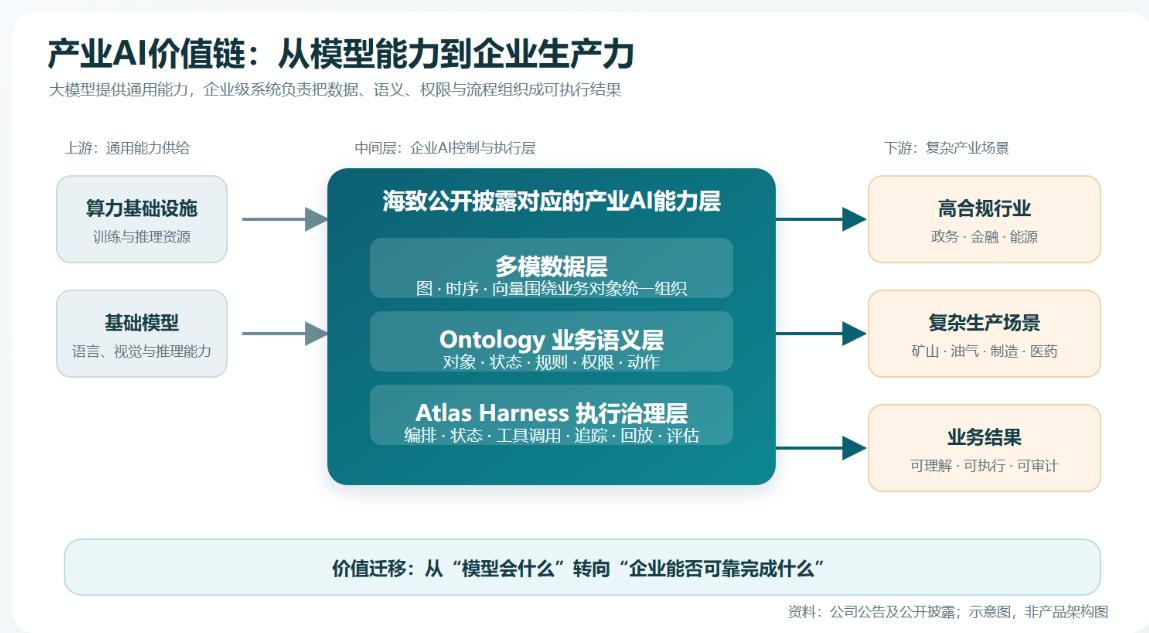
The technology path publicly disclosed by Haizhi can be summarized as a three-level progression of “multimodal data - business entity - agent operation time”.
The first layer is a multi-mode data base. Different types of data, such as graphs, time series, and vectors, are organized and calculated uniformly around the same business object, reducing the cost of repeated data handling and splicing between different systems. The second layer is Ontology itself, which organizes enterprise objects, relationships, states, rules, permissions, and actions into a set of business semantics that can be understood by machines. Businesses are no longer just “having data,” but can be described as “how they operate.” The third layer is Atlas Harness, which is responsible for context construction, task state management, tool and skill call, workflow orchestration, link tracking, playback, and effect evaluation, moving agents from one-time responses to continuous operation that can be observed and diagnosed.
The industry significance of this approach is that it separates the long-term value of enterprise AI from a single model. The model can be updated and replaced, and the data, terminology, business rules, authority system, skill base and execution trajectory accumulated by the enterprise itself can be settled in the semantic and operational layer decoupled from the model. We can call it an “enterprise AI asset” — this set of business capabilities that can be accumulated, migrated, and reused — not reporting assets in the accounting sense.
The Atlas smart system is already compatible with more than 100 major language models; the company's publicly disclosed cooperation with partners such as Spectrum, Haiguang Information, Bank of Ningbo, and Jingdong Technology, as well as progress such as upgrading academicians' expert workstations to integrate knowledge maps with big models and participating in relevant national standards formulation, also reflect its ecological connection and engineering accumulation.
From the perspective of the industrial chain, Haizhi does not mainly participate in general model parameter contests, but rather adds layers of data governance, business semantics, and execution control between computing power and models and enterprise production systems.
And the next question is: Can a technical base form an industry position?
It may eventually come back to whether the customer is willing to pay, upgrade, and continue to reuse.
3. From one project to one industry: customer upgrades turn know-how into growth assets
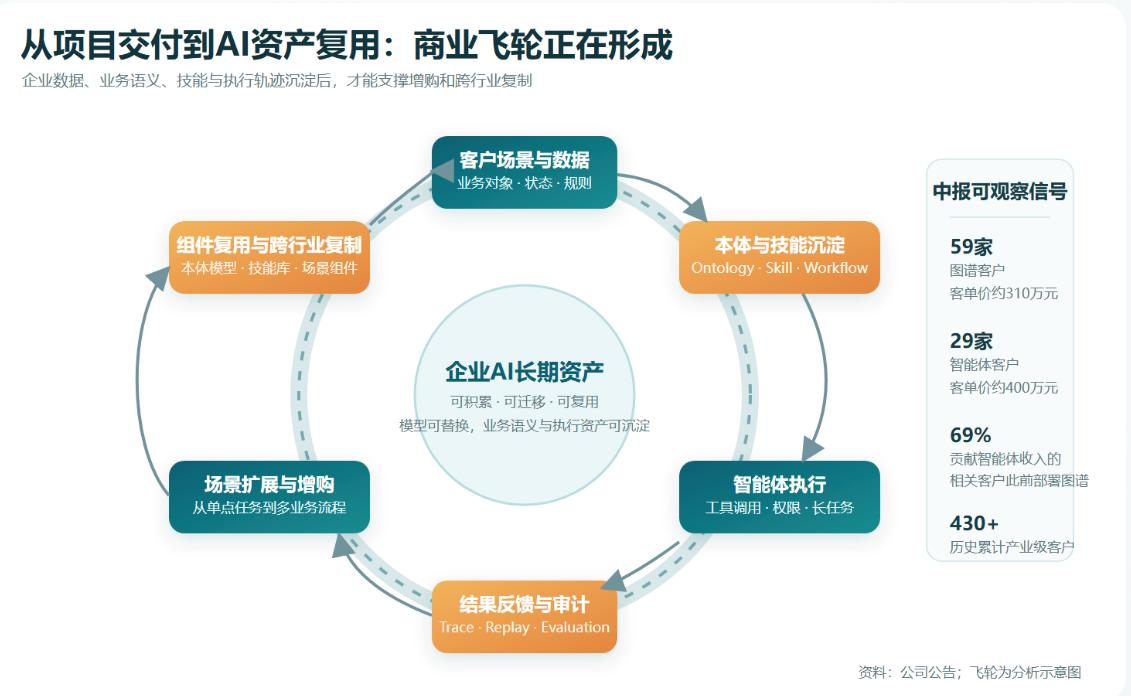
According to Haizhi China News, the number of Atlas Solution customers is 59, with an average customer unit price of about 3.1 million yuan; there are 29 smart customers, with an average customer unit price of about 4 million yuan. Of the relevant customers contributing revenue to smart devices, 69% have previously deployed a mapping solution.
This ratio cannot simply be understood as the conversion rate of all customer profiles, but it clearly shows an observable customer upgrade path: first enter with a data and business semantic base, then extend to higher-value agents and more business processes.
If the Atlas Project addresses “what is the enterprise and how is it related,” then the intelligent solution is “what actions are taken under what conditions.” The connection between the two provides an opportunity for a project delivery to settle into ontology models, skill libraries, and scenario components, and then serve additional purchases by the same customer and replication in new industries. Historically, it has served more than 430 industry-level customers, and has also provided a customer base for this “advance entry and further expansion” path.
Judging from public disclosure, in addition to basic markets such as government affairs, finance, and energy, Haizhi has extended its capabilities to smart mining, oil and gas, telecommunications, manufacturing, pharmaceuticals, etc., and has set up Hong Kong entities and exclusive teams. Replicating across industries does not mean simply translating the same set of solutions, but rather continuously “compiling” industry knowledge formed during on-site delivery into reusable components, skills, and processes. As component reuse, delivery efficiency, and customer purchases continue to improve, project-based revenue will gradually show platform-based characteristics.
The operating data in the interim report also provided corresponding support: R&D expenses increased by 81.5% year on year, and sales and marketing expenses increased 15.1% year on year, which is significantly lower than the revenue growth rate, indicating that while increasing base investment, the company is beginning to show signs of improving operating efficiency.
By the end of the period, the company's cash and cash equivalents and financial assets measured at fair value and recorded in current profit and loss totaled about $972 million. The balance ratio was 26.3%, and there were no external loans, providing a financial buffer for continuous R&D and industry delivery.
4. Conclusion: The next competition for industrial AI is to turn experience into infrastructure
According to the Chinese report, Haizhi is forming a “map base - smart application - customer upgrade - component deposition - cross-industry replication” chain. Its position in the industry does not have to be defined by “industry first” or a single analogy, but can be viewed from the four dimensions of high compliance scenario depth, cross-industry migration ability, ecological collaboration ability, and standardized replication ability.
The real watershed for industrial AI is probably not who has more models, but who can deposit enterprise data, business semantics, permission rules, and execution experience into productivity for sustainable reuse.
For Haizhi, the 2026 interim report is more like a verification point: the path of Haizhi's evolution from a project provider to an infrastructure provider connecting models to industrial production systems is gradually being clarified. Furthermore, on August 28, the Hong Kong Stock Exchange announced the first quarterly adjustment after announcing a plan to optimize the Technology 100 Index, which included Haizhi Technology, along with companies such as Wenyuan Zhixing, My Little Pony Zhixing, and Insilicon Smart as constituent stocks, further highlighting its representation on the AI technology circuit. For the market, this provides a new coordinate for observing industrial AI samples from Hong Kong listed technology companies; for companies, it is a visible sign that technological attributes, growth performance, and industrialization progress have received external attention.