


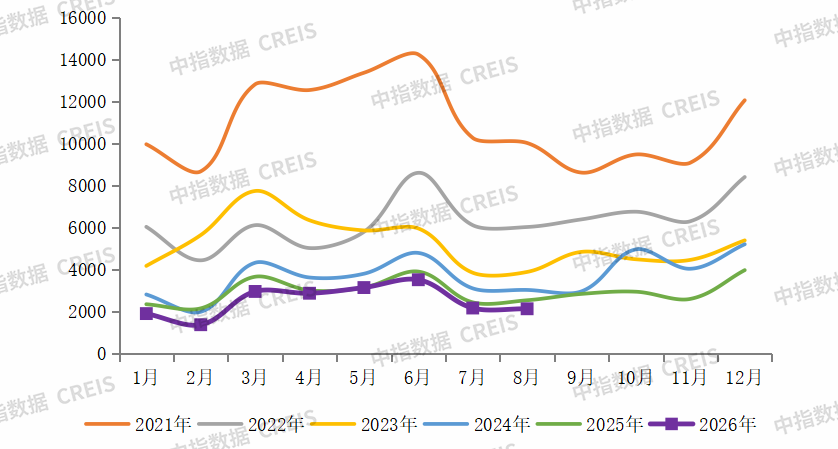
The Zhitong Finance App learned that on August 31, the China Index Research Institute released an analysis of the sales performance of Chinese housing enterprises from January to August 2026. From January to August 2026, the total sales volume of 100 real estate companies was 590 million yuan, an increase of 0.3 percentage points over January-July. The property market is still in an off-season situation. Only core cities still have market support, driven by the entry of high-quality projects into the market, and the decline in sales performance of key housing enterprises has increased slightly. The trading sales of 100 housing enterprises were 1583.39 billion yuan, and equity sales were 1406.88 billion yuan. Looking at specific companies, sales of companies such as Zhonghai Real Estate, China Resources Land, China Merchants Shekou, China Jinmao, and Beijing Urban Construction increased year-on-year in January-August. The good performance of these companies is the result of a combination of “core city refinement stocks+credit premium+product power iteration for central and state-owned enterprises”. These companies have locked their investment levels in the core area of core cities, and have effectively grasped the recovery of the core city market. At the same time, the low cost financing and “guarantee delivery” certainty brought about by its central state-owned enterprise credit has significantly increased buyers' trust, making the project premium and elimination rate superior to the industry. Furthermore, these companies continue to iterate on the “good house” product line, match the improved customer base that currently dominates the market with differentiated products, and use layout dividends as sales increases in structural differentiation.
Figure: Average cumulative full-caliber sales volume and growth rate of 100 real estate companies from January 2022 to August 2026
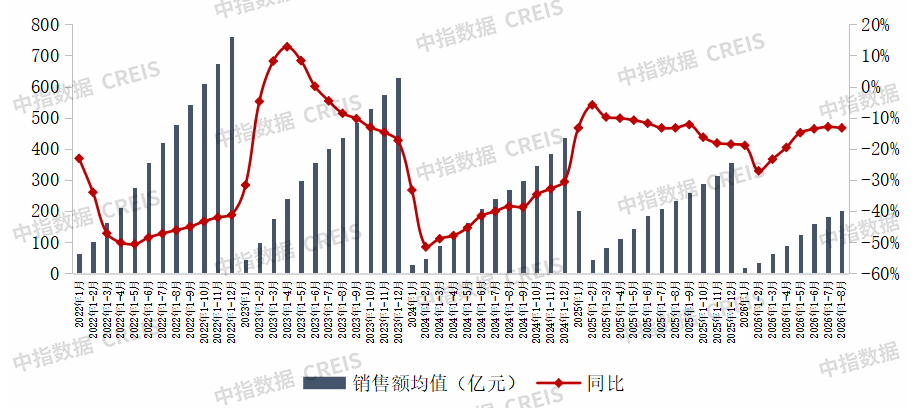
Figure: Monthly sales of 100 housing enterprises in a single month from January 2021 to August 2026 (unit: 100 million yuan)
Explanation: Sales used in the analysis in this article, if not specified, all refer to full-caliber sales
Data source: Middle Index Data CREIS
Number of factions: Industry clearance continues, and the pattern of leading housing enterprises is relatively solidified
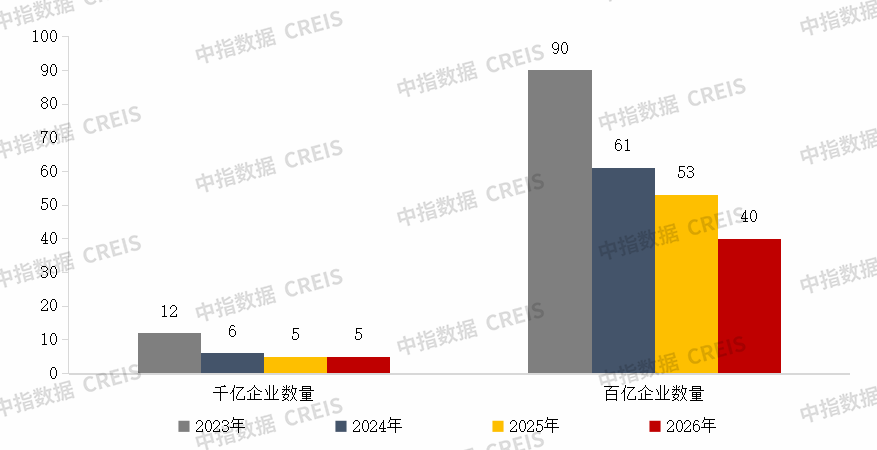
From January to August 2026, there were 5 100 billion housing enterprises, the same as the same period last year; there were 40 10 billion housing enterprises, a decrease of 13 from the same period. The 100 billion faction has stabilized at 5, but the 10 billion camp continues to decline, indicating that the industry is still being cleared and sales pressure continues. Overall, the industry has moved from large-scale expansion to a stage of strong cash flow, strong delivery, and strong product strength, and enterprise differentiation has intensified. The 100 billion camp stabilized, reflecting the relative solidification of the pattern of leading housing enterprises. The decline in the number of ten-billion enterprises shows that midstream housing enterprises are weak in sales recovery, project cancellations, and high repayment pressure. Whether subsequent sales can stabilize still depends on policy effects, residents' expectations, inventory digestion, and improvements in the capital chain of housing enterprises. In the short term, structural differentiation on the sales side is still the main line.
Figure: Number of 100 billion and 10 billion housing enterprises from 2023 to 2026 and January-August
Popular projects: Transforming scarce land resources, achieving effective product quality implementation, and winning the market with “quality-price ratio”
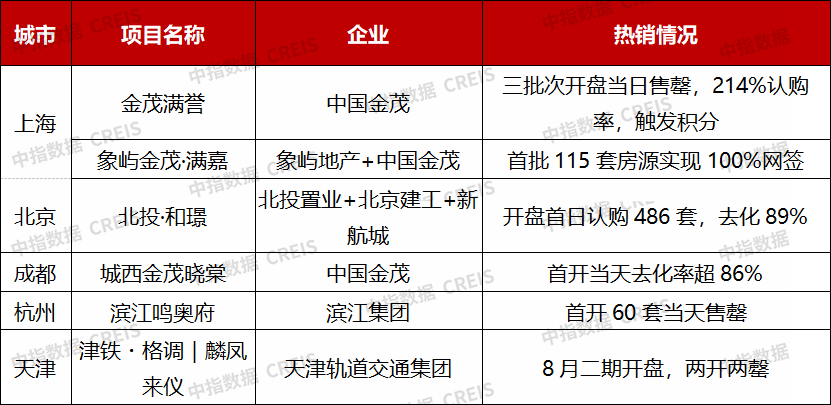
Under the structural market where “demand is stratified and product is king”, popular projects in key cities such as Shanghai, Beijing, Chengdu, Hangzhou, and Tianjin emerged from the “off-season” independent market, and factors such as “scarce land, product generation difference, and accurate customer base” resonated to help the project sell well. From the land side, these projects all occupy scarce local resources in core cities, such as low-density, dual-track interchanges, parks, or TOD resources. From the product side, popular projects generally use 3.5-generation homes, fourth-generation residences, and three-dimensional double clubhouses with leading housing configurations. At the same time, some projects use differentiated community facilities such as a “whale storage system”, a bustling shopping street in Tangshi, and a full library to create unique competitive advantages. From the customer base side, popular projects accurately capture customer group pain points, respect customer needs, and achieve effective quality implementation. Beitou Hejing accurately matches the needs of the sub-center to improve the needs of the customer base and improve the quality of regional living with pure low-density bungalow settlements. Chengxi Jinmao Xiaotang focuses on scene design and arranges it around the interests of the customer base to effectively meet the immediate needs and high requirements of the main city of Chengdu's youth buyers. When the market says goodbye to general rise, works with scarce locations, product leadership, and price sincerity can replace low price competition with “quality-price ratio” to efficiently meet demand for improvement during the policy window.
Table: Status of some recent best-selling properties
Data source: Comprehensive compilation by the China Index Research Institute
Outlook: In August, various ministries and commissions issued documents clarifying that all regions should vigorously and orderly implement commercial housing sales. Core cities such as Beijing and Shanghai will introduce demand-side support policies. The New Deal supports extending individual loans for up to 40 years, and the decline in sales performance of key housing enterprises is expected to narrow
In terms of policy, on the 28th, the Ministry of Housing and Construction, the Ministry of Natural Resources, and the General Administration of Financial Supervision issued the “Notice on Improving the Commercial Housing Sales System”, proposing that all regions should improve pre-sale management of commercial housing, clearly implement existing commercial housing sales in a vigorous and orderly manner, and require all regions to simultaneously improve relevant supporting policies and measures, and strengthen policy coordination and coordination. On the same day, the Central Bank and the General Administration of Financial Supervision jointly issued “Opinions on Reforming and Improving Real Estate Credit Management to Accelerate the Construction of a New Model for Real Estate Development”, which focuses on improving and optimizing the real estate credit system throughout the real estate development, construction, sales, and operation chain, and also introduces administrative measures such as development loans, personal housing loans, commercial real estate loans, and urban renewal project loans. The Securities Regulatory Commission issued “Opinions on Capital Market Support for Building a New Model of Real Estate Development” to optimize financing systems for housing enterprises' stocks, bonds, asset-backed securities, and real estate investment trusts. Beijing, Shanghai, Chengdu and other places have also successively introduced demand-side support policies.
Taken together, the three core focuses on reforming and improving the housing sales system, improving real estate credit management, and capital market financing reform. This is the first time that the supervisory authorities have intensively released an overall restructuring of basic systems such as real estate development, financing, and sales in a systematic manner. It is of great significance and far-reaching impact. First, this is a historic system change. These changes all mean that the old real estate development model has officially come to an end. The new real estate development model with the stock era as the background and the goal of improving quality and efficiency is taking shape at an accelerated pace, which is a landmark of the times. Second, it will have a profound impact on buyers, housing enterprises, financial institutions, and the market. For buyers, this round of reform will protect the legitimate rights and interests of buyers throughout. Whether it is closing and supervising pre-sale funds, raising the pre-sale threshold, or vigorously and orderly promotion of existing housing sales, implementing “being able to get a house, repay the loan” and “hand over and pay” mortgages, they are all starting and foothold to ensure the safety of buyers' funds, ensure timely delivery, and improve housing quality, and establish a full-chain, multi-level rights protection system for buyers. For housing enterprises, system reform will push enterprises to return to project management, strengthen capital coordination, and focus on product quality. The competitive advantages of enterprises with high product strength, strong brand power, and sound financial resources are expected to be further reflected, and the competitive pattern of the industry may accelerate differentiation.
In terms of new housing, in August, the property market was still in the off-season, housing companies' enthusiasm for promotion was still weak, and the trend of fragmented transaction performance between cities continued. According to preliminary statistics from the China Index, in August, the sales area of newly built commercial residential homes in 30 cities declined year on year. Among them, the sales area of new homes in first-tier cities increased year on year. Driven by the entry of high-quality projects into the market, core cities formed some support for the market, but most cities are still in the process of adjustment. In terms of second-hand housing, the performance is still superior to new housing, and core cities have maintained a certain level of activity. According to preliminary statistics from the China Index, second-hand housing transactions in 20 key cities declined month-on-month in August, but continued to increase year-on-year.
In terms of the land market, in August, the scale of residential land transactions in 300 cities continued to shrink. Land concession funds increased year-on-year, driven by high-quality land plots in cities such as Shanghai and Beijing, but the division of land sales is still quite obvious. Land auctions are very popular in cities such as Beijing and Shanghai. As of August 30, Beijing had sold 7 parcels of residential land, with a sale price of 24.7 billion yuan, ranking first in the country. Among them, the Haidian Sijiqing Town plot was sold by Jin Mao at a total price of 9.761 billion yuan and a 14.1% premium rate; the 0409-10 plot on Guangqu Road in Chaoyang was obtained by CNOOC at a total price of 8.399 billion yuan and a 19.1% premium rate through 185 rounds of on-site bidding. Shanghai sold 5 parcels of residential land, 3 premium transactions, and sold 9.06 billion yuan.
In terms of housing enterprise sales, core cities such as Beijing and Shanghai have introduced demand-side support policies. Adding a sentence in the middle, the New Deal supports extending individual loans for up to 40 years, which is expected to drive a steady release of demand in core cities. Combined with a low annual base, the decline in sales performance of key housing enterprises is expected to maintain a narrowing trend, and the trend of sales performance differentiation among enterprises continues.


