


Autodesk stock has fallen 19.0% over the past year. An intrinsic value estimate using a Discounted Cash Flow (DCF) approach suggests the shares may trade at a sizeable discount to that estimate, while market based multiples look closer to fair.
- The 1 year return has declined 19.0%, which means anyone who bought Autodesk a year ago is currently sitting on a noticeable paper loss.
- Investor focus on Autodesk now centers on how far subscription based cash flows and AI linked products can support long term cash generation. Any disappointment in profit trends or end market demand can quickly weigh on what investors are willing to pay.
- The broader valuation checks are mixed rather than pointing to a clear bargain or clear expensiveness, with a value score of 4 out of 6.
The issue now is whether Autodesk’s current share price already reflects its cash flow potential or if the gap to the intrinsic value estimate can reasonably close over time.
Compare Autodesk's setup to a curated list of other companies with resilient cash flows and room for a potential rerating by scanning 45 high quality undervalued stocks.
Is Autodesk a Bargain on Cash Flow?
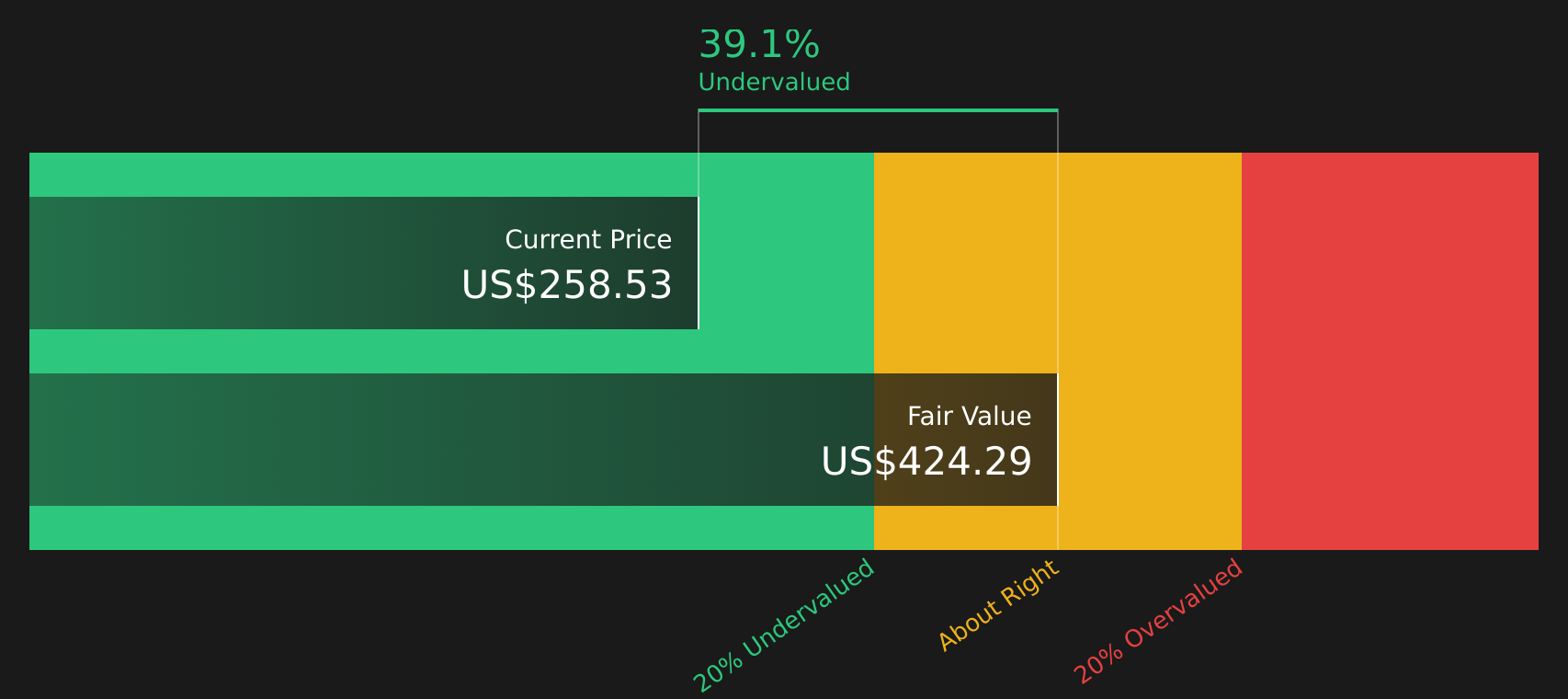
The Discounted Cash Flow (DCF) model here projects what Autodesk’s future cash generation could be worth in today’s money. On this approach, Autodesk’s latest twelve month free cash flow is about $2.8b and the model assumes those cash flows continue growing over time rather than shrinking. Rolling those projections forward, the DCF points to an estimated intrinsic value of about $424 per share.
That estimate sits well above the current market price, which implies the stock trades at roughly a 39.1% discount to this intrinsic value. The recent drop after Autodesk issued a weaker profit outlook, despite stronger than expected Q2 results and raised full year guidance, helps explain why the market price has lagged the DCF view of the company’s subscription and AI linked cash flows.
On this DCF view, Autodesk stock currently screens as undervalued relative to its modeled cash flow potential.
Our Discounted Cash Flow (DCF) analysis suggests Autodesk is undervalued by 39.1%. Track this in your watchlist or portfolio, or discover 45 more high quality undervalued stocks.
Does Autodesk Look Fairly Valued on Earnings?
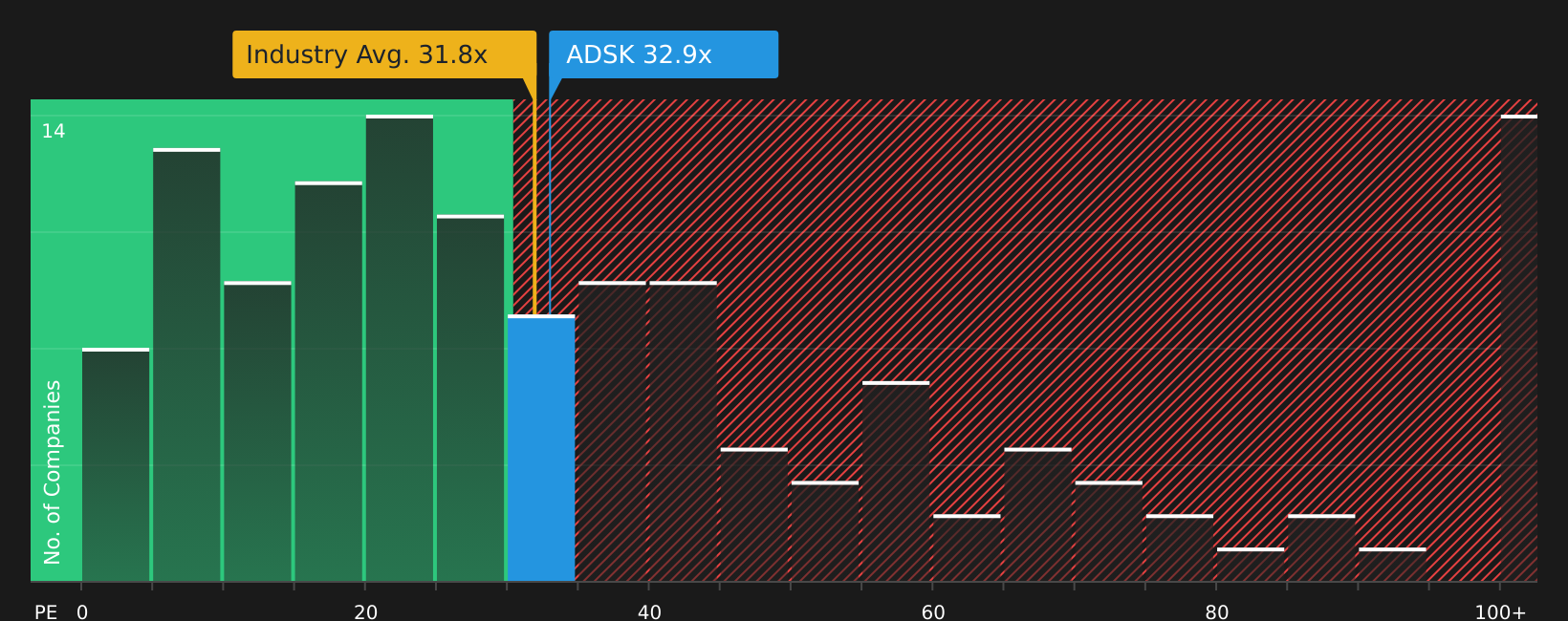
The P/E ratio works well for Autodesk because earnings are a key focus for investors in mature software businesses with recurring revenue. Autodesk currently trades at about 32.9x earnings, which is slightly above the software industry average of 31.8x and a bit below the peer group average of 36.0x.
The model based fair P/E for Autodesk is 32.9x, which is almost identical to where the stock trades now. That suggests the market price already broadly reflects the company’s earnings profile, business quality and risk, without a clear discount or premium on this metric alone.
On the P/E multiple, Autodesk stock appears roughly fairly valued compared with both its tailored fair ratio and wider software peers.
See what the numbers say about this price — find out in our valuation breakdown.
The Autodesk Narrative: What Would Justify Today's Price?
Simply Wall St Narratives for Autodesk take the valuation puzzle you have just seen and set out which paths for Autodesk's growth, margins and earnings would need to play out for the stock to be worth materially more or less than today's price, on the Community page. Where a ratio or model gives a single figure, these narratives describe the future that figure relies on so you can see whether reality is tracking that path.
Community views on Autodesk pull in very different directions, with one camp focused on long term platform upside and the other on execution and margin risk.
Bull case: 36% undervalued
"Autodesk's proprietary 2D and 3D AI models trained on geometry rich, real world project data, combined with an agentic AI layer that can be priced through subscription, consumption and outcome based models, create multiple monetization paths that can support revenue and earnings over time..."
Read the full Bull Case to see why Autodesk could be undervalued
Bear case: 14% overvalued
"Although the shift to cloud platforms and industry clouds should support longer term demand for connected data environments, the company’s own comments about macro uncertainty, ongoing sales and marketing optimization and remaining friction from the new transaction model point to a risk that any slowdown in large renewals or EBA expansions would weigh on revenue growth and keep net margins below internal long term targets..."
Read the full Bear Case to see why Autodesk could be overvalued
Do you think there's more to the story for Autodesk? Head over to our Community to see what others are saying!
The Bottom Line
The Discounted Cash Flow (DCF) view suggests Autodesk could offer upside if its cash generation unfolds as modeled, while the P/E based view points to a stock that is already priced roughly in line with peers. That split, along with a mixed overall value profile, leaves Autodesk looking neither like a clear bargain nor obviously stretched. What matters most from here is whether subscription and AI linked products can sustain cash flows and margins well enough to close the gap between the market price and the intrinsic value estimate, rather than that discount proving to be a value trap.
This article by Simply Wall St is general in nature. We provide commentary based on historical data and analyst forecasts only using an unbiased methodology and our articles are not intended to be financial advice. It does not constitute a recommendation to buy or sell any stock, and does not take account of your objectives, or your financial situation. We aim to bring you long-term focused analysis driven by fundamental data. Note that our analysis may not factor in the latest price-sensitive company announcements or qualitative material. Simply Wall St has no position in any stocks mentioned.
Have feedback on this article? Concerned about the content? Get in touch with us directly. Alternatively, email editorial-team@simplywallst.com