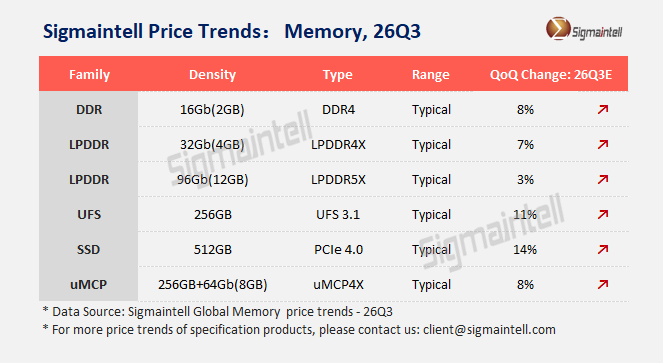
The Zhitong Finance App learned that Qunzhi Consulting released the Memory price trend vane for the third quarter of 2026. In the third quarter of 2026, overall supply and demand in the global memory market remained tight, and prices for all DRAM and NAND categories maintained a month-on-month increase. However, compared to the sharp rise in the second quarter, the price increase in the current quarter has clearly slowed, the month-on-month increase has subsided significantly, and the structural differentiation of the market has further intensified. The core logic is that the continued rise in memory particle prices has drastically raised terminal BOM costs, terminal manufacturers' acceptance of high prices has declined, and end customers have suspended delivery, driving the supply side to narrow the Q3 price increase.
Based on the data analysis of Qunzhi Consulting, the market segment trends for this quarter are as follows:
DRAM: Prices continue to rise, terminal stocking is slowing down, and consumer grade gains have narrowed sharply
The 2026Q3 DRAM market continues to maintain an upward trend, but downstream acceptance is clearly divided. According to data from Qunzhi Consulting, taking 16GB DDR4 as an example, there was a 16% increase over the previous month. The original manufacturer is still willing to push prices, but PC terminals are affected by BOM pressure, OEM procurement tends to be conservative, and the momentum for a further increase in DDR unit prices has been weakened.
The increase in mobile LPDDR was more prominent due to the slowdown in terminal stocking. According to data from Qunzhi Consulting, LPDDR4X (4GB) rose 7% month-on-month; high-end LPDDR5X (12GB) rose only 3% month-on-month. Previous rounds of price increases have drastically raised the overall cost of mobile phones. Mobile phone brands are less accepting of storage offers, actively control stocking, and only keep orders for high-end flagship models. Combined with the spot channel, some traders profiably liquidate low-price shipments, further limiting the upward space of mobile DRAM.
Overall, Qunzhi Consulting believes that the third quarter has entered a game period between DRAM manufacturers and terminal manufacturers. Although demand for AI computing power is supported, consumer terminal procurement demand has been suppressed, the market game has intensified, and the overall price increase will be drastically reduced.
NAND Flash: SSD growth is relatively strong. Mobile devices are affected by terminal control costs, and price increase flexibility is weakening
The price of the 2026Q3 NAND Flash continued to rise month-on-month. According to data from Qunzhi Consulting, the 512GB PCIe 4.0 SSD increased 14% month-on-month this quarter, providing some support for enterprise-level related demand. However, consumer PC customer acceptance of price increases declined, and their willingness to purchase and prepare goods contracted at the same time.
In particular, mobile storage growth was clearly limited. According to Qunzhi Consulting data, the 256GB UFS 3.1 rose 11% month-on-month. BOM cost pressure for mobile terminals is high, and brands are taking the initiative to reduce the amount of goods stocked; some spot traders chose to clear and ship at a low price after early profit, and the spot price loosened, limiting the continued sharp price increase for mobile NAND. Although high-end mobile phone storage configurations have not been downgraded, high prices have curtailed the scale of terminal purchases.
Overall, the Q3 storage market in 2026 is still in an upward cycle, but the rapid and sharp rise in prices in the first half of the year caused the storage market to enter a new stage of “supply and demand compete with each other and growth converges” in the third quarter.