


“Baidu is expected to soon usher in new capital inflows and fresh capital. The results may be seen next week.” On September 1, Baidu Chief Financial Officer He Haijian said in an exclusive interview with Bloomberg that referring to some opinions from brokerage firms and analysts, companies with market capitalization such as Baidu are expected to have 10% to 15% incremental capital flowing into the stock.
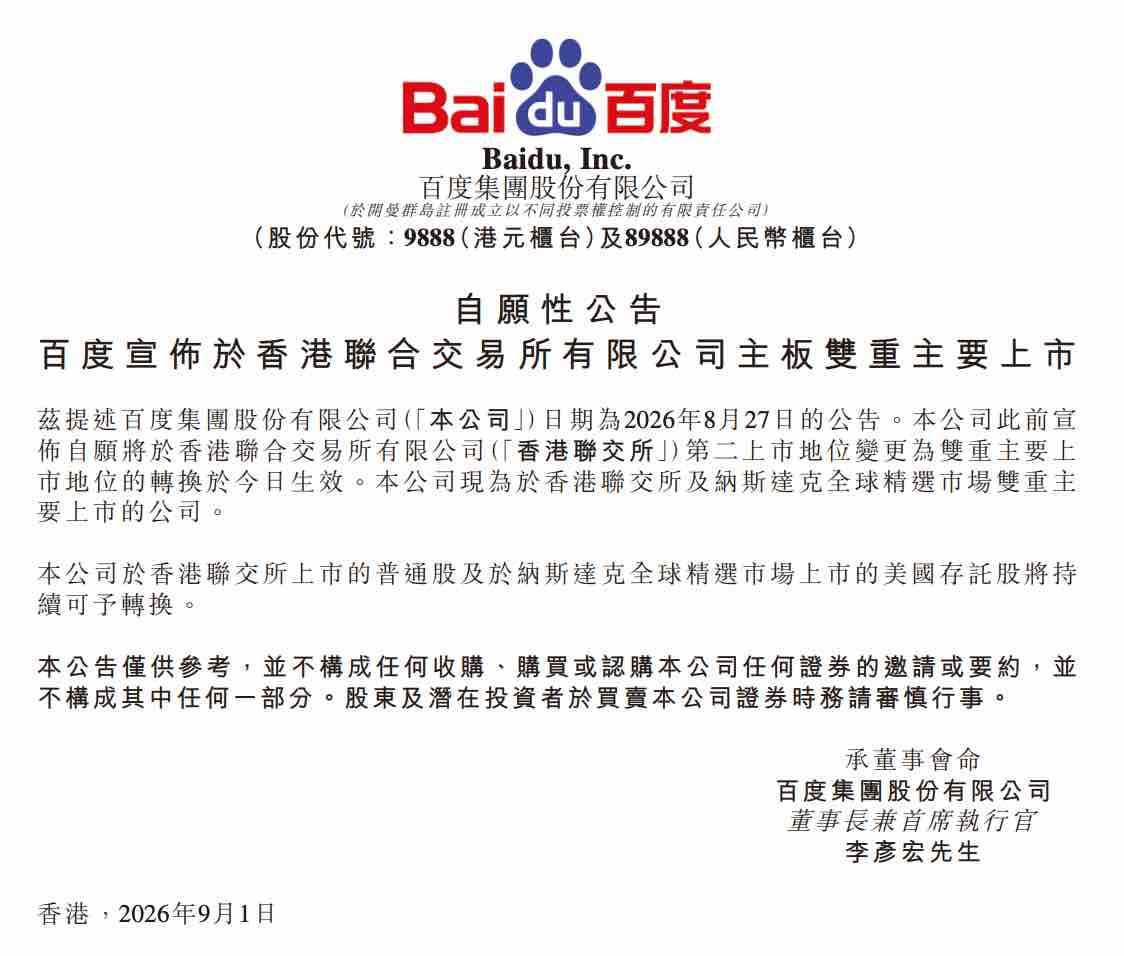
The Zhitong Finance App learned that before the market today, Baidu Group (09888, BIDU.US) issued an announcement on the Hong Kong Stock Exchange stating that it had previously announced that it would voluntarily change its secondary listing status to the main listing position on the Hong Kong Stock Exchange, which took effect today. Baidu is currently a major listed company on both the Hong Kong Stock Exchange and the NASDAQ Global Select Market.
According to market analysis, according to the current rules and inspection cycle, Baidu is expected to be included in the Hong Kong Stock Connect as soon as September 7. At that time, mainland investors can directly trade Baidu Hong Kong stocks through the Shanghai-Shenzhen-Hong Kong Stock Connect mechanism.
It is worth mentioning that this conversion did not involve issuing new shares or financing. According to public data, as of the end of June this year, Baidu's total cash and investments reached 283.1 billion yuan, and operating cash flow was positive for four consecutive quarters.
As one of the few companies in the world with a full-stack artificial intelligence layout, Baidu has competitive products at every layer, from AI chips, AI cloud infrastructure, models to AI applications. According to financial reports, Baidu's AI business revenue has accounted for more than half of general business revenue for two consecutive quarters. Total revenue for the second quarter was 31.3 billion yuan, AI cloud infrastructure revenue was 7.3 billion yuan, and GPU cloud increased 283% year-on-year, with three-digit growth for four consecutive quarters.
For investors, Baidu's completion of a dual major listing is not a single capital move; it is also a reset of valuation coordinates. In the past, the market was used to first look at Baidu's advertising revenue, search traffic, and profit elasticity; today, with Baidu's AI business continuing to increase in the share of general revenue, the question has become: How should this full-stack AI company reprice?
Zou Chengfeng, senior vice president of Dongxing Securities Investment Bank headquarters, believes that from an investment bank valuation perspective, one notable change after Baidu's dual listing is that AI assets may receive more independent pricing. Currently, many institutions in the market have used segmented valuation methods to evaluate Baidu. If businesses such as Kunlun Core, Smart Cloud, and Radish Express are valued separately, and the AI business growth space is considered, some estimates show that Baidu's potential growth potential is close to three times, and a change in the valuation system is worth looking forward to.
Full-stack AI has been trending for ten years, and the Looping flywheel is running at an accelerated pace
“The first full-stack AI stock” began ten years ago.
As early as August 2016, Baidu founder Li Yanhong made a judgment at the Baidu World Conference: “The era of mobile internet is over; the next scene is artificial intelligence.” At the time, the outside world didn't immediately believe it, but Baidu had already built AI full-stack capabilities around “core, cloud, model, and body” — first to lay out AI chips, first to launch AI clouds, first to launch generative AI products among major domestic manufacturers, and first to lay out smart devices.
After more than 10 years of investment, Baidu's “Xinyun Model” has grown into a system that can run on its own. Huaan Securities believes that Baidu's core advantage compared to global Internet vendors is to build a full-stack AI system with a four-layer “core - cloud - model - body” architecture.
However, Baidu's real competitive advantage is not only that it has these capabilities, but rather allows these capabilities to form synergy — chips improve training efficiency, cloud platforms amplify computing power requirements, models improve application experience, and applications in turn deposit users and data, and continue to boost underlying capabilities. The four-layer architecture can form looping through deep collaborative optimization to achieve end-to-end cost control and performance improvement.
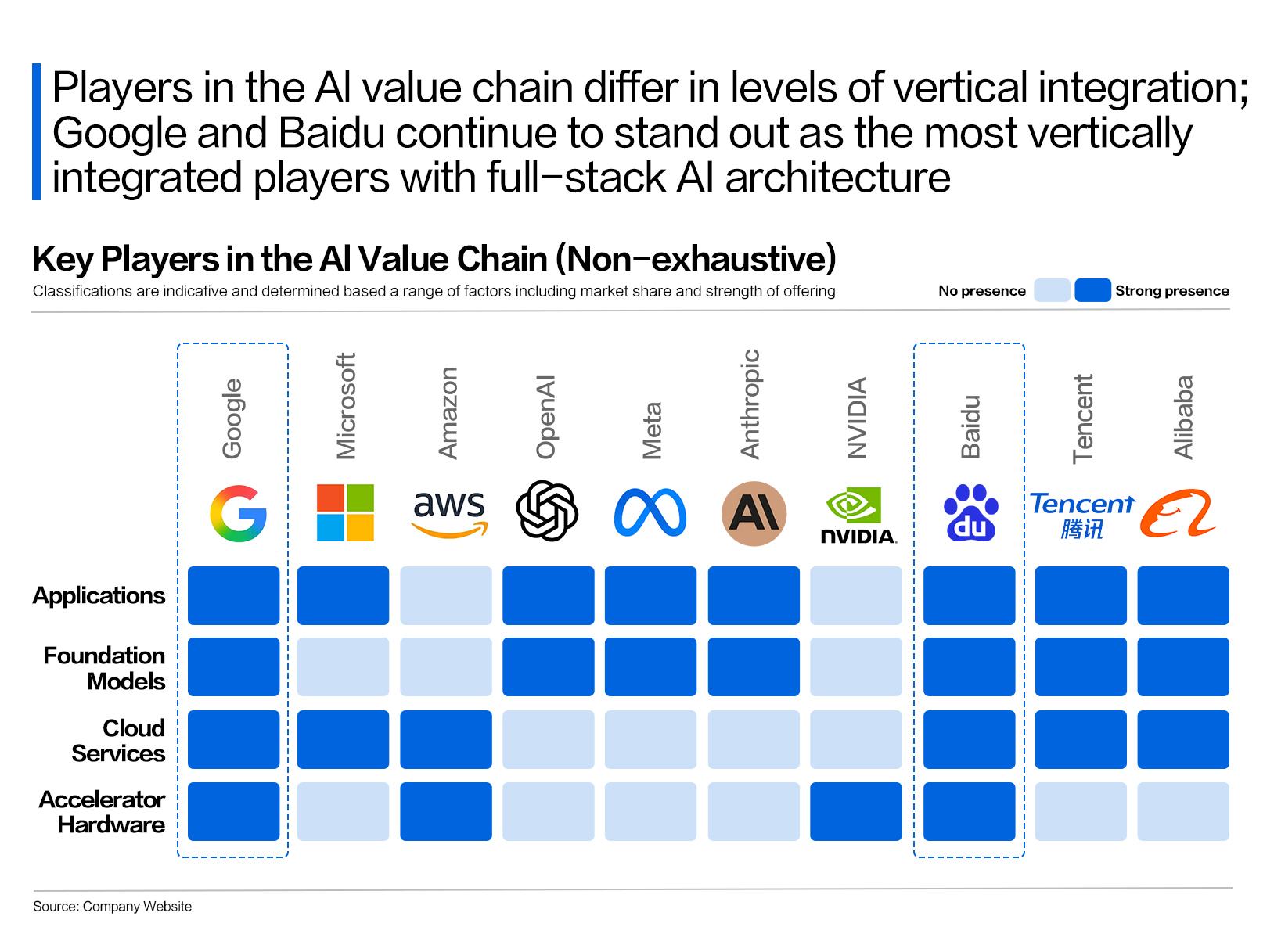
Each layer of this chain has achieved independent large-scale results in 2026.
Kunlun Core is gradually moving from Baidu's internal computing power infrastructure to the external market. In January of this year, Baidu announced its intention to split Kunlun Core and promote its independent listing in Hong Kong. Since 2025, Kunlunchip has delivered several 10,000-card P800 clusters, with customers covering hundreds of leading companies in the industry, including China Merchants Bank, China Southern Power Grid, China Steel Research, State Pipeline Network, Geely Automobile, and Tencent, with the third largest shipment volume in the country.
The revenue of AI cloud infrastructure in the second quarter was 7.3 billion yuan, and the GPU cloud growth rate was 283%. The three market segments of finance, gaming, and physical intelligence all ranked first, and the five cloud vendors accounted for more than 60% of the bid amount for the big model.
Wenxin 5.1 was the only one to have the four highest ratings in the Omdia review, ranking first in the overall strength in the field of Chinese creative writing; open source Unlimited OCR topped the HuggingFace global trend list.
Baidu's AI application business continues to make progress, and the AI office field is developing rapidly. According to data from the AI product list for July 2026, Baidu's monthly active users increased by 1063.79% month-on-month, ranking first in the AI office intelligence growth rate list; Kuku AI has more than 25 million monthly active users, ranking first in the AI office circuit industry. Both user size and growth rate occupy the leading position in the industry, showing that Baidu's AI applications are continuing to be implemented and are maintaining a growth trend.
In the real world, robotaxi tracks around the world are heating up. As the world's driverless duo, Baidu Radish Run and Google Waymo are speeding up the layout. Radish Express has traveled to 28 cities around the world, truly introducing AI into the physical world. Huaan Securities believes that as a leading manufacturer in the field of driverless driving in China, its mature business model can directly target Waymo and is scarce domestically, and the global layout of Radish Express is expected to drive it to achieve value revaluation.
“As the AI business becomes Baidu's core development direction, we are laying the foundation for the next phase of AI-driven growth.” In the latest financial report, Li Yanhong said that the continued growth of the AI business has further confirmed Baidu's transformation from an Internet-centered company to an AI-first company, and has further strengthened Baidu's confidence in long-term growth potential.
From the judgment that “the next scene is artificial intelligence” in 2016 to the “AI first” transformation ten years later, Baidu took ten years to become the “first full-stack AI stock” in China.
The room for growth has been fully opened up, and the market value may be revalued at HK$trillion
“Baidu has completed two major listings, which can broaden its customer and investor base, and now is an excellent time. It is sending signals to the outside world, and Baidu has already entered the second growth curve. Baidu's early layout in the field of artificial intelligence, from clouds, applications, chips, to various smart devices, has now become an important source of revenue.” He Haijian said, “I think now is the best window to show the Hong Kong market and mainland investors that everyone can invest in a company with unique full-stack AI capabilities in the Hong Kong stock market. This is a very rare opportunity.”
The US market has long been accustomed to using the Chinese Internet and search advertising frameworks to understand Baidu, but today Baidu is no longer a company that only relies on a profit statement to tell stories. As cloud services, AI chips, software applications, and driverless cars gradually grow into different business curves, it is more like a set of mutually supporting AI asset portfolios. In the past, the market asked if Baidu could continue to squeeze out profits from searches, but now the more important question has become, exactly what standard should this company reprice according to.
This is where the dual major listing is really worth amplifying. For Baidu, this conversion is not about financing, not about supplementing blood; it is about changing a valuation method that is closer to reality. The main significance of a dual listing is to expand the base of potential investors, enhance research coverage and transaction convenience. It also gives capital that is more familiar with China's cloud computing, domestic chips, and driverless driving industry chains an opportunity to understand Baidu in a way that is closer to industry logic.
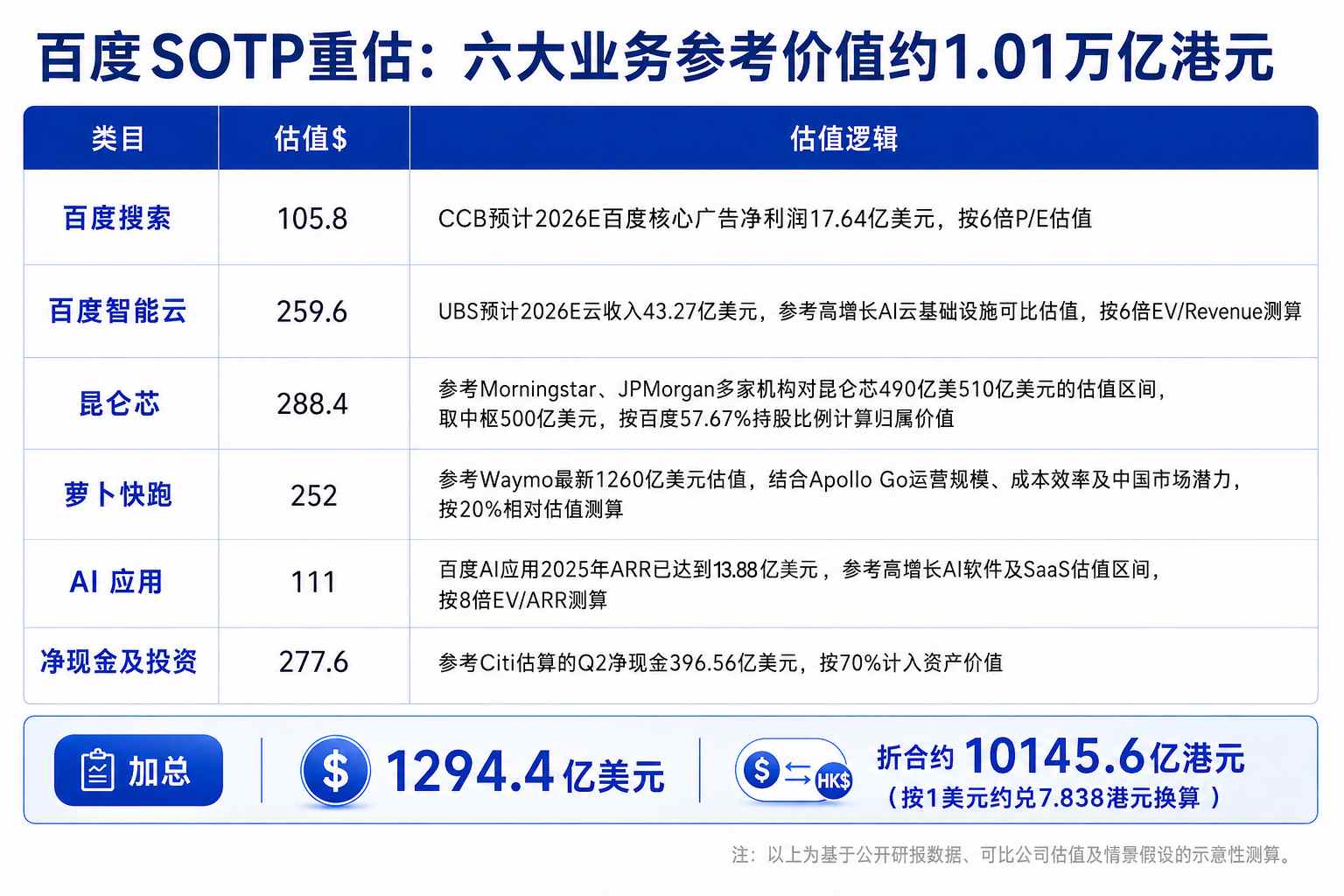
Once the market shifts from a single unified price-earnings ratio to segmented valuation, Baidu's Smart Cloud, Kunlun Core, AI application, and Radish Express will no longer be just a few projects in financial reports, but will become a growth curve that can be observed and priced separately: the search business provides a cash flow chassis, and the smart cloud takes on AI computing power and enterprise customer needs. Kunlun Core represents the underlying computing power barrier. AI applications are responsible for transforming model capabilities into real usage scenarios, and Radish Express pushes AI into the physical world. For a company that has already developed chips, clouds, models, applications, and physical AI scenarios, the market is not imagining Baidu's space to move towards HK$1 trillion; it is a market move that will happen sooner or later.
Baidu also has no shortage of motivation to support this shift in valuation coordinates. By the end of June 2026, the company's total cash and investment had reached $283.1 billion, and operating cash flow had been positive for four consecutive quarters. More importantly, Baidu's AI business has moved from concept to performance. In the past, investors focused more on changes in search ad revenue, profit margins, and traffic, but now they also need to look at GPU cloud growth, AI application revenue, Kunlun Core's industry launch, and the global operation scale of Radish Express.
In other words, Baidu is gradually changing from a “general ledger” of an internet company to an asset portfolio composed of multiple AI businesses. Investments that seemed long, scattered, and even difficult to measure at one time will become the main line driving Baidu's market capitalization to continue listing.
The double major listing on September 1 is not the end; it is the starting point for the market to reunderstand Baidu.