Although there are still eight months until the French presidential election, the country's assets are beginning to show signs of pressure.
The Zhitong Finance App learned that as one of the most popular bond risk measures, France's borrowing cost premium compared to Germany is approaching the highest level since the European sovereign debt crisis in 2012. Tension also spread to the French stock market and corporate bond market, dragging down its performance compared to similar international assets.
For investors, the central question is how the next president, succeeding pro-business centrist Emmanuel Macron, will deal with deep economic challenges — including a fiscal deficit of more than 5%, soaring debt service costs, and weak growth on the verge of recession. The far-right candidate Marina Le Pen and the far-left candidate Jean-Luc Mélenchon both promised to take France in a very different direction.
The proposals put forward by these candidates (who just joined the first election campaign last week) include boosting the economy by expanding spending, lowering the retirement age, canceling some government debts, and even suspending financial contributions to the EU.
The following are some aspects of the heightened political risk in France that have been reflected in the market.
The bond market
Bond futures trading data shows that investors have established new short positions to bet on falling French bond prices.
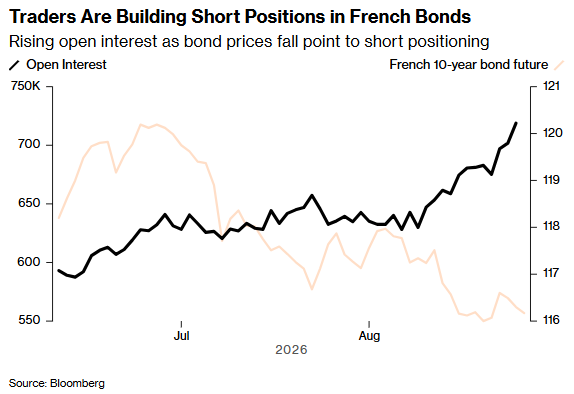
“There is no parliamentary majority, no budget, no room for maneuver, and political capital has been exhausted — Macron is clearly unable to stop the situation from worsening,” Louis-Vincent Gave, CEO of Gavekal Research, said of French bonds. “Instead, the risk is that the situation may worsen at an accelerated pace.”
How to resolve France's heaping debt has dominated recent debates. Despite the current administration's attempts to reduce the deficit, its fiscal goals have repeatedly been weakened by a fragmented parliament.
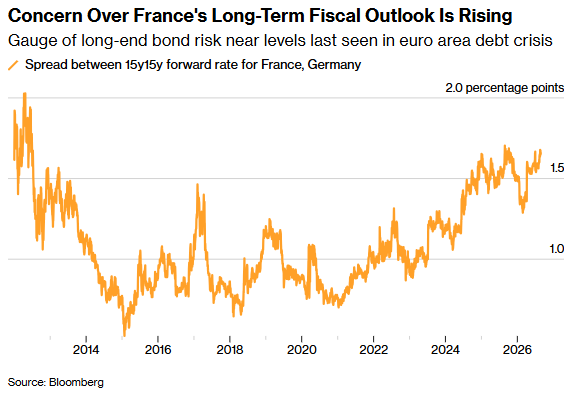
For long-term investors, the 15-year forward rate (15y15y forward rate), which starts after 15 years, excludes the impact of short-term monetary policy and is used to measure long-term borrowing costs. Currently, the interest rate spread between France and Germany is approaching the highest level since 2012, indicating that the market is pricing France's structurally deteriorating fiscal situation compared to Germany over the next few decades.
stock market
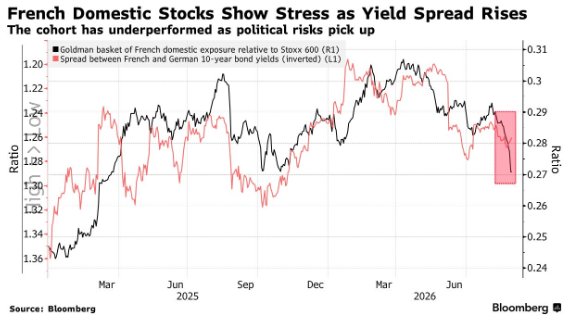
As far as stocks are concerned, the domestic revenue share of the French benchmark CAC 40 index accounts for less than 20%, which limits the impact of political risk on earnings to a certain extent. However, domestic demand-driven industries such as banking, utilities, telecommunications, and construction are often under pressure due to widening interest spreads on Franco-German bonds.
Larger spreads will reduce the attractiveness of French stocks, suppress companies' ability to invest, and ultimately damage their competitiveness.
The basket of stocks with high sales exposure to France compiled by Goldman Sachs Group includes individual stocks such as BNP Paribas, Orange, Engie, and Vinci. The index fell more than 3% last week due to heightened political uncertainty, outperforming the Pan-European Stoxx 600 Index, which rose 0.2% during the same period.
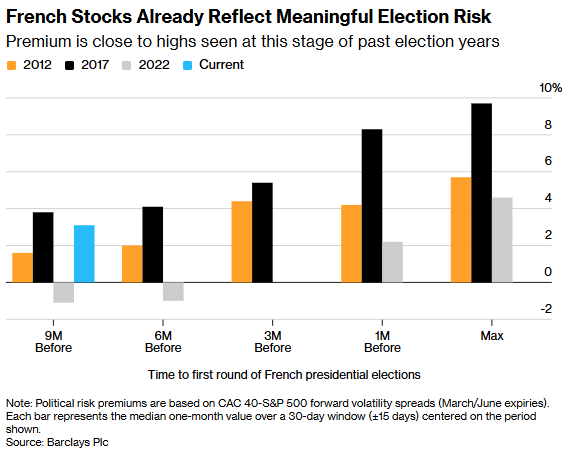
Barclays Bank's analysis found that the risk premium already reflected by French blue-chip stocks was close to the phased high level in the same period of the previous election cycle. The calculation is based on the difference between CAC 40 and the S&P 500 March/June forward volatility.
“This shows that while election premiums may continue to accumulate, current pricing has factored in a significant degree of political uncertainty,” strategists including Stefano Pascale and Anshul Gupta wrote in the report.
Their research also showed that Air Liquide Group, AXA Group, and Renault Group are the most historically sensitive to changes in interest spreads on French and German bonds, which means that if the sovereign risk premium widens further, these individual stocks may be particularly vulnerable.
credit market
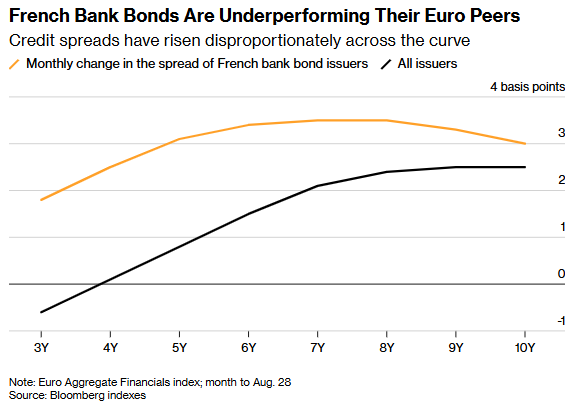
Bonds issued by French financial institutions have shown signs of fatigue. The increase in risk premiums over the past month has exceeded the overall level of the Eurozone bank bond market. This differentiation is particularly pronounced among bonds maturing within five years, while the gap in long-term interest spreads has narrowed somewhat.
The worst performers are subordinated bonds — when banks go out of business, this type of bond takes the lead in losing money.
In France's previous period of high political risk, the banking sector has always been one of the most volatile industries in the credit market. In 2024, Macron's decision to announce an early general election triggered a surge in the volume of major French bank bond transactions.
currency risk
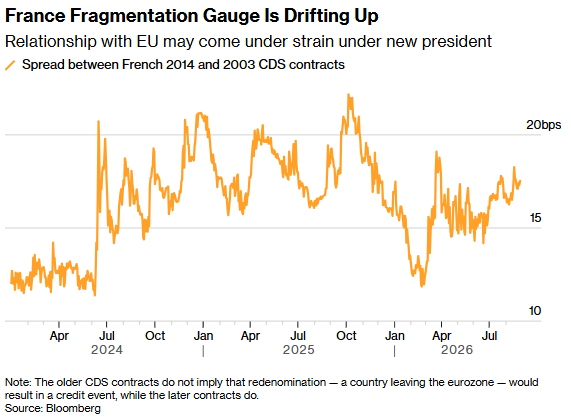
The indicator measuring France's risk of leaving the Eurozone is rising, but it is still below the peak of the past two years.
The indicator is calculated based on interest spreads between different credit default swaps, and is still far below the level during the 2017 election — when Le Pen threatened to hold a referendum on abandoning the common currency. However, Le Pen, who is leading the poll this time, has abandoned this position.
However, the spread is still worth watching, as it can be a leading indicator of potentially strained relations between France and the European Union in the next few years. Left-wing politician Mélenchon (arguably Le Pen's biggest rival) has proposed that France not abide by EU rules and treaties when there is a conflict of interest with France.