


The Zhitong Finance App learned that as market concerns about the possibility of the Fed's interest rate hike this month became the main factor dominating market sentiment, overshadowing the Middle East conflict and the impact of artificial intelligence (AI) related fluctuations on market sentiment, global bond sell-offs spread to emerging markets — from South Africa to South Korea and Poland, and 10-year government bond yields all rose.
Among them, South Africa, which is seen as a weather vane for emerging market assets, led the decline in the bond market among major emerging markets on Tuesday. According to the data, South Africa's 10-year treasury bond yield rose 9 basis points to 8.83%, the highest level since July 24. South Korea, Indonesia, and Latvia all increased the yield on similarly matured bonds by 5 basis points.
Meanwhile, J.P. Morgan data showed that risk premiums on emerging market dollar bonds rose 6 basis points to 235 basis points on Monday. Credit default swap (CDS) prices for sovereign issuers in 30 developing countries rose for the fourth day in a row, marking the longest round of increases since April.
According to money market data, the market currently believes that the probability that the Federal Reserve will raise the benchmark interest rate by 25 basis points on September 16 is close to 70%. The reason the market is pricing this way is because Federal Reserve Chairman Kevin Walsh sent hawkish signals at the Jackson Hole central bank's annual meeting last week. Walsh said that there has been no meaningful slowdown in US inflation, and action may be needed from the Federal Reserve.
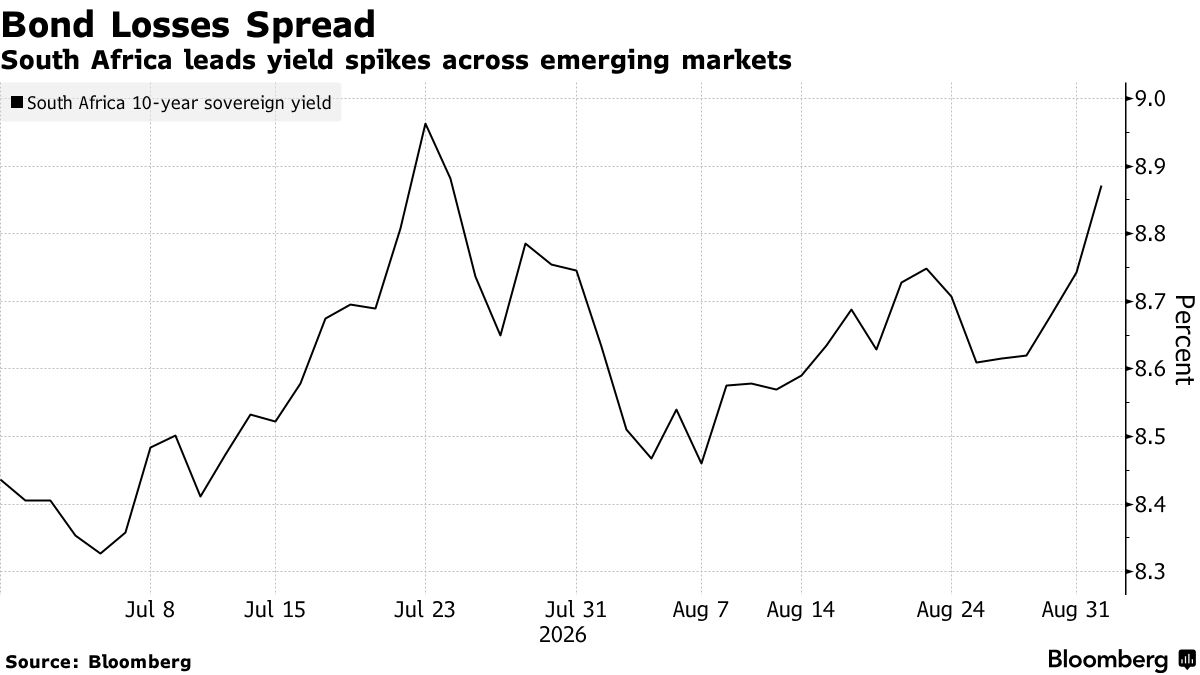
Emerging market local currency bonds have continued to decline since reaching a record high on August 25. Market concerns about continued high inflation and the hawkish stance of the Federal Reserve have dampened investors' interest in risky assets. Although AI stocks continue to rise and investors are still optimistic about the prospects for carry trade (carry trade) in developing countries, emerging market local currency bonds are still falling. However, some asset management agencies said that global investors are promoting diversification of investment portfolios from dollar-denominated assets and will soon attract capital inflows again, thereby supporting bond prices.
Pessimism also spread to the foreign exchange market, with most emerging market currencies falling. The Indian rupee and Taiwan dollar rose slightly, while the Korean won, Hungarian forint, Malaysian ringgit, and Israeli shekel were underperforming currencies.
Simon Quijano-Evans, senior emerging market strategist at Macro Hive, wrote in a report: “Emerging market forex is still in a relative value pattern and is digesting Walsh's remarks last Friday.” “The market is actually doing the work for the central bank. So, will the market now begin to anticipate that central banks such as the Federal Reserve will buy bonds again?”
Emerging market stocks continued their upward trend. The MSCI Emerging Markets Equity Benchmark Index rose 0.3% on Tuesday after the index recorded its biggest monthly gain since 2004 in August. TSMC contributed 66% of the index's increase. Investors' confidence in Taiwanese AI companies was boosted after Nvidia invested $3.5 billion in MediaTek — the largest direct investment made by Nvidia outside the US.
After entering September, new bond issuance activities will be active again. Saudi Arabia is promoting base-sized dollar-denominated Islamic bonds with terms of 5 and 10 years, respectively. Pakistan also held a conference call for investors to prepare for the issuance of long-term 5- and 10-year bonds. The Bank of Israel will face a difficult decision on interest rates on Tuesday. Economists disagree on whether the central bank will cut interest rates for the third time in a row or keep interest rates unchanged. Israeli policymakers will seek to balance moderate inflation and strong shekels — thanks to the current end of the direct conflict between Israel and Iran — and fiscal pressure that may build up before the October election.